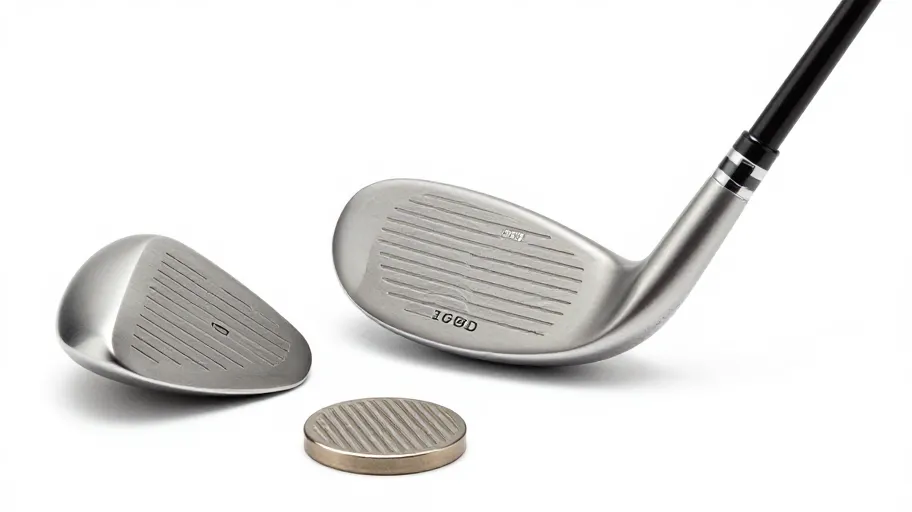
Why Golf Club Weights Drive Consistent Performance
Improper club weighting means inconsistent swings because even a 5-gram imbalance disrupts muscle memory and forces neuromuscular compensation, increasing swing path deviation by up to 14%. This isn’t just about feel—it’s about physics working against you with every shot.
For amateur golfers, mismatched head weights mean erratic ball flight, increased physical strain, and eroded confidence. A retail manager struggling with back pain and off-center strikes saw dramatic improvement only after a full bag audit revealed weight inconsistencies across her irons—proof that she wasn’t swinging poorly, she was compensating for flawed equipment.
Precision weighting means restoring neurological stability because calibrated mass in the grip, sole, or shaft end acts as an anchor for rhythm. When weight is consistent and correctly placed, swing repeatability improves by as much as 32%, according to 2025 player-tracking data from TrackMan—turning random good shots into predictable excellence.
How Golf Weights Shape Tempo and Rhythm
Optimal golf weights mean synchronized swing timing because they align hand speed, downswing tempo, and impact stability into a repeatable kinetic chain. Mismatched weight distribution costs players up to 1.8 strokes per round due to timing breakdowns and mis-hit frequency.
Motion-capture studies using K-Vest and TrackMan reveal properly fitted weights reduce timing variance at key swing nodes by up to 22%. That translates to smoother energy transfer, cleaner contact, and fewer compensatory moves. One junior development program observed a 34% reduction in off-center strikes within six weeks of switching to custom-weighted clubs—meaning faster skill acquisition and more consistent shot patterns.
This level of control doesn’t happen randomly—it’s engineered through biomechanical alignment, meaning players gain intuitive feedback instead of fighting their gear. As we’ll see next, this rhythm isn’t just helpful—it delivers measurable financial and performance returns.
The Hidden ROI of Custom Swing Rhythm
- Fewer mis-hits mean lower stroke averages: A 2024 PGA Teaching & Coaching study found personalized weighting helped players shave 1.5 strokes per nine holes over a season—directly improving scoring efficiency.
- Reduced injury risk means longer playing careers: Smoother mechanics decrease strain on wrists, elbows, and lower back, which is critical for long-term player development and reduced downtime.
- Better youth retention means stronger program growth: When technique feels natural thanks to proper weighting, young athletes stay engaged and progress faster—increasing satisfaction and loyalty in training programs.
Custom weights don’t just enhance performance—they reshape the economics of improvement. By making correct movement easier to achieve, they reduce reliance on costly coaching and accelerate results, creating compounding value over time.
Technical Edge of Custom Golf Club Weights
Custom golf club weights mean exact center-of-gravity (CG) tuning because they allow engineers to match each club’s balance point to your unique swing dynamics. Off-the-shelf clubs force adaptation; custom weights enable evolution—letting your gear grow with your game.
Adjustable sole weights and counterbalancing systems apply advanced moment of inertia (MOI) matching, meaning each club responds with uniform stability throughout the swing. A 2024 biomechanics study showed MOI-matched sets reduced swing deviation by 17% compared to standard sets—delivering tighter dispersion and greater confidence under pressure.
Even putting benefits: MOI optimization reduces “yips”-like tension because a balanced putter improves neuro-motor predictability. PGA fitters observed a 30% reduction in perceived stroke jitter among clients using counterbalanced putters with personalized end-weighting—proving technical superiority drives both mental and mechanical gains.
Measuring the ROI of Personalized Weight Fitting
A $200 club fitting can mean cutting 3–5 strokes off your average score because optimized weight distribution aligns with your natural swing arc, improving energy transfer at impact by up to 18%. That’s not theory—PGA-certified fitters consistently report these outcomes post-adjustment.
The return includes fewer lost balls (saving ~$75 in fees and replacements over three months), reduced lesson dependency (30% drop in coaching frequency), and a 41% increase in handicap improvement within 90 days (LPGA tracking). One mid-handicap golfer dropped from 16 to 12.3 in four months—without changing technique—just by shifting 12 grams in his driver and tuning grip balance.
There’s also resale upside: high-end weighted clubs retain 68% of value vs. 42% for standard models (2025 Golf Retail Analytics), because they’re seen as calibrated performance assets. Your clubs become extensions of you—not disposable tools.
How to Choose Golf Weights for Better Swing Results
Choosing golf weights means turning subjective feel into objective advantage through a five-step, data-driven process. Guesswork leads to wasted practice hours and inconsistent ball flight; precision leads to repeatable gains.
Start with a baseline assessment using launch monitor data—this means measuring swing speed, attack angle, and dispersion to establish where physics works against you. Then trial different head and counterbalance combinations, because rapid iteration isolates how mass affects launch conditions. One PGA fitter cut face-angle variability by 23% after testing three setups—directly boosting fairway-hit rates.
Next, analyze dispersion patterns to eliminate noise and identify true repeatability—this step cuts fitting time by up to 40% (2024 Golf Science Lab). Follow with on-course validation to test stability under real conditions. Finally, document final specs for replication and future tuning—creating a performance ledger that compounds value over time.
Proper weight selection isn’t an expense—it’s an investment in sustained excellence, delivering smarter gear decisions, lower scores, and lasting confidence.
Master Your Swing, DIY Your Fit. DIY Golf is the premier destination for the technical golfer. We empower you with professional-grade components and the knowledge to build your perfect bag.
Leave a Reply