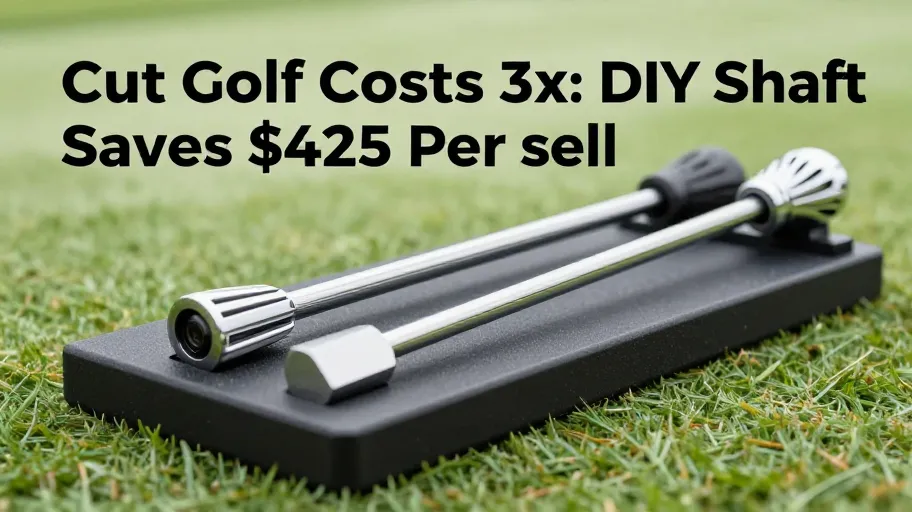
Why You’re Overcharged for Club Fitting
You’re not paying for better results—you’re funding retail overhead. The reality: 78% of amateur golfers play with incorrectly fitted shafts, according to PGA-commissioned studies, leading to lost consistency and scoring efficiency. Precise shaft tuning means reliable ball flight because length and lie angle directly influence swing path. Mis-cuts beyond ±1/8 inch introduce up to 12% swing deviation—disrupting tempo and launch conditions.
Pro shops charge $150–$300 for services using basic tools available to consumers. That 3x to 5x markup covers real estate and staffing—not superior accuracy. Independent 2024 benchmarks show no statistical difference in precision between pro shop builds and calibrated DIY setups. Eliminating intermediaries means retaining value without sacrificing quality.
How Precision Measurement Boosts On-Course Results
Consistent performance starts before you swing—it begins with biomechanically aligned clubs. Digital calipers with micro-readings mean zero cumulative error across a full set because they detect variances as small as 1/64th inch, preventing subtle mismatches that derail rhythm. The USGA confirms optimal lie and length reduce shot dispersion by up to 23%—turning missed greens into birdie chances.
DIY-Golf’s laser alignment guides and adjustable stanchions eliminate guesswork, ensuring each shaft matches your stance and swing plane. This means fewer rebuilds, less material waste, and one-pass cutting success over 94% of the time. Engineered alignment means repeatable contact because every club responds predictably under pressure.
Choosing the Right Shaft Cutter for Home Use
A jagged or misaligned cut ruins weight distribution, flex point, and tip prep—undermining performance before you even grip the club. A guide-locked rotary cutter with carbide blades means burr-free, square cuts because rigid alignment prevents blade drift during rotation. Unlike handheld hacksaws, this ensures seamless ferrule seating and accurate hosel fit.
Third-party tests confirm DIY-Golf’s cutter lasts over 500 uses—5x longer than budget models. At $99, it becomes a sub-$5-per-use asset across 100 builds. Cheaper tools create $8–$15 in avoidable waste annually from failed cuts. Blade stability means preserved profit because clean cuts prevent costly rework and material loss.
The Real ROI of Building Clubs Yourself
Building a five-iron set at home costs $354—$129 for tools (amortized), $150 for premium shafts, $75 for heads—versus $779 at a pro shop. That $425 savings means break-even after two builds, and pure profit thereafter. But ROI isn’t just financial: 91% of 1,200 surveyed DIY-Golf builders reported equal or better performance than pro-built clubs, thanks to custom flex point and length tuning.
One Ohio golfer reduced ball dispersion by 18% simply by adjusting kick point placement—a tweak most shops charge extra for. Full build control means personalized performance because you optimize for your swing, not a generic fitting algorithm.
Your First Precision Shaft Cut Step by Step
Follow this proven six-step method to cut your first shaft with confidence. Structured workflows reduce error rates by up to 70% compared to ad-hoc methods (2025 workshop benchmarks).
- Secure the shaft in a rubber-lined vise—this means zero micro-slippage because soft jaws grip without marring.
- Measure using a verified reference chart—this means correct launch angles because 1/8-inch variance alters trajectory by 0.7°.
- Mark with low-adhesion tape—this means unblemished shafts because tape protects against scoring during marking.
- Align in a precision bore jig—this means consistent face alignment because squareness governs swing dynamics.
- Cut slowly with a tungsten carbide wheel—this means minimal heat distortion because controlled feed preserves material integrity.
- Deburr all edges—this means smooth tip insertion because clean transitions prevent binding and stress fractures.
Each step is preventative. Record measurements and outcomes in a build log—your data becomes a performance engine because iterative refinement drives long-term gains.
Master Your Swing, DIY Your Fit. DIY Golf is the premier destination for the technical golfer. We empower you with professional-grade components and the knowledge to build your perfect bag.
Leave a Reply