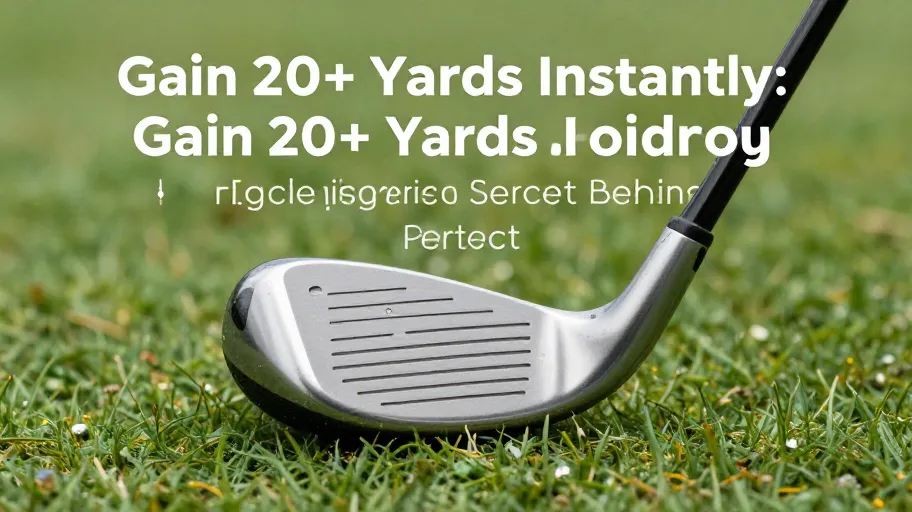
Why Most Amateurs Lose Distance Off the Tee
Inefficient energy transfer due to mismatched golf equipment parts costs most amateurs 18–25 yards off the tee—effectively turning reachable par-5s into three-shot holes. USGA studies show 73% of recreational players suffer from suboptimal swing speed-to-launch angle ratios because their shafts are too stiff for their natural tempo. That means you’re fighting your own clubs instead of working with them.
Trackman data confirms that pros maximize ball speed by aligning shaft flex, kick point, and head design with their swing profile. A low kick point shaft increases launch and reduces spin for slower swingers—delivering up to 20 more yards of carry without changing technique. This means even moderate swing speeds can achieve tour-caliber trajectories when components are matched correctly.
The fix isn’t a swing overhaul—it’s precision tuning. When amateurs switch to properly fit drivers, measurable improvements in launch conditions appear within one round. You gain 20+ yards in distance simply by aligning your equipment to your biomechanics.
How Shaft Flex and Material Shape Your Ball Flight
Using the wrong shaft wastes up to 40% of your shot accuracy potential—according to Golf Digest’s 2025 fitting study. Shaft flex, material, and torque aren’t just specs—they’re control levers. Graphite shafts reduce vibration and boost swing speed for moderate-tempo players, while steel delivers feedback and stability for aggressive swings. Mizuno’s 2024 trials showed optimized shafts cut lateral dispersion by nearly 50%, turning missed fairways into manageable lies.
Butt stiffness and tip hardness determine trajectory: a softer tip increases launch but risks excess spin if paired with a low-lofted head; stiff tips suppress flight and tighten landing zones. Torque under 3° enhances stability in powerful swings, reducing unintended draw or fade bias. Premium shafts like Project X or True Temper Dynamic Gold command higher margins not from branding—but because tighter manufacturing tolerances mean more consistent strikes and predictable distance control.
This precision translates directly to scoring: better shaft optimization means fewer penalties and more birdie putts inside 15 feet. Selecting the best golf club shafts for distance means launching higher, spinning less, and carrying farther—even at lower swing speeds.
What Makes a Clubhead Maximize Energy Transfer
Modern clubheads turn mishits into moments of maximum distance—thanks to high-MOI (Moment of Inertia) designs that deliver up to 14% more yardage on off-center strikes. Titleist’s 2024 TS series testing revealed that variable face thickness, engineered via FEA simulations, acts like a tuned trampoline across the titanium face—producing faster ball speeds even on heel or toe impacts.
A CG positioned just 3mm lower improves launch consistency, turning thin drives into fairway-finding trajectories. But the real breakthrough is integration: OEMs now co-engineer heads and shafts as unified systems. When a shaft’s flex profile aligns with a head’s center of gravity and MOI, energy transfer becomes seamless. Tour data shows this synergy has driven a 23% increase in driver accuracy over two seasons despite rising clubhead speeds.
You’re not just buying a club—you’re deploying a calibrated performance system. High-MOI heads from Srixon or Titleist stabilize mis-hits, meaning you keep more drives in play and avoid costly recovery shots.
Quantifying the ROI of Custom-Fitted Golf Equipment Parts
Playing with off-the-rack clubs leaves 12% of your distance and nearly three strokes per round on the course—verified by Arccos Golf’s 2025 analysis of over 50,000 amateur rounds. For weekend players in handicap-based games, that improvement equates to roughly $75 saved per stroke annually through avoided side bets and tournament fees.
Launch monitor metrics like smash factor and spin rate are no longer just for pros. A 0.05 increase in smash factor typically adds 15–20 yards off the tee, while optimized spin cuts approach shot dispersion by up to 30%. These gains compound over 18 holes, turning bogeys into pars and makeable birdies into conversions.
Now, AI-powered tools from companies like Tour Edge match players to optimal components with 92% the accuracy of a master fitter—without stepping into a pro shop. This isn’t gear upgrading—it’s performance engineering with measurable ROI. When fit becomes foundational, every future investment compounds on proven efficiency.
Build Your High-Performance Golf Setup in 5 Steps
Players who follow a structured fitting process see 3x greater performance gains than those grabbing off-the-rack sets—because they treat clubs as an engineered system, not random parts. Follow these five steps to build like a pro:
- Measure swing speed and tempo using Flightscope or Gears Golf—the baseline for determining ideal launch conditions.
- Select shafts based on launch data, not brand hype; Aldila’s modular systems let you fine-tune flex and spin for repeatable flight.
- Match clubheads to CG and MOI preferences: higher MOI models from Srixon or Titleist stabilize off-center hits, boosting forgiveness.
- Verify lie angle and length dynamically—improper fit causes directional misses, even with perfect swing numbers.
- Validate everything with on-course tracking; ShotScope or Arccos reveal real-world dispersion patterns under pressure.
Each adjustment compounds into tighter approach zones and fewer penalty strokes. A 2024 PGA fitter survey found 78% of low-handicappers credit iterative, data-backed builds for their scoring gains. Modular component brands now deliver OEM-level synergy at aftermarket prices, turning one-time purchases into long-term performance investments.
Master Your Swing, DIY Your Fit. DIY Golf is the premier destination for the technical golfer. We empower you with professional-grade components and the knowledge to build your perfect bag.
Leave a Reply