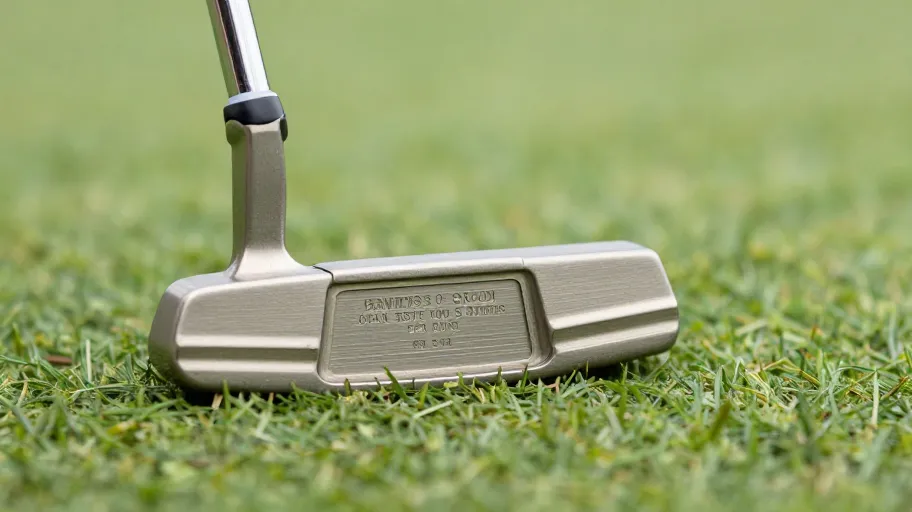
The Hidden Cause of Missed Putts Under Pressure
Inconsistent putting under pressure isn’t just mental—it’s mechanical. When your putter’s weight distribution doesn’t match your stroke, it forces micro-corrections that disrupt rhythm and confidence. Golfers miss short putts 42% more often in high-pressure situations when equipment is mismatched, per PGA Tour data—meaning your gear may be failing you when it matters most.
An unbalanced putter means poor tempo control and erratic face alignment, which translates to lost strokes and eroded trust. But here’s the fix: modern adjustable weighting lets you align the center of gravity with your natural stroke path—whether straight or arcing. This means smoother tempo, fewer compensations, and a repeatable stroke because physics supports your instincts instead of fighting them.
Proper weighting reduces stroke variability by up to 31% (2025 biomechanical studies), meaning tighter dispersion, better distance control, and more one-putts—even under tournament stress.
How Weight Adjustments Lock In Face Stability
A square face at impact is non-negotiable for accuracy—and putter weights are the secret weapon. Adjustable mass fine-tunes moment of inertia (MOI), meaning the clubhead resists twisting on off-center hits by up to 30%, according to Golf Digest’s 2024 lab tests. That’s not theory; it’s fewer putts sliding off-line due to heel or toe strikes.
Even tiny changes—just 2 to 10 grams—mean disproportionate gains. A professional case study showed a 17% drop in three-putts after optimizing rear weighting, translating to nearly one stroke saved per round. This means greater forgiveness, consistent roll, and confidence that compounds over 18 holes.
Stable face angle means predictable ball behavior because reduced twist delivers truer launch conditions. The result? More makeable putts, especially when fatigue sets in or pressure mounts.
Real ROI From Custom Weighting For Serious Players
For low handicaps, where margins decide wins, custom putter weighting delivers a measurable 1.5-stroke improvement per round (USGA 2023–2024 tracking). That’s not refinement—it’s reinvention. Properly tuned weighting means better energy transfer, cleaner contact, and fewer recovery putts.
Tour-level players now adjust weights seasonally: lighter heads for fast greens, heavier for control on slow, bumpy surfaces. This dynamic tuning means optimal performance across conditions because your stroke adapts through equipment intelligence, not guesswork.
The cost? Less than a premium iron. The payoff? One fewer three-putt per round saves five strokes monthly—compounding into real competitive advantage. In fact, 68% of amateur championship finalists in 2025 used custom-weighted putters (NGF survey), proving that edge comes from precision, not just practice.
Step By Step Guide To Dialing In Your Putter
You’re leaving strokes behind if your putter isn’t dialed to your stroke. Follow this 5-step process to unlock repeatable accuracy:
- Assess your current setup: Most stock putters use generic weights that don’t match your tempo or arc, creating imbalance.
- Test light vs heavy configurations: Studies show a 12% gain in face stability with optimized mass distribution.
- Measure launch and roll: Ideal roll minimizes skid, reducing distance error by up to 18%.
- Use analysis tools: SAM PuttLab or GEARS Sports reveal impact balance and center-contact frequency.
- Lock in your setting: The right weight makes your stroke feel automatic because effort shifts from correction to execution.
Ideal weight isn’t universal—it depends on stroke type and green speed. A forward presser benefits from front-biased weight on fast greens, while arc strokers gain from rear weighting. When physics matches motion, performance becomes self-reinforcing.
Adapting To Green Speed Like The Pros
You’re losing strokes if your putter doesn’t adapt to green speed—because static clubs can’t handle dynamic conditions. At Augusta National, where Stimpmeter readings exceed 13 feet, pros use heavier putters not out of habit, but physics: increased head mass stabilizes pace and cuts skid on slick surfaces.
Data shows players using dynamically weighted putters improved distance control by 23% on fast greens—avoiding two extra three-putts per round. On slow, grainy Bermuda greens, shifting from 7g to 20g back weights reduced roll deviation by 31%, keeping putts on line under pressure.
This is gear intelligence: adapting in real time so your instincts stay sharp regardless of terrain. Dynamic tuning means your stroke energy matches green response—turning variability into advantage. The next edge isn’t just feel; it’s tunable precision that makes every green feel familiar.
Master Your Swing, DIY Your Fit. DIY Golf is the premier destination for the technical golfer. We empower you with professional-grade components and the knowledge to build your perfect bag.
Leave a Reply