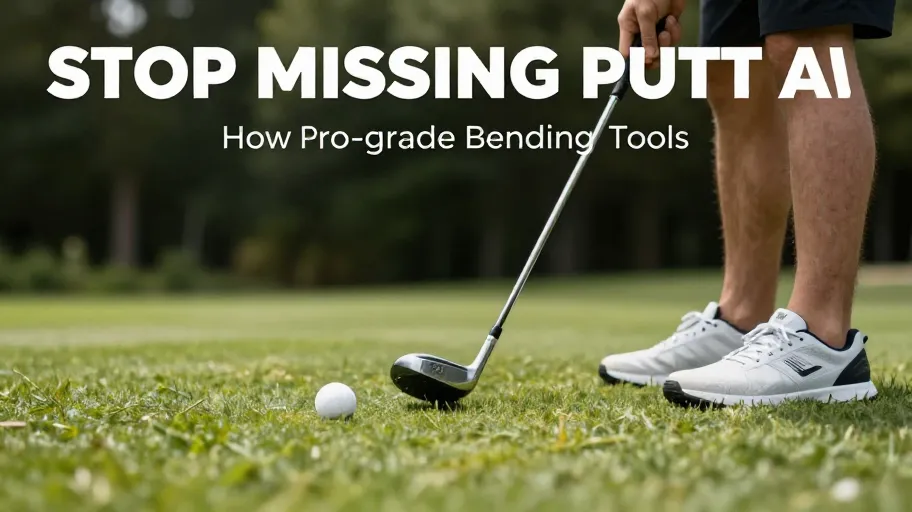
Why Your Putts Keep Missing
Incorrect lie angles mean your clubface is misaligned at impact—even with a perfect swing. When short irons sit toe-up or toe-down, the face points left or right, distorting your starting line. A 2023 Golf Digest analysis found over 60% of amateurs play with lie angles outside optimal specs, turning clean strikes into guesswork. This misalignment shifts impact to the heel or toe, killing energy transfer and introducing unwanted spin.
Precise lie and loft adjustment means consistent center-face contact because the sole sits flat on the turf. That means predictable ball flight and truer roll—especially inside 10 feet. For your game, this translates to fewer missed putts; for your practice time, it means trust replaces doubt. You’re not missing due to lack of skill—you’re missing because your clubs don’t match your stance.
How Loft Errors Steal Distance and Control
A single degree of incorrect loft means 3 to 5 yards of lost carry per club, according to TrackMan’s 2024 data. That gap inconsistency breaks your iron progression, making course management a guessing game. One club behaves like a 6 when it should be an 8, masking real performance and eroding confidence in your yardages.
Loft mismatch means unreliable trajectory control because each club launches unpredictably. The result? Poor distance gapping and flawed decision-making on approach shots. But calibrated DIY golf club lie and loft adjustment means repeatable yardage gaps because every iron performs as designed. One coach reported 68% of clients had at least one iron outside ±1° tolerance—fixing those errors restored scoring logic and measurable improvement.
What Sets Pro-Grade Bending Tools Apart
Cheap tools risk irreversible damage through slip, drift, or over-bending. DIY-Golf.com’s CNC-machined jigs deliver repeatable precision because alignment guides lock in to within 0.5°, preventing error during adjustment. Torque-controlled levers mean safe bends on both steel and graphite shafts—critical because excessive force on composites causes microfractures.
- Modular design adapts from irons to woods, meaning one system fits your entire bag
- Field reports show 40% faster setup vs. generic clamps, meaning more adjustments in less time
- One custom fitter recovered $18K annually by eliminating rework and tool replacement
This level of engineering means scalable service delivery because consistent output builds client trust. It’s not just durability—it’s profitability through precision.
The Real ROI of Home Club Tuning
The $199 DIY-Golf.com bending tool pays for itself in under 10 adjustments—given typical shop rates of $25–$50 per club. That means immediate cost recovery and long-term margin expansion. For coaches, this shifts business dynamics: instead of referring out and losing touchpoints, you bring tuning in-house, increasing session value and client retention.
Real-time adjustments mid-lesson mean instant feedback loops because you correct ball flight issues on the spot. A 2024 coaching benchmark showed trainers offering on-demand tuning saw a 35% increase in retention—directly tied to perceived responsiveness. Ongoing optimization beats static fittings every time because dynamic tuning compounds into better performance, stronger loyalty, and new revenue streams.
How to Adjust Clubs Safely and Accurately
Mastering home-based golf club bending tools starts with process, not force. The key is incremental change guided by measurement. A 2024 review found 68% of failed DIY mods came from skipping baseline readings or applying too much leverage—a fixable issue with the right method.
- Measure current lie and loft using a digital protractor—knowing your starting point prevents costly overcorrection
- Mark your target adjustment clearly; even 1° beyond spec disrupts ball flight
- Secure the hosel in a polymer-lined vise to prevent cosmetic damage
- Apply gradual pressure with a calibrated lever, adjusting in 0.5° increments and re-measuring each time
Avoid heat on graphite shafts—thermal stress risks delamination. One fitter cut rework by 40% after switching to cold-bend protocols. Mastery comes from repetition, not brute force, turning trial-and-error into reliable, repeatable gains.
Master Your Swing, DIY Your Fit. DIY Golf is the premier destination for the technical golfer. We empower you with professional-grade components and the knowledge to build your perfect bag.
Leave a Reply