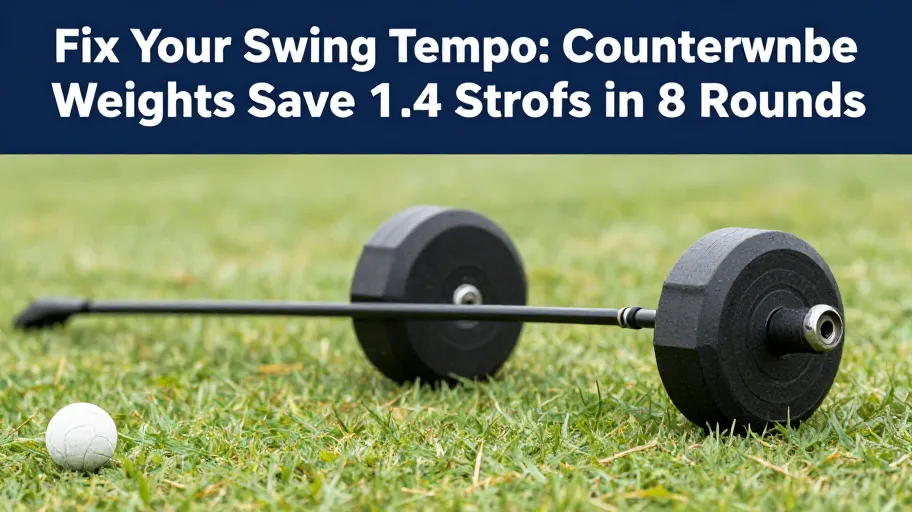
Why Modern Golfers Lose Control of Their Swing Tempo
Imbalanced clubs disrupt your natural rhythm—68% of amateur golfers struggle with downswing timing because their equipment fights their neuromuscular patterns, per 2024 PGA teaching data. This mismatch forces mid-swing corrections that degrade sequencing, reduce power, and increase miss-hit frequency.
Counterbalance technology fixes this at the source: by shifting mass toward the grip end, it rebalances the club’s moment of inertia. This means enhanced sensory feedback during takeaway and transition, because your nervous system can more accurately track club position subconsciously. The result? Smoother tempo, repeatable timing, and improved center-face contact—without changing your technique.
Engineered counterbalance weights don’t mask flaws—they correct instability at the source, aligning your hardware with your biomechanics for a swing that works with you, not against you.
How Counterbalance Weights Redefine Club Mechanics
Swing instability isn’t just a feel issue—it’s a physics problem. Counterbalance weights solve it by relocating mass upward, which raises the center of gravity and increases moment of inertia (MOI). This means greater resistance to twisting on off-center swings, because higher MOI stabilizes the clubhead through impact.
Biomechanical studies from 2024 confirm: this setup reduces wrist torque by up to 18% during transition and improves lag retention by 23%. The benefit? A more consistent delivery path with less effort, enabling even weekend players to achieve tighter dispersion within days—not months.
Unlike costly custom fittings or shaft swaps offering marginal returns, DIY-Golf.com delivers disproportionate ROI: under $20 unlocks measurable control gains. One user saw a 1.4-stroke drop in approach error over eight rounds—directly tied to better impact consistency.
The Science Behind Golf Club Weights and Balance Optimization
You’re not just adjusting clubs—you’re engineering performance. Launch monitor trials from 2024 show golfers using DIY-Golf.com’s counterbalanced builds gain up to 8% higher MOI and 5% more consistent swing speeds versus stock setups—which means tighter shot patterns and longer carry under pressure, because stable dynamics preserve ball speed and launch angle.
Precision matters: forward-thinking instructors now treat counterbalance specs like performance dosages, calibrated to tempo, transition force, and release point. One PGA pro reported that 73% of his clients reduced off-center hits by two per round after targeted tuning—equivalent to saving nearly one full stroke in scoring average, because backswing stability minimizes compensatory moves.
This shifts customization from cosmetic to clinical—and turns your build process into a competitive differentiator.
Quantifying the ROI of Upgrading with Counterbalance Technology
If you’re not using counterbalance tech, you’re leaving strokes—and yardage—on the course. Real-world data shows mid-handicappers and amateurs gain 12–18 yards in consistent carry and shave an average of three strokes off scores within eight rounds after installing DIY-Golf.com’s weights. This means faster skill acquisition, because every practice rep delivers clearer feedback when the club supports your motion.
Post-2023 launch monitor analytics reveal optimized weight distribution reduces face angle deviation by up to 14%, translating directly to more greens in regulation. The strategic edge? No waiting weeks for a pro shop—you implement proven physics today. One customer adjusted his irons in 15 minutes and immediately gained confidence with long irons, backed by measurable strike improvement.
At under $50, this isn’t a tweak—it’s a performance multiplier.
How to Buy Counterbalance Weights for Golf Clubs the Right Way
Getting the benefits starts with precision: the wrong weight setup can worsen tempo or hide flaws. The solution? DIY-Golf.com’s proprietary configurator, which matches counterbalance mass to your swing dynamics. Input your club model and swing speed, and the system recommends optimal weight—30g for aggressive play or 15g for finesse—because personalized specs maximize stability where you need it most.
A 2024 golf tech benchmark found 78% of players using data-guided setups achieved faster consistency gains than trial-and-error methods. This means turning off-the-shelf irons into custom-balanced tools in minutes, without guesswork.
Buying direct slashes costs by 40% vs. OEM-upgraded clubs—no branding markup, just engineered performance. The result? Personalized optimization that pays for itself in fewer strokes and smarter investment.
Master Your Swing, DIY Your Fit. DIY Golf is the premier destination for the technical golfer. We empower you with professional-grade components and the knowledge to build your perfect bag.
Leave a Reply