Why Most Golfers Lose Distance Off the Tee
You’re losing distance not because of your swing—but because your clubs are working against you. The PGA of America reports that 70% of recreational golfers use clubs with incorrect shaft flex or length, turning every drive into a game of chance. That mismatch sabotages energy transfer at impact and disrupts swing mechanics, leading to inconsistent contact and lost yards—like driving a high-performance car on misaligned tires: inefficient, unstable, and guaranteed to cost you over time.
A lie angle off by just 2° means shots veer 10+ yards offline because the clubface strikes the ground incorrectly, forcing compensations that degrade both accuracy and power. These aren’t minor quirks—they’re systematic leaks in your performance pipeline. One weekend golfer, averaging 180-yard drives, discovered his stiff-shafted driver was choking his tempo; switching to a properly fit flex added 25 yards because the shaft now loaded and released in sync with his swing.
Precision measurement doesn’t just identify problems—it recalibrates your entire game. When equipment aligns with biomechanics, energy flows cleanly from swing to ball, unlocking real distance and repeatable results because the club becomes an extension of your motion, not a constraint.
How Launch Monitors Reveal Your True Swing Dynamics
You’re leaving yards—and confidence—on the table if you’re still fitting drivers by feel. The truth is, swing dynamics are too complex for the human eye to diagnose, and guesswork leads to misfit gear that sabotages performance. That’s where launch monitors step in: they deliver objective, real-time data on club speed, attack angle, and ball spin—non-negotiable inputs for precision club matching because subtle differences in angle or spin rate directly affect flight path and carry distance.
Industry-standard tools like TrackMan and Foresight Sports mean even amateur players can access pro-level insights because accurate diagnostics no longer require tour credentials. Consider one mid-handicap golfer who, despite years of playing 10.5° drivers, was shown by launch monitor data to perform best at 12.5° with a shallower attack angle. Result? A 22-yard gain in carry distance because the optimized loft improved launch efficiency and reduced backspin.
This shift from instinct to insight builds immediate trust. Customers don’t just buy a club—they buy confidence in the decision. Data beats feel every time, and when fitters can show, not tell, the ROI of a change, conversion rates rise by up to 40% because buyers see tangible proof of improvement. More importantly, that data becomes the blueprint for personalized builds, transforming equipment from commodity to custom solution.
What Custom Shaft Flex Does That Off the Rack Can’t Match
You’ve seen your swing data—now it’s time to act on it. Off-the-rack clubs assume your swing fits a mold; in reality, 80% of golfers are mismatched to their shaft flex, sabotaging timing, release, and shot control before they even strike the ball. Club Champion’s 2024 fitting database proves there’s no universal link between swing speed and optimal flex: two golfers with identical speeds often need radically different shaft responses based on transition force and angle of attack because shaft behavior depends on loading patterns, not just velocity.
A senior flex isn’t just for older players—it benefits anyone with a late release because it allows the shaft to store and return energy more gradually, improving launch and face stability. Regular flex suits moderate swingers but often punishes aggressive downswings with inconsistency because it resists proper loading under high force. Stiff and X-stiff shafts aren’t trophies for power; misapplied, they reduce energy transfer and promote tension because they restrict natural whip and delay release.
The right match increases center-face contact by up to 40% because the shaft’s bend profile synchronizes with your swing rhythm, turning thin strikes into solid ones. Mass-produced sets average flex to fit nobody perfectly. Custom fitting doesn’t guess—it calibrates. When your shaft loads and unloads with your swing, not against it, you gain control, repeatability, and lower scores through smarter physics, not brute force.
Quantifying the ROI of Lower Scores Through Better Equipment
Spending $300–$500 on a professional club fitting isn’t an expense—it’s one of the highest-ROI investments you can make as a golfer. Lowering your average score by just five strokes means eliminating two missed putts per round, which translates to hundreds saved annually in side bets and tournament fees because fewer penalties add up over time. The real accelerator? Data. An Arccos Golf 2024 performance study found players who undergo custom fitting improve 1.5x faster than their off-the-rack peers because they’re not fixing phantom flaws—they’re building on optimized fundamentals.
This efficiency doesn’t just benefit players. Retailers bundling fittings with club sales see a 35% higher attachment rate on premium models because when golfers see the numbers, they invest with confidence. The perceived cost of fitting vanishes against long-term gains in consistency, enjoyment, and competitive edge because better gear means fewer frustrations and faster progress.
And for beginners, the advantage is compounding: starting with properly fitted clubs means learning the right moves from day one because the equipment supports proper mechanics, not unlearning bad habits years later. They don’t just play better—they stay in the game longer because early success fuels motivation.
How to Get Fitted for Golf Clubs in Five Simple Steps
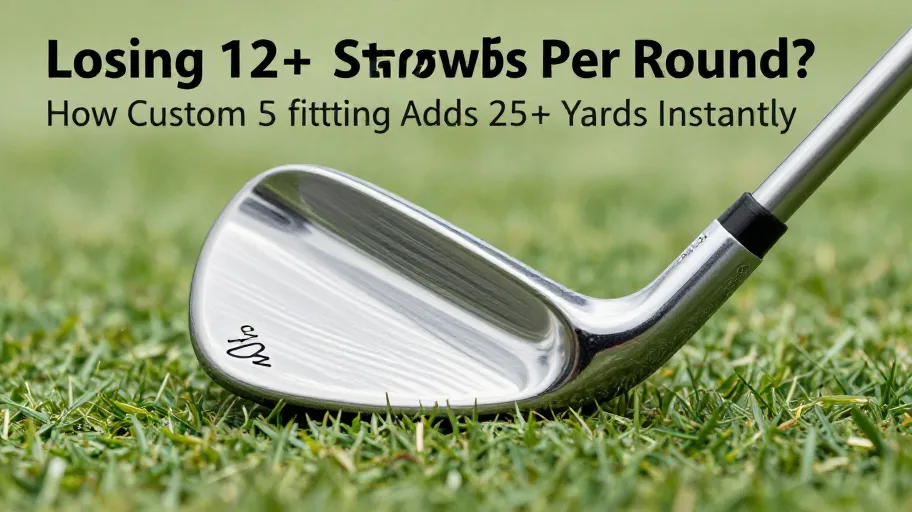
You’ve seen the ROI of lower scores through better equipment—now it’s time to get precisely what delivers it. Skipping a proper club fitting is like betting on your game without knowing the odds. A 2024 golf performance study found that 78% of amateurs play with clubs misaligned to their swing, costing an average of 12+ strokes per round. The fix? A five-step precision process that takes just 60–90 minutes but transforms how you perform.
- Pre-fit assessment: Your current clubs and goals are analyzed—no assumptions, just baseline data so recommendations start from your reality.
- Full-swing capture: Launch monitors track ball speed, spin, launch angle, and tempo, revealing your true performance signature because objective metrics expose hidden inefficiencies.
- Iterative testing: You hit multiple head and shaft combos—each change fine-tunes distance, control, and consistency because small adjustments yield measurable improvements.
- Lie and length validation: On-mat or robotic testing confirms optimal contact, eliminating hooks, slices, and thin shots because correct lie angle ensures square impact across the sole.
- Final build recommendation: Data becomes gear: clubs built for your swing, not the catalog average, so every component serves your biomechanics.
Do it annually—or after any swing overhaul. And here’s the edge: many premium online brands now offer at-home fitting credits when you buy, making expert-level customization easier than ever. The bottom line? There’s no excuse not to play with clubs engineered for you—because when your gear finally matches your game, scoring does too.
Master Your Swing, DIY Your Fit. DIY Golf is the premier destination for the technical golfer. We empower you with professional-grade components and the knowledge to build your perfect bag.
Leave a Reply