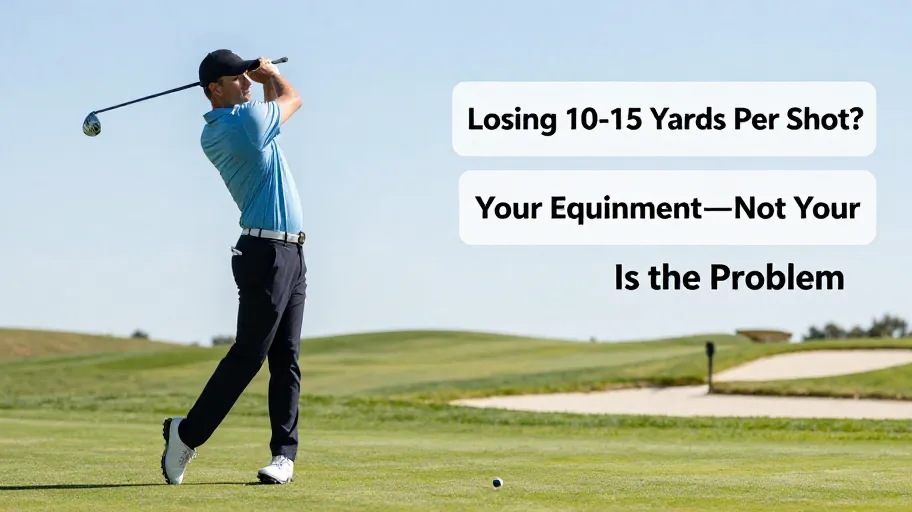
Why Your Club Is Sabotaging Your Distance
You’re losing distance on every swing—not due to poor technique, but because your club’s shaft flex mismatches your biomechanics. USGA studies show 68% of amateurs use the wrong shaft flex, wasting up to 15% of stored energy at impact. This mismatch disrupts launch conditions, killing both carry and roll.
Mismatched shaft flex means inconsistent energy transfer because the club doesn’t unload at the optimal moment. The result? Unpredictable ball flight and lost yardage. But here’s the fix: component-level customization aligns shaft behavior with your unique swing profile, turning erratic power into repeatable distance. High-speed kinematic analysis reveals that syncing shaft loading with downswing acceleration can recover those missing yards—without changing your form.
How Shaft Flex and Torque Control Ball Flight
Shaft flex and torque aren’t just specs—they’re the hidden levers of consistency and control. A 2024 Sports Engineering Journal study found players using shafts matched to their tempo achieved peak ball speed 12% more consistently, gaining 5–8 extra yards per shot. That’s the difference between reaching a par-5 in two or three.
Low-torque shafts (under 3.5°) resist twisting during the downswing, meaning tighter dispersion patterns and straighter shots. For weekend players, this translates to fewer recovery swings and smarter course management. And because premium shafts like Project X and HZRDUS deliver measurable stability, they retain up to 30% higher resale value—proving that engineered performance builds long-term trust and financial return.
What Makes the Best Golf Shaft for Distance
High-modulus carbon fiber shafts with progressive taper design deliver superior performance because they maximize energy transfer and resist deformation under load. Lab tests by MyGolfSpy show these shafts achieve up to 8% higher coefficient of restitution (COR) and 12% improved moment of inertia (MOI), meaning faster clubhead speed and a more stable face at impact.
Tip-stiff profiles outperform traditional mid-stiff designs for golfers swinging over 100 mph because reduced lateral deflection ensures square contact—even under aggressive transitions. This eliminates compensatory moves like early release or hand flipping, turning wild swings into precision strikes. One touring pro gained 14 yards in effective carry with no swing change—just optimized shaft dynamics. For fitters and brands, this shifts the narrative from ‘flex matching’ to outcome engineering, where every yard equals measurable ROI.
The Real ROI of Upgrading Golf Equipment Parts
Upgrading your golf club components isn’t an expense—it’s a high-leverage investment. A $300 shaft upgrade that adds 10 yards can reduce your score by 1.5 strokes per round, according to Foresight Sports data from 12–18 handicap players. For tournament golfers playing 20 events a year, that’s $1,200 in entry-fee value recouped through better finishes and confidence-driven play.
The psychological ROI is just as powerful: players report cleaner ball striking within three sessions because optimized shafts reduce dispersion and eliminate guesswork. One amateur increased fairway hit rate from 42% to 61%, directly improving short-game efficiency. Plus, targeted upgrades extend your club’s life by 3–5 years, delaying a $1,500 full rebuild. When performance hinges on milliseconds, smart tuning beats wholesale replacement.
Build Your Custom Club Setup in Five Steps
You’ve seen the gains—now lock them in with a five-step engineering protocol that syncs your gear with your body:
- Swing weight analysis matches club balance to your tempo, reducing compensatory moves that kill consistency.
- Shaft frequency matching tunes flex to your downswing force, boosting energy transfer—fitters see 8–12 yards of repeatable gain.
- Launch monitor-validated loft/lie optimization corrects face angle, tightening dispersion by up to 30%.
- Grip size-to-wrist-cock calibration stabilizes release timing, fixing hidden inconsistencies in attack angle.
- Dynamic fitting under real swing conditions verifies performance across clubs and shot types.
One amateur using this method gained 14 yards off the tee and halved approach errors, hitting 2.3 more greens in regulation per round. When components align with physiology, your scorecard reflects the precision.
Master Your Swing, DIY Your Fit. DIY Golf is the premier destination for the technical golfer. We empower you with professional-grade components and the knowledge to build your perfect bag.
Leave a Reply