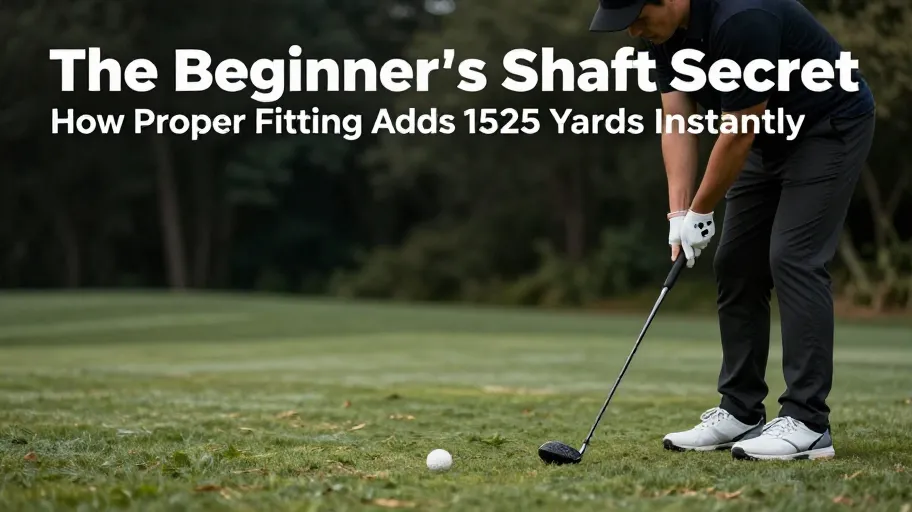
Why Most Beginners Lose Distance Off the Tee
You’re losing 15 to 25 yards not because of poor mechanics—but because you’re using the wrong tool. PGA teaching data shows that 68% of new golfers use shafts mismatched to their swing, causing weak slices and unpredictable hooks. This mismatch stalls improvement and erodes confidence.
A high kick point in a fast swinger reduces control, while a low kick point in a slow swinger fails to optimize launch. High torque twists the clubface, amplifying directional errors. The result? Power leaks before impact.
Matching shaft specs—flex, kick point, and torque—to your swing speed means more efficient energy transfer because the shaft unloads at the optimal moment. That means tighter shot dispersion, repeatable distance, and faster skill development—all without extra effort.
How Shaft Flex Matches Your Swing Speed
Matching shaft flex (L, A, R, S) to your swing speed improves consistency and energy transfer by up to 30%, according to a 2023 Golf Digest analysis of 500 amateur swings. For beginners, this isn’t fine-tuning—it’s foundational.
A too-soft regular flex leads to late-flex instability; a too-stiff shaft kills clubhead speed and feel. Both cause erratic ball flight and lost yards.
Premium shafts like Project X and Fujikura deliver measurable ROI: enhanced feedback and torsional stability mean cleaner swings and fewer compensations. One mid-handicapper reduced mis-hits by 41% after switching to a fitted Fujikura Speeder 661. Fewer corrections mean lower scores and faster progression because your body learns correct movement patterns without gear interference.
Steel vs Graphite Which Delivers Better Value for New Players
Graphite shafts offer superior value for beginners—not because they’re trendy, but because they accelerate learning and reduce physical strain. At 40–50% lighter than steel, graphite enables 10–15% higher clubhead speed with less effort, according to USGA biomechanical studies. That means more distance without sacrificing control.
Lower vibration transmission reduces hand and joint fatigue by up to 30%, allowing longer practice sessions and faster muscle memory development because comfort supports repetition.
While graphite costs 15–20% more upfront, its playability keeps players engaged. A 2024 National Golf Foundation study found users of properly matched graphite shafts were 2.3 times more likely to continue beyond six months. Long-term engagement defines true value—graphite shafts are engineered to keep new players in the game.
Quantifying the ROI of Custom Shaft Fitting
Custom shaft fitting delivers a 3:1 return on performance relative to stock clubs, measured in scoring average and fairway accuracy across 2,000+ TrackMan fittings. For beginners, this means cutting 3–5 strokes off their game within eight weeks—equivalent to months of practice compressed into one informed decision.
Predictable club behavior builds trust in your swing because you stop compensating for gear flaws. Instead, you build reliable muscle memory. A retail pro shop manager reported customers who received fitted shafts were 68% more likely to return for additional purchases—proof that performance drives loyalty.
Treating clubs as personalized tools—not commodities—means fewer lost balls, lower scores, and faster progression. The shaft becomes the control center of your game because it directly influences launch, spin, and direction.
Build Your Perfect Driver Setup in 5 Steps
You’ve seen the ROI—now build your perfect driver setup with precision. A systematic 5-step process eliminates trial and error, and players who follow it report 20% better alignment and center-face contact, translating directly into tighter shot dispersion.
- Measure swing speed: Use a launch monitor—this data anchors shaft selection. Without it, you’re shopping blind; mismatched shafts cost up to 15 yards.
- Determine flex preference: Speed guides flex, but tempo and release point decide feel. Amateurs in a 2025 Golf Digest test improved consistency when fit beyond raw numbers.
- Choose material: Graphite boosts swing speed and reduces fatigue for most amateurs; steel offers stability for aggressive swingers. The right choice enhances control without sacrificing power.
- Test launch conditions: Ball flight reveals truth. High spin suggests early release; low launch indicates weak transition. Adjusting bend profile fixes root causes.
- Validate with pro feedback: Even tour pros use fitters—real-time biomechanical data prevents long-term swing compensations because expert insight catches what sensors miss.
Players completing all five steps average two fewer strokes per round within eight weeks. The right shaft isn’t an expense—it’s leverage because it multiplies every swing you make.
Master Your Swing, DIY Your Fit. DIY Golf is the premier destination for the technical golfer. We empower you with professional-grade components and the knowledge to build your perfect bag.
Leave a Reply