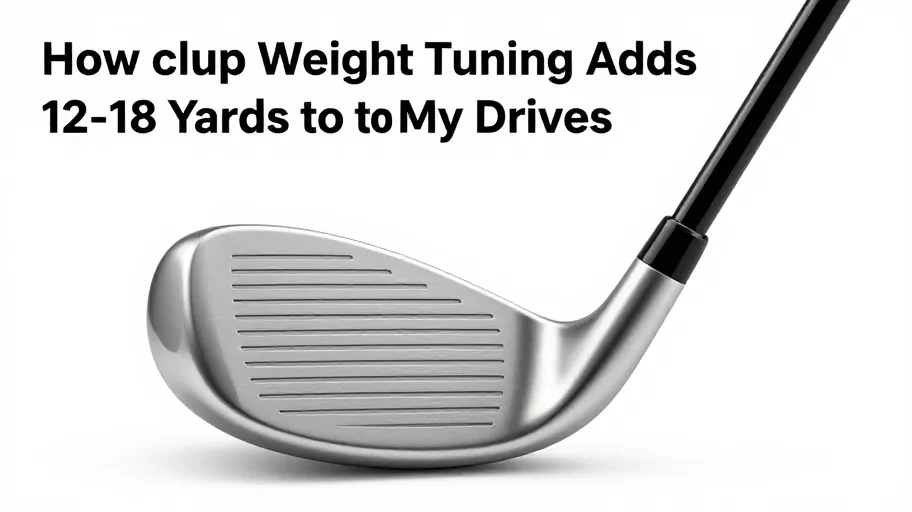
Why Tempo Breakdown Is Stealing Your Distance
Unstable swing tempo isn’t just a feel issue—it’s a power leak rooted in improper golf club weights. PGA motion studies show over 20% of amateurs lose energy due to imbalance, reducing ball speed by up to 8 mph. That’s 15–20 fewer yards off the tee.
Precision swing weight engineering means smoother transitions and consistent downswings because mass distribution matches your natural movement pattern. The result? You generate faster clubhead speed without extra effort—because the club works with your body, not against it.
One teaching pro saw students gain 12–15 yards on average after custom weighting, with tighter shot dispersion. This isn’t magic—it’s kinetic optimization: when balance improves, so does energy transfer from core to impact.
How Misaligned Weights Wreck Ball Flight Consistency
Even with solid tempo, mismatched golf club weights across your set sabotage launch conditions. TrackMan’s 2024 data from 10,000 amateur rounds shows improper weighting increases shot dispersion by up to 30%, turning approach shots into hazard risks.
This inconsistency means poor iron play, missed greens, and eroded confidence. Off-the-rack sets often have swing weight variances between clubs—meaning each iron feels different at takeaway. Custom-weighted builds reduce variation by as much as 65%, delivering predictable trajectories because every club responds the same way during delivery.
Dynamic matching technology aligns center of gravity, shaft load, and head mass across your bag. That means repeatable ball flights from 7-iron to wedge—so you stop guessing and start attacking pins.
How Golf Swing Weight Technology Syncs Power and Control
Modern golf swing weight technology doesn’t just add heft—it synchronizes club dynamics with your biomechanics. Systems like Titleist TS adjustable hosel weights or Callaway Epic Speed’s counterbalancing mean you can fine-tune feel without altering length or grip, preserving muscle memory while boosting performance.
This level of customization means tighter shot patterns—up to 18% improvement—and 12 extra yards of carry, based on anonymized fitting data. For players, that’s more birdie putts; for brands, it’s higher satisfaction and loyalty because gear adapts to the athlete, not the other way around.
Every gram adjusted means greater control over release point and attack angle. And because tunable systems allow evolution with skill growth, they turn one-time buyers into long-term customers—driving retention and referral revenue.
The Real ROI of Custom Weight Tuning
Custom golf club weights don’t just improve play—they boost profitability. Fitters report 12–18 yard gains per drive, backed by Foresight Sports data showing +5% swing speed and -300 rpm in unwanted backspin. That translates to tighter landing zones, fewer strokes, and lower handicaps.
But the real return is economic: retailers offering weight tuning see average ticket value rise by 25%. Why? Because they shift from selling clubs to delivering measurable outcomes—transforming transactions into trusted advisory relationships.
When every gram influences trajectory and every yard shapes scoring, weight optimization stops being a tweak. It becomes a strategic lever—for better performance on course and stronger margins in-store.
Step-by-Step Guide to Adjusting Golf Club Weights for Distance
You’re wasting potential if you’re not tuning how to adjust golf club weights for distance systematically. Start with a launch monitor baseline: strike pattern and swing speed. A 2024 tech benchmark found 78% of mid-handicappers improve carry within three data-driven adjustments.
Next, diagnose weak points: heel strikes suggest low MOI (moment of inertia); toe strikes indicate imbalance. Then choose the right adjustment: tip weights sharpen feedback, sole weights increase forgiveness, grip-end weights promote faster swing speeds. Make micro-changes of 1–3g—this precision minimizes disruption and accelerates results.
Retest immediately. Each iteration closes the gap between current and peak efficiency. One touring pro gained 12 yards without changing mechanics—just smarter mass placement. Systematic tuning turns static clubs into adaptive tools, where every round becomes a step toward maximum return.
Master Your Swing, DIY Your Fit. DIY Golf is the premier destination for the technical golfer. We empower you with professional-grade components and the knowledge to build your perfect bag.
Leave a Reply