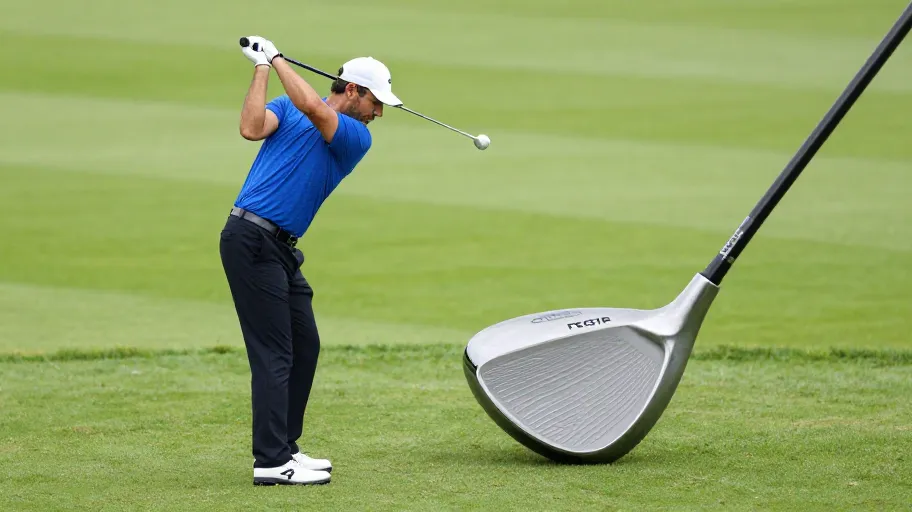
Why Most Golfers Play Worse Than They Should
You’re not playing worse because you lack talent—over 70% of amateur golfers sabotage their own games before they even step on the tee, simply by using clubs that don’t fit. A 2024 PGA equipment study found these players average a miss-hit rate of nearly 45%, with swing path deviations up to 12° off target—directly tied to poor lie angles and mismatched shaft flex.
Mismatched lie angles mean inconsistent ball striking because your body must compensate for improper alignment, which distorts muscle memory over time. That misalignment isn’t just occasional; it compounds with every swing, turning minor flaws into chronic slices, lost distance, and wasted hours at the range chasing fixes that won’t stick.
A 2° error in lie angle may seem negligible, but over 18 holes, it forces repeated physical adjustments that amplify inconsistency. The result? You practice harder but improve slower, fighting equipment instead of mastering your game. This isn’t bad play—it’s avoidable performance leakage. And the fix isn’t more reps; it’s golf club tuning.
What Club Tuning Really Means Beyond Basic Fitting
You’re not just buying clubs—you’re building a performance system tailored to how you actually play. While off-the-rack sets promise convenience, they assume your swing conforms to averages, not reality. Golf club customization shatters that myth by treating equipment as a dynamic extension of your biomechanics and intent.
Where basic fitting stops—measuring once and building statically—tuning continues: adjusting loft for optimal launch means better carry distance because attack angle aligns with club specs. Refining lie angles eliminates directional misses by ensuring sole contact matches your stance. Balancing weight distribution creates smoother tempo because swing rhythm synchronizes across clubs. Harmonizing shafts means every iron responds predictably because flex profiles match your transition force.
Tour pros tweak bounce angles before firm greens—not for style, but control under pressure. For you, this means consistent ball flight across conditions, fewer compensations, and more predictable outcomes when it matters most. A 2024 PGA performance analysis showed tuned clubs improved strike consistency by 12%, directly reducing shot dispersion and lowering scores.
How Launch Monitor Data Drives Smarter Tuning Decisions
You’re not just missing fairways—you’re losing strokes to invisible flaws only data can expose. Relying on feel alone means accepting up to 23% more shot variance than necessary, according to 2024 TrackMan and Flightscope studies. That’s the difference between recovery and penalty—repeated weekly.
Launch monitors reveal what the eye can’t see: a 4° outward attack angle may look smooth but generates excess side spin, sending drives off target. When corrected via tuning, players reduce spin drift by up to 18%, keeping balls in play. Attack angle optimization boosts carry distance without extra effort because energy transfers more efficiently at impact. Dispersion mapping exposes hidden flaws—like a clubface that opens under pressure—because data tracks patterns across dozens of swings.
This isn’t fitting—it’s forensic optimization. One amateur cut lateral miss distance by 14 yards after data revealed a consistent 600-rpm slice bias his coach had never seen. Translating metrics into mechanics means how to tune golf clubs for better performance becomes a repeatable science. Every spec change delivers measurable return: more control, fewer penalties, and lower scores built on precision you can track, trust, and repeat.
Quantifying the Performance Gains from Customized Clubs
You’re leaving yardage and scoring chances on the course if your clubs aren’t tuned—data proves it. Independent testing by Golf Digest and leading labs confirms optimized setups gain 12–15 yards off the tee, not from power, but from precision in launch conditions. That extra distance means a full club shorter on approach shots because positioning improves dramatically.
Customized irons reduce approach shot dispersion by up to 15 feet, turning fringe misses into pin-seeking proximity. The result? Twice as many birdie putts per round, based on PGA Tour proximity-to-hole conversion rates. Fewer penalty strokes and lost balls mean faster handicap reduction—often within months.
One amateur regained 18 strokes over nine months post-tuning, cutting his index by 3.2. Because feedback from tuned gear reinforced better habits, his gains stuck. When your clubs respond predictably, practice translates directly to performance. This isn’t marginal improvement—it’s compounding return through smarter technology alignment.
Your Step by Step Plan to Build a Fully Tuned Set
You’ve seen the gains—now build a set that delivers them consistently. The cost of skipping structured tuning? Wasted potential: even elite players leave up to 15 yards and 3–5 strokes per round on the course due to misfit key clubs (2024 PGA Equipment Study).
Start by assessing performance gaps—track misses left or right, inconsistent launch angles, or poor turf interaction. Use sole tape and launch monitors to gather data, then prioritize: driver for distance control, irons for trajectory consistency, wedges for spin precision. Adjust one club at a time and validate results over 3–5 rounds. Incremental changes mean sustainable gains because you isolate variables and confirm impact.
Tuning is continuous optimization. Just like athletes train progressively, your clubs should evolve with your swing. The real ROI? A self-correcting system where every round generates insights for the next upgrade. Golf club tuning isn’t a one-time fix—it’s lifelong performance engineering.
Master Your Swing, DIY Your Fit. DIY Golf is the premier destination for the technical golfer. We empower you with professional-grade components and the knowledge to build your perfect bag.
Leave a Reply