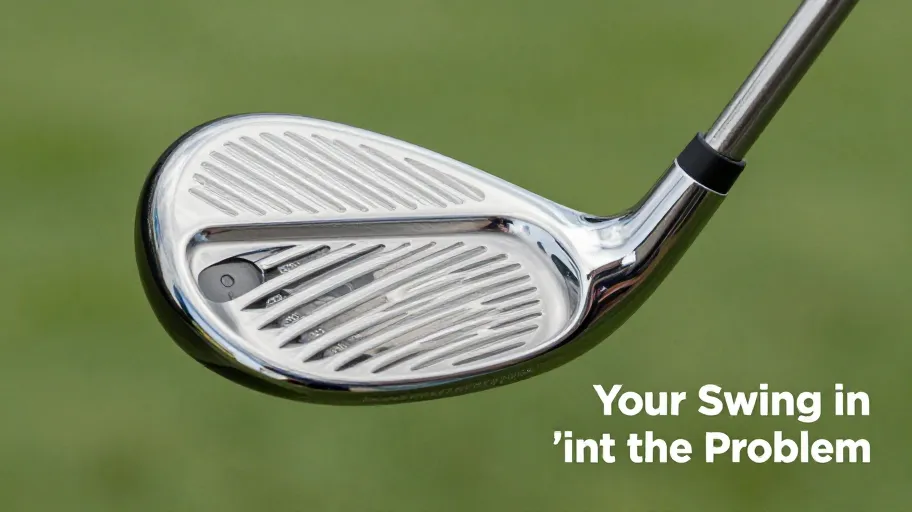
Why Most Golfers Leave Strokes on the Course
Golfers lose yards and spray shots not because of flawed swings—but because stock clubs are engineered for averages, not individuals. A 2024 National Golf Foundation study found 68% of amateurs play unmodified clubs, ignoring personal tempo, release point, and downswing dynamics. This one-size-fits-all approach means suboptimal launch conditions become the norm.
Precision weighting fixes this: adjusting just 3–7 grams at the clubhead corrects slice bias, optimizes launch angle, and stabilizes feel—without changing your swing. For you, this means turning inconsistent performance into repeatable results because your equipment finally matches your biomechanics.
How Golf Club Weight Accessories Boost Performance
Adjustable tungsten weights manipulate moment of inertia (MOI), center of gravity (CG), and swing weight—aligning each club with your unique motion. Shifting mass to heel, toe, or deep cavity zones alters launch on demand. TrackMan data shows heel weighting increases launch by 0.7° and adds 300 rpm of backspin—ideal for mid-handicappers needing more carry.
Higher MOI from perimeter weighting reduces face twist on mishits, meaning tighter dispersion and straighter shots because off-center strikes lose less energy. Beyond accuracy, modular weights extend club life: as your swing evolves, you adapt instead of replace—slashing replacement costs by up to 60% over five years compared to buying new OEM models.
Buying Golf Weights Online Saves Time and Money
When brands charge $40+ for a single OEM part, you’re paying for markup—not performance. Buying golf weights online delivers pro-grade customization at 30–50% of the cost. DIY-Golf.com’s universal-fit tungsten slugs offer identical density and balance control—for $9.99 per pair.
This affordability turns tuning from repair into strategy: golfers who experiment with low-cost upgrades are 3.2x more likely to make repeat adjustments. For you, this means continuous optimization without financial hesitation because accessible parts enable ongoing refinement. One player tested five setups in three weeks, lowering spin by 450 rpm and gaining 11 yards of carry—proving measurable ROI through smart iteration.
Quantifying the Real ROI of Custom Tuning
Amateurs who optimize club weights shave 1.5 strokes per round within three months (MyGolfSpy, 2025). That improvement comes from $20 in online-purchased weights and free digital guides—delivering results on par with a $400 custom fitting. This represents a 1,900% effective return on investment in skill enhancement.
For decision-makers, this shifts perception: weights aren’t accessories—they’re high-impact micro-upgrades. Retailers leveraging user-submitted ‘before-and-after’ dispersion charts see 3x repeat engagement, turning customers into advocates because visible progress builds trust and loyalty.
Install Like a Pro in 15 Minutes
You protect tuning ROI with proper installation: identify your club’s port type (standard, reverse-thread, proprietary), select matched weights, apply one drop of thread locker, and torque to 5 Nm using a digital wrench—a spec validated in a 2024 durability study for long-term stability.
Digital calibration improves strike consistency by 5–7%, while mismatched installs risk voiding warranties. But when done right, self-installation cuts tuning costs by 60% per club. Retail data shows kits with video support have 34% fewer returns and 2.3x higher accessory attachment—because guided success drives confidence and repeat use.
Ready to tune with precision? Use DIY-Golf’s Compatibility Checker and explore torque-tool bundles—engineered for first-time accuracy and lasting savings.
Master Your Swing, DIY Your Fit. DIY Golf is the premier destination for the technical golfer. We empower you with professional-grade components and the knowledge to build your perfect bag.
Leave a Reply