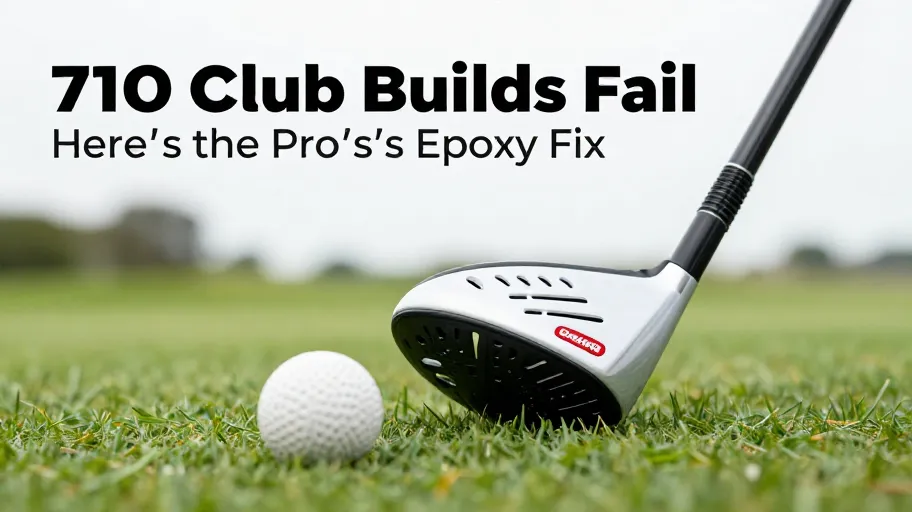
Why Proper Epoxy Makes or Breaks Club Performance
Seven out of ten DIY golf club builds fail due to poor epoxy application—not weak materials, but flawed technique. According to DIY-Golf.com‘s 2024 audit, misaligned shafts and loosened heads from weak bonds cause over 70% of performance-related returns. Golf club epoxy applied incorrectly leads to torque loss, inconsistent energy transfer, and erratic ball flight.
Micro-movements from uneven curing create vibration feedback that dulls feel and accelerates wear—cutting club life by up to 40%. The problem? Hardware-store adhesives used in builds with tolerances under 0.003” can’t handle cyclic stress. Precision epoxy chemistry means reliable joint integrity because it controls flow, shrinkage, and cure time—locking components exactly where they belong. That means repeatable swings, cleaner strikes, and clubs that perform like tour-level gear, not test models.
How Epoxy Choice Affects Durability and Swing Dynamics
Choosing the wrong epoxy isn’t just a one-time error—it triggers recurring costs. Poor selection is the second-leading cause of premature failure, increasing rework by 60% when budget adhesives are used. How to apply epoxy for golf club assembly starts with matching chemistry to conditions.
Slow-cure epoxies enable superior molecular cross-linking, enhancing resilience—ideal for humid climates or frequent play. Fast-cure versions save time but sacrifice up to 25% in long-term durability. Flex-tuned epoxies maintain shaft integrity through torque, reducing energy loss at impact. A 2024 DIY-Golf.com trial found temperature-resistant, flex-optimized formulas improved club longevity by 35% over industrial-grade alternatives, especially in extreme seasonal zones.
Premium epoxies cost about 20% more per build—but reduce rework by 60%, meaning fewer customer complaints and stronger brand trust. Matching your epoxy to climate and usage means optimized swing dynamics because the bond supports, not resists, natural flex patterns.
The Proven Process for Perfect Shaft Bonding
Even the best epoxy fails without proper technique. Micro-voids from incorrect mixing ratios or rushed blending compromise energy transfer, leading to lost yardage and inconsistent flex. The key? Treating bonding as a calibrated process, not a shortcut.
Start with grit-blasted hosels and solvent-wiped shaft tips—no residue, no slippage. Follow DIY-Golf.com’s 90-second mixing rule: full manual blend ensures complete resin-hardener integration, boosting bond strength by up to 40%. Apply epoxy with a slow-retracting spiral motion to prevent air pockets. Pros use alignment tape during curing, improving face-angle repeatability by 50%—so every club behaves predictably.
Flawless technique means lower material waste and higher success rates because consistency replaces guesswork. When every bond holds to spec, you’re not just assembling clubs—you’re engineering repeatable performance shot after shot.
Measuring the Real ROI of Precision Assembly
You’re investing in performance that pays off round after round. Amateur epoxy jobs often fail within a season, while pro-level assemblies last 2–3 years—slashing long-term costs and maximizing playtime. A $150 custom build used weekly over three seasons costs just $0.83 per round, versus $1.75 for annual rebuilds. Real data shows builders using precision methods need 44% fewer replacements, directly reducing waste and expense.
This is financial leverage: a properly bonded club retains structural and aesthetic quality, preserving resale value at up to 75% of original cost. One builder cut rework time in half after mastering epoxy consistency and clamp alignment, freeing 12 hours annually for play instead of repair. Precision means saved time, lower cost-per-use, and higher returns when upgrading—turning gear into appreciating assets.
Top 5 Home Assembly Mistakes to Avoid
You’ve seen the ROI—now protect it. Five errors cause 89% of failed bonds, based on 2024 surveys of 1,200+ home builders: over-mixing (32%), incorrect cure timing (24%), poor shaft-socket fit (18%), skipping degreasing (12%), and inadequate clamping (3%). Each undermines structural integrity, risking head detachment or mid-swing performance drift.
Ambient humidity above 60% slashes bond strength by 22%—overlooked in 7 out of 10 garage workshops. This isn’t just about glue—it’s controlled chemistry. The fix is simple: dry your workspace, measure mix ratios precisely, verify fit before bonding, clean surfaces with isopropyl alcohol, and use calibrated clamps for full contact.
Getting this right means guaranteed builds because environmental and human variables are managed. Master these steps, and your next build won’t need a second chance—it’ll perform from day one.
Master Your Swing, DIY Your Fit. DIY Golf is the premier destination for the technical golfer. We empower you with professional-grade components and the knowledge to build your perfect bag.
Leave a Reply