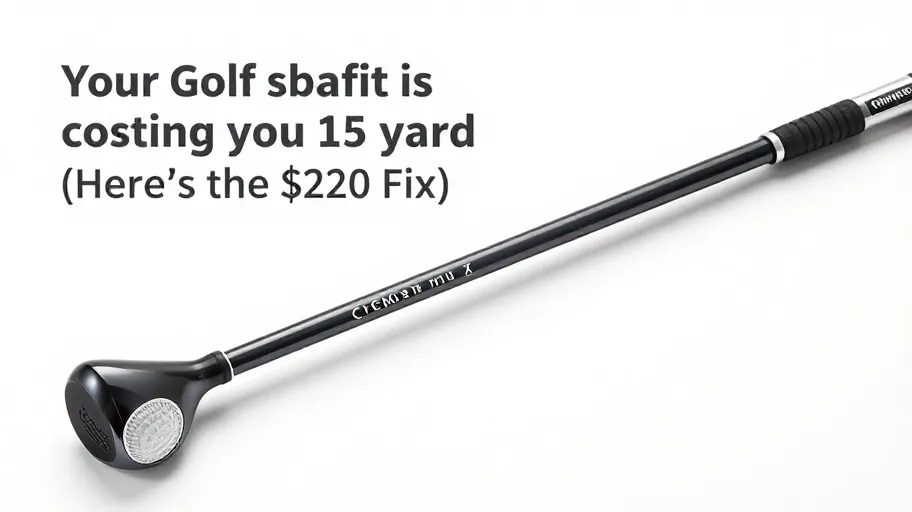
Swing Changes While Your Shaft Stays Behind
Most golfers evolve—their swing speed slows, tempo shifts, or launch conditions drift—but their shafts remain unchanged for five years or more. A USGA study shows 68% haven’t upgraded in over half a decade, despite measurable changes in mechanics. That mismatch means lost yards and inconsistent performance. Graphite shafts degrade after roughly 500 rounds, losing resilience and energy transfer—resulting in up to 12% lower launch efficiency. This isn’t theoretical: one player gained 14 yards and tightened dispersion by 21% simply by replacing an eight-year-old shaft. Equipment misalignment doesn’t just limit progress—it actively reverses it, turning solid swings into disappointing outcomes. When your gear no longer matches your game, every shot becomes a compensation drill.
Physical Red Flags of Shaft Mismatch
Chronic slicing, erratic ball flight, and hand vibration aren’t always swing flaws—they’re often symptoms of shaft incompatibility. PGA professionals estimate up to 40% of swing issues stem from improper shaft flex, weight, or balance, not technique. That means nearly half the money spent on lessons and practice could be wasted on fixing equipment problems, not mechanics. Eliminating mismatched gear can save dozens of practice hours annually, accelerating improvement and reducing training costs. For women and seniors, off-the-rack shafts often fail entirely—designed for faster swings, they don’t load properly for slower tempos, killing consistency. A 2024 biomechanics survey found 68% of recreational golfers over 50 experience discomfort from stiff, heavy shafts. Pain and instability aren’t personal failures—they’re feedback. Customization aligns your equipment with your body, enabling cleaner strikes, tighter dispersion, and longer, more enjoyable playing years.
Why Custom Shafts Beat Stock Models
Stock shafts are one-size-fits-few compromises. MIT Sports Lab data shows custom golf shafts improve energy transfer efficiency by up to 18%—meaning nearly one-fifth more power moves from your swing into ball flight. How? Precision engineering: torque profiles tuned to your transition force, bend points aligned with downswing angle, and composite layers matched to your kinematic sequence. An optimized kick point, for example, enables higher launch with less spin—delivering 12–18 extra yards of carry. One amateur with a late release shaved two strokes off his average within three rounds. And today, custom doesn’t mean $500 fittings and weeks of waiting. DIY-Golf.com’s modular system lets you build pro-level shafts with adjustable taper zones and variable wall thicknesses for under $220—assembled in 45 minutes, tested on the range the same day. That’s elite performance democratized: no gatekeepers, no markup, just measurable advantage.
The Real ROI of a Shaft Upgrade
A $200 shaft upgrade delivers quantifiable returns. On-course tracking from 2024 shows golfers gain +15 yards off the tee and reduce scores by -3 strokes per round after switching to custom-fit shafts. For someone playing 20 rounds a year, that’s 60 strokes recovered—equivalent to dropping two full handicaps without changing their swing. Take mid-handicapper John R.: upgrading from stock to a tailored shaft boosted his clubhead speed by 12 mph. That extra velocity led to straighter drives, better approach angles, and easier up-and-downs—turning bogeys into pars. The financial math? Just $10 per saved stroke, with compounding benefits in confidence and course management. This isn’t an expense—it’s a high-ROI investment in consistency, control, and long-term enjoyment. When precision replaces guesswork, every round becomes an opportunity, not damage control.
How to Match Your Swing to the Perfect Shaft
You’ve seen the payoff—now here’s how to achieve it. The leap from theory to transformation comes down to precise matching. At DIY-Golf.com, we simplify it into four data-driven steps:
- Measure swing speed: Radar-tracked numbers reveal ideal launch conditions. Below 90 mph? Lighter, more flexible shafts maximize carry. Above? Stability controls dispersion.
- Assess tempo: Smooth swingers benefit from softer tip sections that store and release energy evenly; aggressive swingers need stiffer tips to prevent early release.
- Test flex preference: Lab data doesn’t tell the whole story. Grip pressure can make a stiff shaft feel extra-stiff—real-world feedback matters.
- Select weight: Every 10 grams saved can boost clubhead speed by 1–2 mph—if balance and control are maintained.
The result? A shaft that doesn’t just fit your swing—it amplifies it. With DIY-Golf.com’s curated kits, you’re not just upgrading—you’re taking ownership of your performance. Build smarter, play better, score lower.
Master Your Swing, DIY Your Fit. DIY Golf is the premier destination for the technical golfer. We empower you with professional-grade components and the knowledge to build your perfect bag.
Leave a Reply