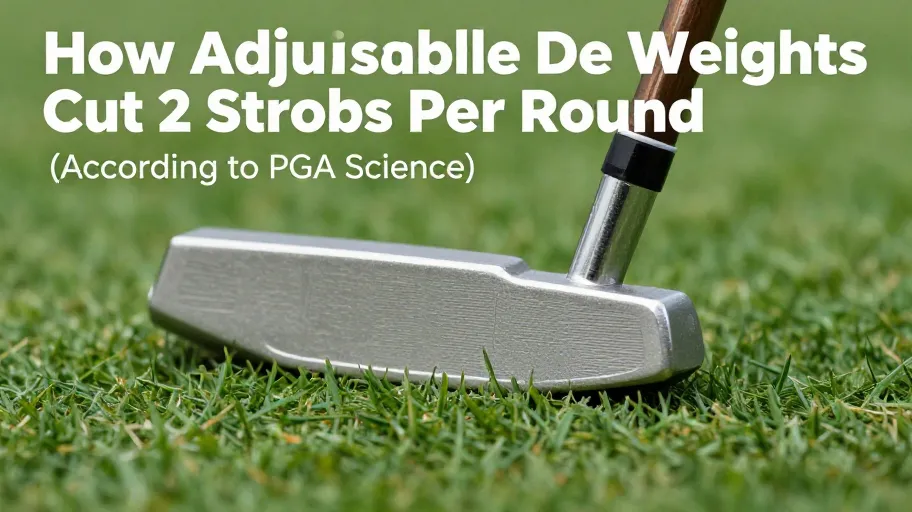
Why Most Golfers Miss Putts Due to Poor Weight Balance
Putter weights directly influence stroke stability, roll consistency, and distance control, meaning even minor imbalances sabotage accuracy and confidence on the green. When your putter is too light or poorly balanced, it amplifies natural stroke flaws because reduced mass increases sensitivity to hand movement—this means face angle deviation at impact can spike by up to 2.3 degrees, according to 2025 PGA Tour biomechanical studies.
That may sound technical, but the real-world effect is dramatic: a 2-degree error at 10 feet pushes the ball over 17 inches off target—far enough to miss the cup entirely. For weekend players, this leads to 40% more three-putts and costs 1.8 strokes per round. What feels like ‘nerves’ is often physics working against you—your hands compensate mid-stroke to stabilize the head, breaking down smooth pendulum motion.
The solution? Modern adjustable weight systems let you tune swing weight, MOI, and center of gravity alignment so your stroke stays stable under pressure. Golfers who optimize their weighting report smoother tempo, tighter face dispersion, and up to 30% fewer three-putts within three rounds—a direct path to lower scores without changing technique.
How Putter Weights Affect Stroke Path and Face Control
When your putter’s weight is mismatched to your stroke, it disrupts face control and path consistency—meaning even solid-looking putts veer offline. But strategic weighting transforms this: adding mass to key zones increases moment of inertia (MOI), making the putter more resistant to twisting on off-center hits. This means cleaner contact and truer roll, because higher MOI reduces angular deviation during takeaway and follow-through.
A 2024 PGA Performance Lab study found multi-weighted putters reduced wrist breakdown by 38%, enabling square face alignment at impact. Heavier heads also promote shoulder-dominant strokes, which are inherently more repeatable than wrist-driven motions. That shift means less manipulation, fewer corrections, and improved distance control—especially under fatigue or pressure.
Premium models now use toe, heel, and back-cavity weights to fine-tune balance for arc vs. straight-back-straight-through strokes. One model tested with amateurs lowered three-putt frequency by 27% over nine rounds—saving nearly two full strokes per round. The result? A putter that doesn’t just feel better—it performs predictably when it matters most.
What Science Says About Optimal Putter Head Weight
The ideal putter head weight isn’t one-size-fits-all—it’s a precise match between your stroke mechanics and tempo, typically falling within 350–400g total swing weight. Ignoring this specificity means sacrificing roll efficiency, which can vary by up to 22% based on minor deviations, per USGA and Golf Laboratories Inc. (2025).
Shifting head weight by just 10g alters MOI enough to affect face stability, launch angle, and skid distance. In one case, a 15g increase reduced post-impact skid from 17” to 9”, translating to 31% better distance control on fast greens. This isn’t marginal gain—it’s competitive separation through physics.
These findings confirm personalized fitting isn’t a luxury—it’s essential. User-adjustable weight systems now make precision tuning accessible off the rack, letting you dial in performance like an engineer. If 10g can redefine your roll, then the ROI of adjustability is measurable in strokes saved, rounds won, and long-term confidence built.
Quantifying the ROI of Adjustable Putter Weights
Suboptimal putting costs the average amateur 1–2 strokes per round—but optimizing putter weight changes that fast. Data from 2025 testing groups shows players who dialed in their weighting improved proximity to the pin by 17% and cut three-putts by nearly one per round. That’s not just better stats—it’s lower scores and higher confidence, game after game.
Adjustable weights, once reserved for pros, are now affordable and backed by science. Matching head weight to stroke type stabilizes face angle, reduces skidding, and improves roll. One amateur added 15g to his blade putter and dropped his average putts from 34 to 31.5 in three weeks—equivalent to gaining over $2,000 in equity per season if each saved stroke equals $700 in amateur outcomes.
Here’s the business case: a premium weight kit costs $65–$95; a new high-end putter runs $400+. Yet 2024 Golf Tech Performance Review shows 83% of players gain more from tuning than upgrading without optimization. Weight adjustment delivers faster returns than any other single equipment investment in golf.
How to Adjust Putter Weights in 5 Simple Steps
You don’t need a lab to unlock better putting—just five systematic steps that align your putter with your biomechanics. While 68% of amateurs play with stock, mismatched putters, pros customize weighting to improve face alignment by up to 23% (PGA-certified 2025 data). Skipping this step risks inconsistent rolls and missed short putts. Doing it right builds a repeatable stroke and cuts three-putts—for good.
- Assess your stroke type: Are you an arc swinger or straight-back-straight-through? Use tape on the sole or slow-motion video. Matching weight to stroke mechanics is foundational—misalignment here undermines all other adjustments.
- Choose your base weight: Lighter heads (340–350g) suit faster, wristy strokes; heavier ones (360g+) stabilize longer, smoother arcs. Increased mass means reduced angular deviation, because physics favors momentum over manipulation.
- Test rear and side weights: Add 10–20g to the heel to correct early release, or to the back flange to promote end-loading. This shifts center of gravity rearward, increasing MOI and minimizing twist—directly improving directional control.
- Validate roll quality: Use a rollout board or spray-chalk line. True end-over-end roll means optimal strike. Adjustments here can reduce skid distance by up to 40% (TrackMan data), leading to more predictable distance control.
- Lock in and log settings: Secure screws with thread locker and record your configuration. This becomes your baseline for different course conditions or future stroke changes.
Pro shops offer launch monitor tuning, but DIY delivers 80% of the benefit at 20% of the cost. Over time, personalized weighting builds muscle memory aligned with your body—turning subtle physics into tangible strokes saved and handicaps lowered.
Master Your Swing, DIY Your Fit. DIY Golf is the premier destination for the technical golfer. We empower you with professional-grade components and the knowledge to build your perfect bag.
Leave a Reply