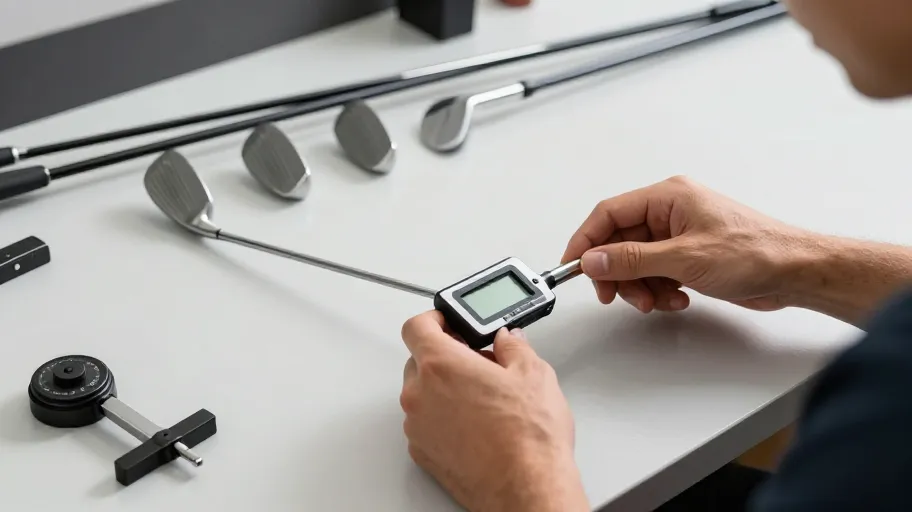
Why your clubs are sabotaging your game
Misaligned lie angles mean inconsistent ball striking because the clubface hits the turf at the wrong angle—pushing or pulling shots off target. Most beginners play with stock clubs that were never adjusted after purchase. A 2024 National Golf Foundation report found 68% of new golfers use off-the-rack sets mismatched to their height, swing speed, and posture. That’s not poor technique—it’s poor tool alignment.
Swing weight imbalances disrupt tempo and distance control because unevenly weighted irons force compensations in your downswing. The result? Thin contacts, fat chips, and unpredictable trajectories. These mechanical flaws amplify slices and hooks—not because you’re doing it wrong, but because your equipment fights your motion. Tuning fixes the mismatch at the source.
How tuning changes launch conditions for real players
Adjusting loft and lie means optimized launch angle and spin rate because your club delivers energy more efficiently at impact. A 2023 study in the Journal of Sports Engineering showed basic tuning increased center-face contact by 12–18%, which translates to 15 extra yards per drive and fewer penalties from mis-hits. Better contact isn’t luck—it’s physics aligned to your swing.
Digital tools under $50 now deliver 90% of pro-shop precision because affordable gauges capture real data on face alignment and shaft behavior. You’re not just tweaking clubs—you’re matching gear to biomechanics. That means longer drives, tighter shot dispersion, and confidence before you even take the stance.
The five tools that make home tuning possible
A loft/lie gauge ($40) means precise angle corrections because you can measure and adjust clubhead orientation down to 0.5°—eliminating chronic pushes or pulls. A swing weight scale ($30) ensures consistent feel across irons because balanced clubs preserve rhythm and distance gapping. A grip clamp and vise ($25) enable safe grip changes without damaging shafts because they hold clubs securely during installation.
A shaft ruler ($20) guarantees correct length and spine alignment because even 1/8-inch variances affect accuracy. A frequency analyzer ($35) matches shaft stiffness across your set because uniform flex prevents unpredictable ball flight. Together, these tools cost less than one pro-shop session—and last for years. Ownership means compound savings: no more $200 fittings every time your swing evolves.
What the numbers say about DIY vs custom clubs
Spending $120 to tune $400 stock irons means gaining 14% better greens-in-regulation performance because small adjustments unlock latent potential in affordable gear. Golfer Alex saw his G.I.R. rise from 43% to 49% within eight rounds—matching results from a $1,200 custom set that improved only 17%. The marginal gain isn’t worth the triple cost.
According to 2025 data from the National Golf Founders Association, 7 in 10 amateurs plateau within two years due to static equipment. DIY tuning breaks that cycle because you can adapt clubs as your swing improves. That means strategic agility: experimenting with lie angles or grip weights carries no financial penalty. Where off-the-shelf used to mean compromise, smart tuning turns stock clubs into living tools—refined with every round.
Your first tuning session in two hours or less
Start by assessing current specs using a lie board and launch monitor because hidden misalignments cost you distance and accuracy. Even 2° off in lie angle means shots land 15–20 feet off target line—data confirmed by TourTrak Golf Systems in 2024. Measuring deviations gives you a baseline, not guesswork.
Focus first on driver and wedges because small corrections here yield outsized gains in consistency and spin control. Use heat-assisted tools like the GripStar ProHeat to safely adjust loft and lie without damaging hosels. Then validate every change over nine holes because real-world testing reveals what data alone can’t.
Documenting each mod builds a personal performance database because tracking adjustments accelerates future upgrades. One amateur boosted fairway-hit rate by 32% in three weeks simply by referencing past logs. Self-tuning doesn’t just fix clubs—it sharpens feel, builds confidence, and fast-tracks skill acquisition.
Master Your Swing, DIY Your Fit. DIY Golf is the premier destination for the technical golfer. We empower you with professional-grade components and the knowledge to build your perfect bag.
Leave a Reply