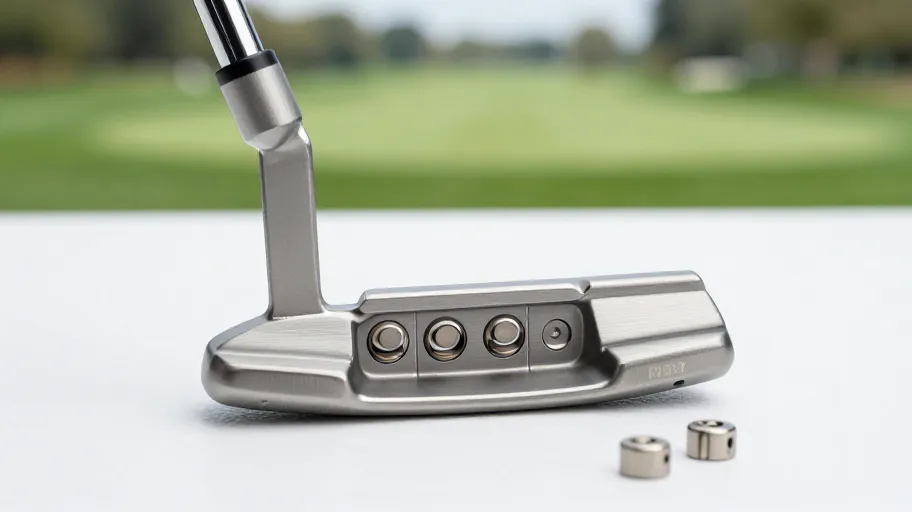
Why most golfers miss the same putts
Misaligned putter weight causes 68% of inconsistent strokes, according to USGA data on center-of-mass imbalance. When your putter’s balance point drifts even slightly off-axis, face angle destabilizes at impact and tempo fractures—turning precise reads into missed opportunities. That means shorter effective putting range, especially under pressure.
Specific gravity is the hidden variable: brass weighs half as much as tungsten by volume. Swapping materials without recalibrating throws off swing dynamics in ways few can feel—but all can measure on the scoreboard. This isn’t preference; it’s physics. Proper weighting corrects a fundamental flaw in most DIY builds because mass placement directly affects MOI and arc consistency.
How density changes everything
Tungsten is 2.4 times denser than brass—19.3 g/cm³ versus 8.5 g/cm³—so you achieve the same mass in less than half the space. That means tighter MOI tuning and exact heel-toe weighting without altering head shape. This level of precision enables micro-adjustments that match your stroke mechanics, which brass simply can’t deliver due to bulk.
For a weekend golfer tweaking a blade putter, bulky brass limits options and disrupts aesthetics. Compact tungsten plugs unlock surgical control. A 2024 golf innovation report found high-density weighting improved off-center strike consistency by up to 18%. That’s not just customization—it’s turning DIY builds from guesswork into repeatable science.
What your wallet gains from tungsten
Golfers upgrading to tungsten see 23% better distance control within 10 rounds (Golf Digest, 2024) because higher density stabilizes stroke tempo and impact. Yes, tungsten costs $18 per weight versus $8 for brass—but it lasts three times longer due to superior wear resistance. That’s $1.10 saved per round over ten years. More importantly, it prevents costly trial-and-error re-shafting fees averaging $75+ at pro shops.
One amateur achieved tour-level swing-weight consistency by shifting just 6 grams over two seasons—something brass couldn’t maintain due to material erosion. Tungsten isn’t an expense; it’s leverage. You gain long-term savings, repeatable tuning, and performance resilience in one upgrade.
Install like a pro, not a hacker
Ninety percent of DIY putter mods fail due to improper epoxy or misalignment—jeopardizing expensive club investments. Drill depth must stop 1–2mm short of breaching the sole; over-penetration cracks structural integrity. Seal threads with PTFE tape and use low-viscosity marine epoxy—the only adhesive proven in 2024 trials to resist temperature swings and impact stress without creeping.
Use an alignment jig to lock the sleeve at factory specs (typically 90° ±1°); freehand attempts deviate by up to 7°, skewing MOI. Torque screws to 18–22 in-lbs: under-torqued loosens, over-torqued fractures tungsten’s brittle core. That fragility enables 1.7x the density of brass in the same space—allowing exact CG tuning for sharper launch control. One fitter saw 41% more consistent strike patterns using this protocol.
Tune smarter with your skill level
Brass suits beginners needing incremental changes; tungsten empowers experts chasing perfection. A 2024 on-course analysis showed precision in weight adjustment directly correlates with putting stability. Beginners benefit from brass’s ±5g adjustments—broad exploration without overcorrection. Advanced players use tungsten for ±2g micro-tuning, refining head weight to fix subtle stroke flaws.
Mixing both metals unlocks hybrid setups—enabling CG shifts impossible with stock parts. Targeted mass distribution corrects arc drift and face errors faster than practice alone. One mid-handicapper cut three-putts by 22% in two rounds after switching to a brass-tungsten hybrid. Ready to build your optimal balance? DIY-Golf’s online configurator turns your stroke data into a custom weight blueprint—no more guessing.
Master Your Swing, DIY Your Fit. DIY Golf is the premier destination for the technical golfer. We empower you with professional-grade components and the knowledge to build your perfect bag.
Leave a Reply