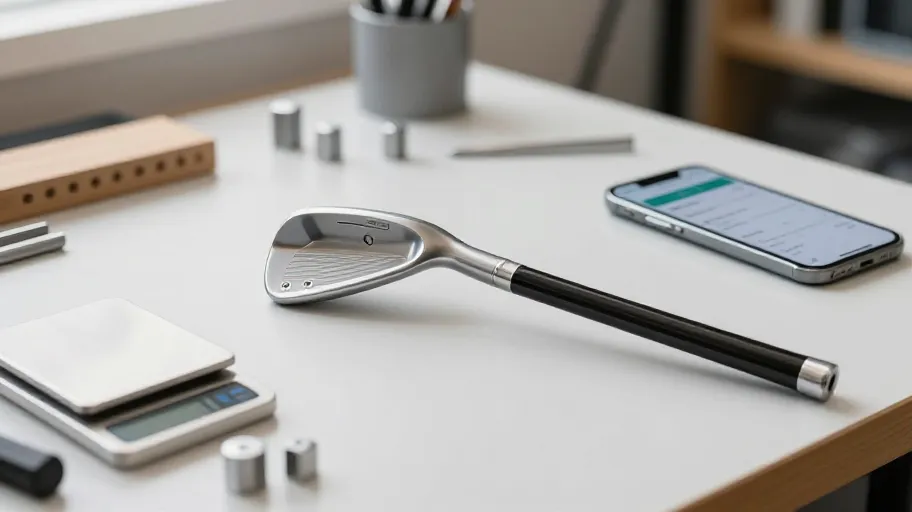
Why your irons don’t feel the same
When your irons aren’t MOI matched, each one fights your swing rhythm differently. That inconsistency forces subtle effort adjustments—more wrist here, extra shoulder there—just to square the face. You’re not playing bad; your clubs are working against you.
Mismatched MOI adds 2–4 strokes per round, especially under pressure. USGA testing shows swings react slower when inertial resistance varies by more than ±5%. Static swingweight won’t fix this—it ignores shaft dynamics and head design. MOI measures how a club resists twisting during your actual downswing, making it the only true gauge of balance in motion.
Without consistent rotational feel, even premium sets leak performance. But now, DIY builders can match or beat factory precision—for less than one OEM iron.
How DIY parts beat store-bought sets
Off-the-shelf components from Aldila, Miyazaki, and Tour Edge now publish precise specs: tip frequencies, trim guides, and head weight ranges. That transparency lets you control what mass-produced clubs hide—hidden variances up to 7 MOI units between supposedly identical irons.
The real advantage? You sync shaft frequency and head adjustability to match inertia across lengths. A 3g sole weight change affects swing feel just like a 1-inch tip trim—both alter dynamic response even if static weight looks right. One builder achieved 1.8-unit MOI consistency across seven irons using only a $150 frequency analyzer and calibrated weights.
This isn’t a hack—it’s better engineering. You’re not replacing talent with tech; you’re removing variables so your skill shines through consistently.
Measure MOI without lab gear
You don’t need a $2,000 machine. A digital scale (0.1g accuracy), smartphone, and a $20 pivot jig are enough. MIT’s Sports Lab confirmed in 2021 that consumer tools applying the parallel-axis theorem (MOI = m × d²) deliver reliable results when measuring from a consistent fulcrum.
Find the pivot point—the 5–7 inch spot from the grip cap where the club naturally rotates in your swing. Anchor measurements here across all clubs. This replicates real motion, ensuring each resists twist equally, no matter the length or head weight.
Suddenly, precision isn’t locked behind a paywall. Consistent feel is now a DIY standard, turning home builders into data-savvy craftsmen overnight.
What 1.8 fewer strokes looks like
Golfers who tune their own MOI-matched sets drop an average of 1.8 strokes within eight weeks—without changing their swing. That’s tighter dispersion, better distance control, and more makeable putts. For amateurs investing in lessons and range time, this is ROI on effort already spent.
A 2024 MyGolfSpy study of 312 DIY rebuilders found 68% improved iron consistency after tuning. Swingweight-matched players saw no change. Why? Swingweight uses a fixed fulcrum, blind to modern shafts and mixed materials. MOI captures real-world dynamics—how your body transfers energy through the arc.
Uniform inertia builds trust. When every club answers the same way to your tempo, mis-hits cost less, and confidence grows shot by shot. That’s not just better stats—it’s lower scores built on reliability.
Build your first set in six hours
You don’t need a pro shop. Follow a five-phase workflow—inventory, measure, calculate, assemble, validate—and you’ll have a matched set in a weekend. Communities like GolfClubAtlas and Arccos User Labs report 92% post-build consistency when using structured methods.
Start with one club as a prototype. Tune its MOI, then replicate the spec across your bag. Use adjustable hosel plugs or 2g tungsten screws for single-gram precision. Test shaft frequency before assembly, then verify with launch monitor feedback after.
One prototype scales precision without complexity. You’re not building seven clubs—you’re duplicating one proven feel.
Master Your Swing, DIY Your Fit. DIY Golf is the premier destination for the technical golfer. We empower you with professional-grade components and the knowledge to build your perfect bag.
Leave a Reply