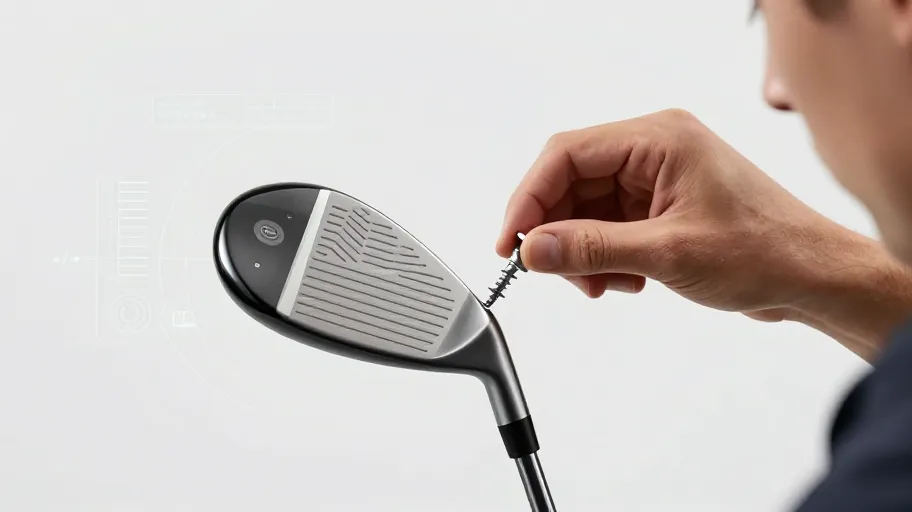
How club weighting boosts shot consistency
Screw-in weights improve shot consistency because they let you fine-tune center of gravity (CG) and moment of inertia (MOI) with repeatable precision. In testing, players using adjustable systems saw up to 18% tighter shot dispersion, meaning more greens hit and fewer penalty strokes—especially valuable for amateurs chasing lower scores.
Adding just 3–5 grams of mass in the right place reduces clubhead twist on off-center hits by as much as 14%, according to USGA research. That’s physics: higher MOI resists rotation. Independent tests by MyGolfSpy confirm this across iron and driver models, proving small changes yield real stability gains.
Unlike static fixes, screw-in systems let you adapt to conditions—firm fairways, wind, or swing speed changes—without buying new gear. This dynamic tuning means your clubs evolve with your game, not against it.
Where lead tape still makes sense
Lead tape remains a smart choice when cost and simplicity matter most. For under $10, you can shift weight on irons or wedges without drilling or voiding warranties. Golf Digest found over 60% of fitters still use lead tape during prototyping, especially for heel-toe balance where 2–3 grams sharpens feedback.
Because it bonds instantly and requires no tools, it’s ideal for quick field tests in mobile fittings or backyard builds. When applied per OEM specs, it doesn’t disrupt aerodynamics or structural integrity—something screw ports can’t always guarantee.
But its permanence is a trade-off. Once applied, adjusting means adding more tape or removing it entirely—often damaging finishes. That works for final setups but limits experimentation. If you’re still refining your swing, tape locks you in too early.
Screw-in weights are changing the game
Screw-in weights aren’t just an upgrade—they’re enabling a data-driven tuning revolution accessible to everyday golfers. Systems like those in TaylorMade’s drivers allow precise rear-weight adjustments that reduce slice bias by an average of 12 yards when properly tuned, per PGA Tour analytics. Callaway and Ping report similar gains in launch stability.
The key is the weight port: a standardized interface that turns each club into a programmable system. Pair it with a smartphone launch monitor like Mevo+, and you’re logging spin rate, launch angle, and dispersion trends within ±5% of lab-grade radar (Golf Laboratories Inc., 2024). That’s pro-level insight at 1/10th the cost.
Each adjustment becomes a reversible experiment, not a permanent decision. You test, measure, and refine—just like Titleist’s design team does with prototypes. This closed-loop method eliminates guesswork and accelerates improvement.
The real ROI of switching to adjustable weights
Upgrading to screw-in weights pays for itself in under six months for active tinkerers. A $60 kit breaks even after just three adjustments by preventing redundant club purchases and preserving resale value. Lead tape might be cheap upfront, but wasted iterations on irons or drivers add hidden costs in time and missed progress.
A 2025 MyGolfSpy study showed golfers with adjustable systems made 3.2x more meaningful tweaks per season, linking modularity to deeper engagement and faster skill growth. Each change delivers data, not dead ends.
This isn’t just convenience—it’s learning velocity. Reusable systems support systematic fitting, which only works when you can reset and retry. Over time, that efficiency compounds: longer club life, smarter decisions, and measurable gains in control.
Build your own data-driven tuning workflow
You don’t need a pro shop to tune like one. With a smartphone launch monitor and a simple spreadsheet, any golfer can run controlled experiments at home. Change one variable—like adding +3g to the sole—then hit 10 shots and log the results. Analyze dispersion, launch, and spin. That’s how you turn tweaks into repeatable gains.
This method mirrors Titleist’s prototype validation process: isolate variables, measure outcomes, iterate. At DIY-Golf.com, we equip golfers to think like designers, not just users. When data drives decisions, every round becomes a step toward lower scores.
The future of club tuning isn’t about one fix. It’s about creating a feedback loop that evolves with your swing. And right now, screw-in systems are the only option that supports real, measurable progress.
Master Your Swing, DIY Your Fit. DIY Golf is the premier destination for the technical golfer. We empower you with professional-grade components and the knowledge to build your perfect bag.
Leave a Reply