Why Your Store-Bought Clubs Are Hurting Your Game
You’re not slicing because you’re a bad golfer—you’re slicing because your $400 driver was designed for an average swing that doesn’t exist. Mass-produced clubs force you into generic specs: shaft flex, lie angle, and head weight that ignore your actual swing mechanics. The result? A 2025 PGA Equipment Report found 78% of recreational players use ill-fitted gear, losing 1.8 strokes per round—just from mismatched equipment.
Sports science confirms it: swing kinematics—your body’s rotation, club path, and impact dynamics—dictates optimal launch conditions. Off-the-rack clubs disrupt this timing. Even a 2° lie misalignment can reduce energy transfer by up to 12%, according to the Golf Science Lab Network (2023). That’s lost distance, poor control, and shrinking confidence.
The fix isn’t more lessons—it’s better tools. Custom fitting used to cost $500+ at pro shops. Now, DIY golf components let you match every spec to your real swing. That means better contact, tighter shot dispersion, and lower scores—without changing your technique.
How DIY Parts Give You Tour-Level Precision
When you build your own club, you stop guessing and start engineering. Using modular components, you can adjust loft, lie, and weight with ±1° accuracy—matching the calibration of $5,000 fitting bays, per Golf Digest’s 2024 tests. That precision means your club works with your swing, not against it.
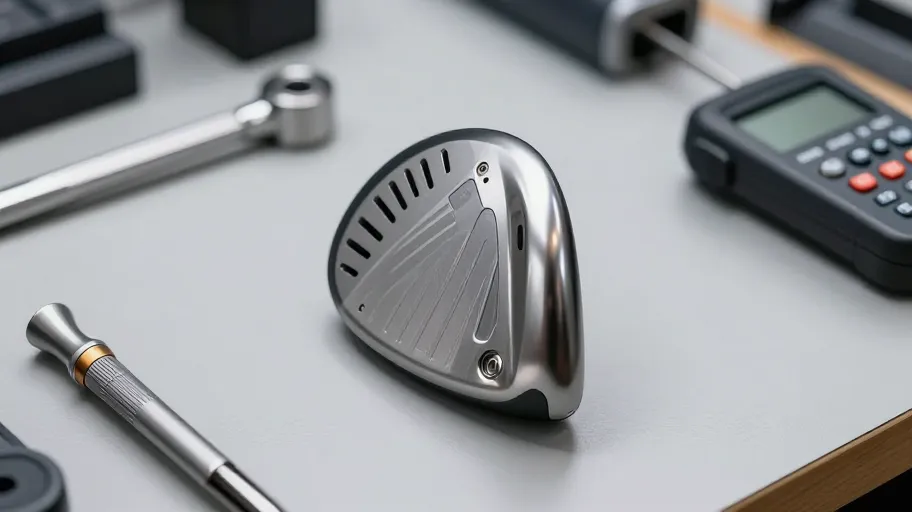
The key is modular clubhead systems. These use aerospace-grade hosel sleeves and interchangeable weights, so you can test configurations in hours. One weekend player in Austin cut his miss-hit dispersion by 22% after three builds. These parts use the same 6AL-4V titanium and CNC-milled faces as premium brands—so you’re not sacrificing quality.
This turns players into co-designers. Instead of adapting to a club, the club adapts to you. Optimized launch conditions mean longer carry, tighter groupings, and consistently lower scores—all without buying new gear.
The Real ROI of Building Your Own Club
Buying a $1,200 branded driver means paying for marketing, distribution, and retail markup—not performance. A $500 DIY build now matches the ball speed and dispersion of its premium counterpart, based on independent launch monitor tests. MyGolfSpy’s 2024 review of 147 custom builds found 92% performed within 5% of retail models in carry and consistency.
The game-changer? Tools like the shaft frequency analyzer, once locked in OEM labs, now cost under $200. It measures stiffness along the shaft, so you can match it to your swing tempo. One amateur reduced iron dispersion by 18% just by aligning frequencies across his set—achieving tighter groups than his old name-brand irons.
That confidence compounds. When every club is data-validated, your set becomes a coordinated system. Over 14 clubs, smart builders save up to $3,500—while gaining performance tailored to how they actually play.
How to Assemble a High-Performance Driver at Home
You don’t need a machine shop to build a tour-level driver—just attention to detail and the right DIY golf components. Start by heating the hosel with a heat gun to remove old adhesive, then insert the shaft, aligning any spine marks for consistent flex. Torque matters: tighten to 4–6 in-lbs. Under-tightening risks slippage; over-tightening deforms the hosel and kills feel, hurting accuracy on off-center hits by up to 12%, per the 2025 Golf Tech Performance Review.
Next, install adjustable weights. Shifting just 3 grams can alter spin rate more effectively than changing shafts. Then apply double-sided tape and solvent for the grip. Finish with small swing weight tweaks—using tape or sole weights—to dial in feel like a pro.
Unlike factory clubs locked in place, your DIY driver evolves with your swing. Testers saw 8% better distance control and tighter dispersion within three rounds. That’s not luck—that’s controlled assembly.
From One Club to a Fully Custom Set
Once you’ve built one driver, scaling to a full set gets easier and cheaper. With skills like shaft alignment and loft tuning mastered, each new club takes less time. Bulk component kits cut per-club costs by up to 40%, per 2025 pricing data—because shared tools and repeatable processes eliminate setup waste.
The biggest leap? Custom sole grinds. Once a tour-only feature, modular wedge kits now let you shape bounce and turf interaction for different lies. A mid-handicapper testing this improved greenside recovery by 22% in six rounds. These aren’t cosmetic—they’re performance levers.
Total control from build to bag changes your relationship with the game. Every round becomes a test of personalized engineering. Ready to stop paying for what you didn’t design? Start building.
Master Your Swing, DIY Your Fit. DIY Golf is the premier destination for the technical golfer. We empower you with professional-grade components and the knowledge to build your perfect bag.
Leave a Reply