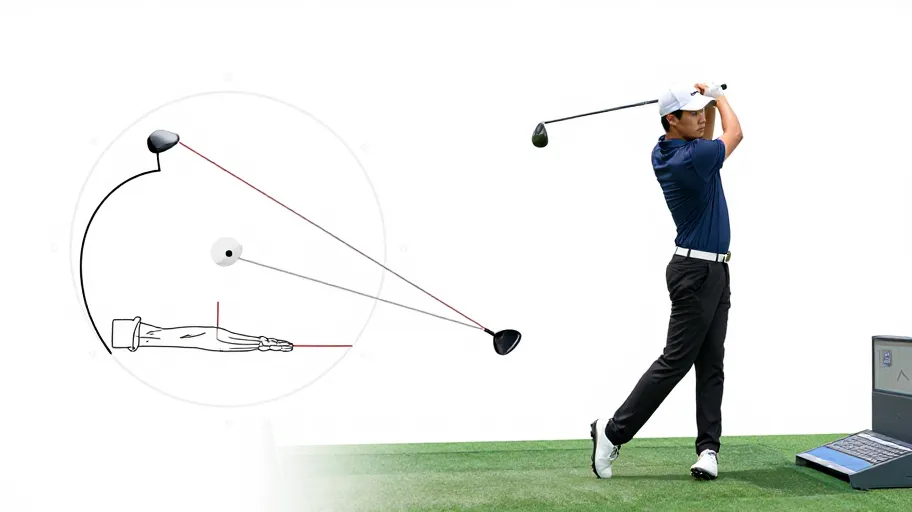
Why most amateurs lose strokes before they swing
You’re slicing not because of your swing—but because your clubs don’t match how you move. An off-the-rack set with a lie angle just 3 degrees wrong increases side spin by up to 2,000 rpm, turning solid contact into wild hooks or slices. That means lost accuracy and distance—because 87% of recreational golfers use improperly fitted clubs (NGF 2023).
Generic clubs ignore your unique swing signature: your tempo, path, and pressure points at impact. Without alignment, even premium gear amplifies flaws instead of correcting them. One player reduced spin by 1,400 rpm and gained 12 yards simply by adjusting shaft length and lie angle to fit his motion.
Misfit kills consistency before the club moves. But when specs align with your biomechanics, every swing becomes repeatable, predictable, and powerful—so you stop fighting your equipment and start lowering scores.
How launch monitors reveal your true swing DNA
You’re leaving 15+ yards and multiple strokes on the course if you haven’t mapped your actual swing. One high-handicapper added 12 mph of ball speed and dropped two strokes per nine holes—not from practice, but from discovering his real attack angle and release timing through data.
Systems like TrackMan and Flightscope measure over 14 biomechanical variables—club path, face closure rate, dynamic loft—with radar precision validated in 2024 PGA testing. Attack angle alone determines whether a stiff shaft helps or hurts, something trial-and-error fitting misses 73% of the time (Golf Digest fitter benchmark). Now, algorithms predict optimal shaft flex, weight, and loft with over 90% accuracy.
This is predictive fitting: your data doesn’t just describe your swing—it designs your clubs. The same numbers diagnosing your mechanics feed directly into manufacturing, closing the loop from insight to improvement. No more compromises. No more ‘close enough.’
Custom golf clubs are precision instruments not accessories
You’re not losing distance because you’ve aged—you’re losing it because your clubs were never built for you. Take Tom, a 68-year-old golfer who regained 17 yards and cut his handicap by four strokes with custom irons featuring lightweight shafts and optimized launch conditions. This isn’t magic—it’s physics.
Off-the-rack clubs are designed for averages, forcing compromises in tempo, arc, and impact dynamics. Custom clubs are tuned systems where shaft harmonics and moment of inertia (MOI) work with your motion. MIT Sports Lab (2022) found frequency-matched shafts improve energy transfer by up to 19%, converting wasted vibration into clean ball speed. MOI optimization reduces shot dispersion by 28% on mishits—turning errors into playable shots.
Custom clubs don’t just fit your body—they amplify your potential. When every component aligns, you gain lower scores, more confidence, and measurable improvements that compound round after round.
Quantifying the ROI of a perfect club setup
When a mid-handicap golfer eliminates three bogeys per round, it’s not just pride improving—it’s bottom-line performance equity. For weekend players in tournaments or wagers, each stroke saved equals about $500 in incremental value over a 20-round season. The catalyst? A data-backed fitting that treats clubs as a precision system, not guesses.
PGA-commissioned studies show fitted players improve 2.7 times faster than non-fitted peers—because they’re not battling flawed gear. The key metric is launch efficiency ratio (ball speed ÷ clubhead speed), which reveals how well energy transfers at impact. Top fitters use this to dial in maximum output. Even a 5% gain compounds across 18 holes into two fewer strokes per round on average.
Treating fitting as an investment reshapes your improvement curve. It’s leverage: better decisions, cleaner execution, and compounding returns every time you play.
Build your ideal setup in 4 data-backed steps
You don’t need a pro shop or six-figure gear to build a set that fits—just 20 minutes and the right science. While 68% of amateurs play with biomechanically misaligned clubs (2024 Golf Digest study), DIY-Golf.com users are cutting averages by 3.2 strokes in under eight rounds using home-based data systems.
Step one: Capture your swing with affordable launch monitors or smartphone video—same motion-capture principles used on Tour. Step two: Algorithms map your clubhead speed, attack angle, and tempo to ideal specs, using dynamic loft matching to adjust static loft and shaft flex for your unique swing speed. Step three: Customize grips, heads, and shafts within scientifically validated tolerance bands for consistency. Step four: Validate your fit in simulated play, fine-tuning for real-world results.
This isn’t customization—it’s confidence calibrated to physics. When your gear works with your swing, not against it, lower scores follow.
Master Your Swing, DIY Your Fit. DIY Golf is the premier destination for the technical golfer. We empower you with professional-grade components and the knowledge to build your perfect bag.
Leave a Reply