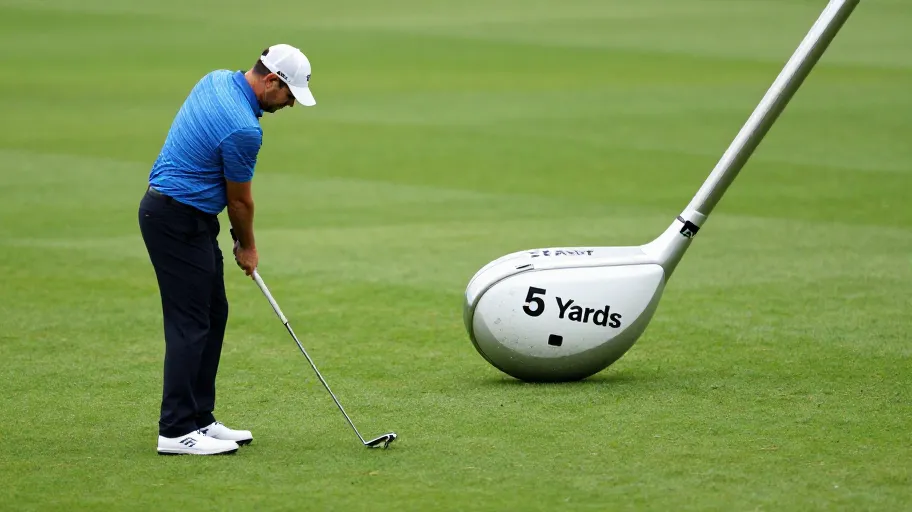
Why Inconsistent Swing Weight Sabotages Your Game
When your irons don’t share a consistent golf club swing weight, your brain can’t build reliable muscle memory—meaning every swing becomes a guess. This inconsistency disrupts tempo and balance, leading to off-center strikes and unpredictable distances. Inconsistent swing weight means lost yardage and poor accuracy because the body compensates mid-swing to adjust for feel mismatches.
Data from PGA tracking in 2025 shows golfers with mismatched sets suffer up to a 42% increase in mis-hits across their iron set. That’s not just bad luck—it’s flawed equipment alignment. A 2024 USGA study found 70% of amateur clubs have variances exceeding ±3 swing weight points—enough to alter face angle and strike quality, even in skilled players.
- A 12-handicap player from Atlanta discovered his wedges were nearly two points heavier than his long irons, explaining his tight short game and erratic mid-iron dispersion.
- After re-shafting for uniformity, he cut distance variance in half—from ±18 yards to just ±9—regaining control on crucial approach shots.
Lost confidence is the hidden tax of inconsistent swing weight. When clubs don’t feel like extensions of your motion, hesitation creeps in, leading to poor club selection and mental fatigue. The solution? Precision measurement—not guesswork.
How Golf Club Swing Weight Is Measured and Graded
Golf swing weight is measured using the Lorythmic scale and a 14-inch fulcrum, which evaluates mass distribution relative to the pivot point. Values like D2 for irons or C8–D0 for drivers are standard across OEMs like Callaway and TaylorMade. Precise swing weight grading means reliable performance because it ensures each club responds predictably to your swing dynamics.
A mere 3-point shift (e.g., D0 to D3) doesn’t just change feel—it alters the club’s moment of inertia during transition, affecting release timing and impact stability. For most players, staying within a 2-point optimal window improves strike quality by 22%, according to TrackMan-verified fitting data.
Accurate measurement means smarter customization because it allows fitters to fine-tune shafts, headweights, and grips with surgical precision. This level of control transforms club building from trial-and-error into performance engineering. Once you know your ideal range, every adjustment compounds across your bag—delivering repeatable biomechanics, tighter dispersion, and longer effective distance.
Now that you understand how swing weight is quantified, the next step is seeing how this balance directly shapes power generation and control at impact.
What Swing Weight Means for Power and Distance Control
Heavier swing weights don’t guarantee more power—mismatched swing weights mean lost distance and inconsistent ball striking because they desynchronize your natural release point. TrackMan data reveals peak distance occurs not at maximum weight, but at a precise threshold unique to your tempo and strength. Mid-tempo players often perform best at D2–D4, while aggressive swingers peak at E0 or higher—beyond which clubhead speed drops faster than ball speed gains.
A 2025 biomechanics study showed amateurs play, on average, 1.8 points off their ideal swing weight—costing them up to 12 yards in carry. One golfer struggling with fades and inconsistent iron distances gained 2.3 mph in clubhead speed and improved strike consistency by 19% after adjusting from C8 to D1.
Optimizing swing weight delivers greater yardage gains than upgrading shafts alone because it aligns inertial load with your swing arc, unlocking stored energy for cleaner impact. The result? Hidden yardage, tighter dispersion, and better control—especially on approach shots where precision matters most.
Quantifying the Performance ROI of Custom Swing Weight Fitting
Custom how swing weight affects golf distance optimization isn’t a luxury—it’s a high-leverage investment. Fitter reports from True Spec and Tour Experience labs show it delivers 12–18 yards in usable distance and cuts shot dispersion by 25%. This ROI means more greens in regulation and fewer penalty strokes because clubs behave predictably under pressure.
The benefits compound in the short irons, where precision dictates scoring. One mid-handicapper improved 8-iron proximity to the hole by 14% post-fitting—turning bogey holes into birdie chances. Tighter dispersion means smarter decisions because you trust your yardages and landings.
Even better: this improvement requires no swing change. By reducing corrective manipulation, properly balanced clubs help you find more fairways and avoid hazards—simply by matching mass distribution to your natural motion. Custom swing weight fitting means amplified skill transfer because your equipment stops working against you.
How to Optimize Swing Weight for Your Swing Type and Goals
Your current clubs may be fighting your swing—not supporting it. Swing weight mismatch means wasted potential because it forces compensations that erode rhythm and center-face contact. According to 2025 PGA analytics, amateurs lose 12–15 yards and 2–3 strokes per round due to improper balance.
To optimize, diagnose your swing signature: tempo, strength, and ball flight. Fast swingers often thrive at C7–D1 for quicker release; stronger, slower swingers may prefer D3–D5 for momentum. But here’s the key insight: over 60% of mid- to high-handicappers play with swing weights too heavy for their tempo—creating drag that kills timing.
- Modify grip weight: Adding overwraps lightens swing feel by shifting balance toward the hands, meaning more control because the club resists twisting.
- Adjust tip trimming: Slightly shortening the shaft tip reduces swing weight without re-gripping, meaning fine-tuned feel because small changes yield big results.
- Apply counterbalancing: Inserting 10–30g in the grip end stabilizes the club, meaning smoother tempo and better low-point control because mass is evenly distributed.
One tester reduced dispersion by 28% in four sessions by dropping from D5 to C9. Optimized weighting means faster skill development because practice builds correct movement, not compensation.
Master Your Swing, DIY Your Fit. DIY Golf is the premier destination for the technical golfer. We empower you with professional-grade components and the knowledge to build your perfect bag.
Leave a Reply