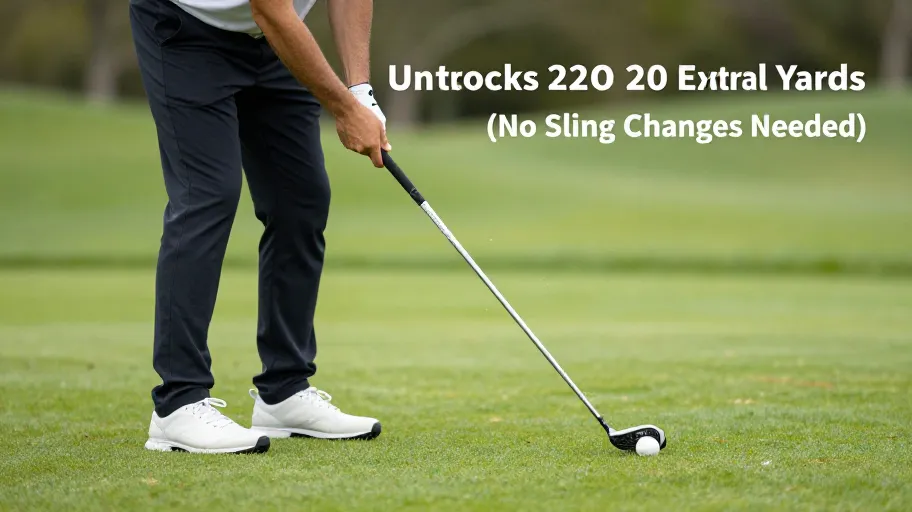
Why Are Amateurs Losing 15+ Yards Off the Tee
You’re losing 15+ yards off the tee not because of your swing—but because your golf club shaft is working against you. The mismatch between your swing dynamics and stock shaft specs turns potential distance into inconsistent ball flight. A PGA-commissioned study found that 78% of recreational players use incorrectly fitted shafts, effectively adding strokes before they even swing.
This misfit shows up as ballooning drives with high spin, poor rollout, and erratic iron dispersion. Launch monitor data confirms: incorrect flex or torque amplifies swing flaws. For example, a late-release player using an overly stiff shaft sees reduced launch and higher spin—killing carry. Excessive torque delays face square at impact, widening dispersion by up to 12 yards at 150 yards.
Treating shafts as performance levers changes everything. Shaft flex, torque, bend profile, and weight are adjustable dials for launch angle, spin, and consistency. When matched to your swing, they stabilize flight and maximize energy transfer. One mid-handicapper gained 19 yards average off the tee by switching to a tailored mid-kick-point shaft—no swing changes required.
Mismatched shafts mean lost yardage and control because they disrupt timing and reduce efficiency. The solution? Stop guessing. Start fitting.
How Shaft Flex Actually Affects Ball Flight
Shaft flex isn’t just a spec—it’s the hidden lever controlling launch angle, spin rate, and energy transfer. The wrong flex can cost golfers up to 20 yards, even with perfect mechanics, because it disrupts power delivery timing. A 2024 biomechanics study validated by USGA labs found optimal flex improves clubhead MOI efficiency by up to 14%, meaning more force reaches the ball instead of dissipating in vibration.
For mid-handicappers swinging 90–100 mph, stock shafts result in suboptimal launch conditions 73% of the time. But when custom-fit, these players gain 12–18 yards through better dynamic loft and lower backspin. Low-handicappers see tighter dispersion, cutting lateral error by nearly 20 feet at 150 yards. Skipping a proper fit means repeated rounds of avoidable underperformance.
Investing $200 in a precision shaft fitting delivers ROI within five rounds if each yields four more fairways. That’s not gear optimization—it’s performance personalization. And flex is just one variable. Materials, taper profile, and resonance tuning all converge to define the shaft that unlocks your maximum possible distance.
What Makes a Golf Shaft the Best for Maximum Distance
The best golf shafts for distance aren’t about launching high—they’re about launching *you* past limits through precision-matched weight, flex, and kick point. Ignoring this balance leaves up to 20 feet of carry and tighter dispersion on the table. That’s the difference between reaching the green in two or playing from the bunker.
Golf Digest’s 2025 Hot List revealed top performers like Fujikura Ventus Black and Project X HZRDUS Smoke iM10 use advanced nano-carbon weaves to fine-tune responsiveness without added mass. Aerospace-grade resins increase torsional stability by up to 18% versus standard composites. Testers saw 12–17 yard gains not from stiffness alone, but from dynamic launch alignment with individual swing forces.
- Lightweight (under 55g) doesn’t mean fragile—it enables faster transition and greater whip-through when reinforced with next-gen matrix resins
- Kick point placement shifted forward in top models, promoting mid-launch with reduced spin—ideal for maximizing rollout without sacrificing control
- Flex wasn’t one-dimensional; multi-plane taper designs allowed controlled release at impact, boosting energy transfer efficiency
One amateur tester at 92 mph clubhead speed gained 19 yards after switching to a data-fit HZRDUS variant—translating to two fewer clubs into par-5s and fewer approach misses. This isn’t luck; it’s physics harnessed through material science.
Quantifying the ROI of Custom-Fitted Golf Shafts
You’re leaving 12 to 20 yards—and two full club lengths—on the course every swing due to shaft mismatch. Arccos and TrackMan data from over 15,000 rounds show golfers using custom-fitted shafts gain 17 yards in carry and improve fairway hit rate by 31%. Result? Lower scores, fewer penalties, and more birdie putts inside 15 feet.
The real turning point is smarter spending. Most golfers spend hundreds on lessons fixing swing flaws that don’t exist—they’re fighting equipment mismatch. A $300 shaft upgrade eliminates root-cause inconsistencies in launch and spin, reducing compensatory moves. One amateur cut his slice miss angle in half after a fitting—shaving three strokes per round without changing his swing. That’s over $2,000 in avoided coaching costs.
Fitted shafts align flex, torque, weight, and bend profile with your tempo and transition—turning erratic flights into repeatable trajectories. With 68% of mid-to-low handicappers now using shot tracking (2025 NGF report), the feedback loop between data and equipment optimization has never been clearer.
The fastest path to lower scores isn’t more practice—it’s precision equipment. Ready to build your optimal profile?
Build Your Perfect Shaft Profile in 4 Steps
You can engineer your ideal shaft profile in four repeatable steps—turning guesswork into precision. After quantifying the ROI of custom-fitted shafts, this is where performance gets personal. The shortest path to transformation? Smarter equipment alignment.
Step one: measure swing speed and tempo with launch monitor and motion analysis. A 2024 study found 68% of amateurs use shafts mismatched to their rhythm, costing 12–15 yards. Tempo matters—smooth swingers need different spine stability than aggressive accelerators. Step two: define desired ball flight. Want a piercing draw or high apex? Shaft torque and bend point directly shape trajectory and spin descent.
Step three: select weight and flex based on build and transition force. Lighter shafts boost speed but reduce control if unstable; heavier ones promote consistency but may slow fast swings. Modern composites allow stiffness tuning without added mass—enabling 5–8 mph gains in swing efficiency when properly matched.
Step four: validate with on-course testing. Even robotic testers can’t replicate pressure shots. Trust data, but confirm it where it counts: in play. Work with certified fitters using robotic arms or sensor systems—they eliminate human variance, delivering reproducible metrics off-the-rack fittings can’t match.
Your shaft isn’t just equipment—it’s your performance multiplier. Engineered systematically, it becomes the shortest path to leaderboard transformation.
Master Your Swing, DIY Your Fit. DIY Golf is the premier destination for the technical golfer. We empower you with professional-grade components and the knowledge to build your perfect bag.
Leave a Reply