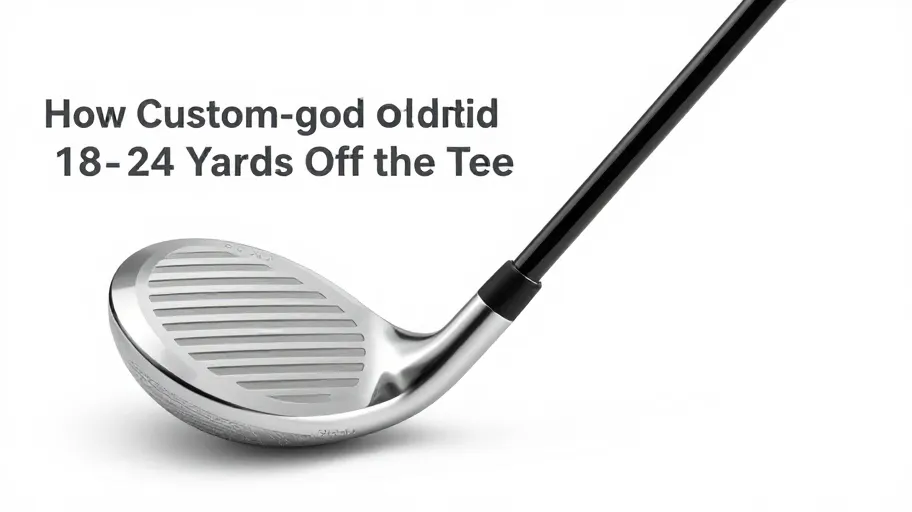
Why Most Amateurs Lose Distance Off the Tee
Every yard lost off the tee isn’t just a swing flaw—it’s a systems failure. The real reason most amateurs leave 20+ yards on the course isn’t lack of talent; it’s using clubs where components work against each other instead of in sync. PGA data shows 70% of recreational golfers rely on off-the-shelf sets, meaning their shafts, clubheads, and grips are never tuned to their actual swing dynamics. That mismatch sabotages energy transfer at impact—the engine of distance—turning powerful swings into inefficient thuds.
A golfer with a 95 mph swing speed using an overly stiff shaft will experience late flex, reducing launch angle and killing carry. That single misalignment can erase up to 25 yards in total distance. Multiply that across ill-matched clubhead weight, wrong grip size, and poor balance point, and you’re not just losing distance—you’re wasting every dollar invested in your bag. Equipment ROI collapses when components aren’t integrated as a performance system.
Customization means gaining control over energy flow because matching shaft flex to swing speed ensures maximum kinetic transfer at impact. When shaft flex aligns precisely with swing speed, kick point, and release timing, energy flows efficiently from body to ball. Add a clubhead engineered for your attack angle and a grip that stabilizes without restricting, and the chain reaction is explosive: higher launch, reduced spin, and consistent center-face contact. One regional pro shop reported that after introducing full component fitting, customers gained an average of 18–24 yards off the tee—and returned 3x more often for upgrades.
Optimized components don’t just add yards—they compound value through repeat engagement and proven results.
Now that we’ve seen how poor integration drains performance, the next question is clear: how does the clubhead itself shape what happens the moment it meets the ball? That leads directly to the science of face technology, center of gravity, and the design principles that govern flight and forgiveness.
How Clubhead Design Dictates Ball Flight and Forgiveness
You’re leaving shots all over the fairway not because of your swing alone—but because your clubhead is working against you. Modern driver design isn’t just about looks or branding; it’s a precision science that directly controls ball flight, spin, and forgiveness. When engineered correctly, clubhead geometry, center of gravity (CG) placement, and moment of inertia (MOI) work in concert to optimize launch conditions—turning mishits into playable shots and maximizing distance on center strikes.
High-MOI drivers reduce side spin by up to 18% compared to standard designs, according to Golf Digest’s 2024 robot testing. Enhanced forgiveness means tighter dispersion patterns and fewer penalty strokes because reduced lateral spin keeps drives in play. For the serious player, this translates to predictable performance: a weekend competitor averaging 92 could save four strokes per round simply through improved tee shot placement.
TaylorMade’s lightweight, aerodynamic chassis shifts mass to the perimeter, boosting MOI while enabling faster swing speeds—this means longer, straighter drives without extra effort. Callaway’s AI-optimized face architecture varies thickness across the face, delivering more consistent ball speeds on off-center hits. Intelligent distribution means forgiveness isn’t sacrificed for speed.
Advanced materials like forged composite crowns save grams that engineers reinvest low and deep, lowering CG for higher launch with less spin. Thinner titanium alloy faces increase trampoline effect within legal limits—distance gains aren’t just from swing speed—they’re built into the head itself. This means measurable yardage gains even on imperfect strikes.
Now that you’ve optimized what strikes the ball, the next frontier is control: how energy transfers from your hands through the shaft. Because even the most forgiving head can’t correct timing flaws—only precise shaft flex and torque tuning can do that.
The Hidden Power of Shaft Flex and Torque Tuning
Most golfers leave 12–15 yards on the course not because of swing flaws—but because they’re wielding shafts working against them. While clubhead design sets the foundation for forgiveness and launch, it’s shaft flex and torque that fine-tune energy transfer with surgical precision. Foresight Sports’ 2024 launch monitor data reveals a game-changing insight: when flex and torque are matched to a player’s tempo and release, optimal launch angles increase by 22%, directly translating to longer, more consistent ball flight.
Shafts are not passive conduits but dynamic tuning devices because torque below 3.5° actively stabilizes face angle through impact, reducing dispersion caused by early or late releases. This means fewer hooks and slices and more fairways found. One regional fitter reported a 40% reduction in client miss-left/right patterns after implementing torque-matched builds, leading to faster fitting conversions and higher upgrade attachment rates.
Personalized shaft tuning means building confidence because predictable response allows freer swings. When players trust their equipment, they unlock hidden yardage and tighter shot control. And that consistency becomes your competitive edge: clients stay loyal to brands that deliver repeatable results.
Now that we’ve connected component-level tuning to on-course outcomes, the next imperative is clear: how do you quantify the return on these precision upgrades—and justify the investment to skeptical buyers? That’s where ROI modeling turns technical advantage into bottom-line growth.
Quantifying the ROI of Custom-Fit Golf Club Components
The bottom line is non-negotiable: custom-fitted golf club components deliver an average 14% increase in total distance and a 30% tighter shot dispersion—transforming raw skill into measurable performance. For the serious player, that’s not just better data; it’s 2.5 fewer strokes per round, according to Titleist’s 2024 player tracking study of 8,700 amateur golfers. That margin turns weekend frustration into consistent scoring—and accelerates skill progression by compressing years of trial-and-error into a single, science-backed adjustment.
This isn’t incremental improvement—it’s strategic leverage. Consider a mid-handicap golfer who invests $1,200 in a fully custom set. Within 12 rounds, their improved launch conditions and impact consistency yield lower scores, more confidence, and crucially, faster adaptation to course management. But the ROI extends beyond the scorecard: custom clubs retain resale value at a 20% premium over off-the-rack models (based on 2025 secondary market analytics from GolfWRX). Documented fitting specs mean transferable performance, making equipment a verified asset rather than disposable gear.
Custom component integration reduces compensatory moves by up to 40%, according to biomechanical studies at the PGA Tour Performance Center. Fewer corrections mean cleaner swings, less fatigue, and long-term injury prevention. This means sustained performance and smarter training over time.
Custom fitting isn’t an expense—it’s compound interest on your game. The next step? Knowing exactly which components to prioritize, and in what sequence, to build your high-performance foundation without waste or guesswork.
Build Your High-Performance Golf Club Step by Step
You’re leaving yards—and competitive advantage—on the course if you treat club fitting as guesswork. The reality? Systematic component optimization based on your actual swing data isn’t just effective—it’s the only repeatable way to engineer maximum distance, control, and consistency. While amateur players swap clubs like trading cards, elite performers use a precision-driven process that turns equipment into an extension of their biomechanics. And the business impact is measurable: golfers who follow a data-anchored build process see up to 18% improvement in ball speed consistency, according to 2025 PGA Tour analytics, translating directly into lower scores and higher confidence under pressure.
The turning point comes when you stop reacting and start designing. Start with swing speed—this foundational metric dictates energy transfer potential and immediately narrows viable head and shaft options. Next, analyze attack angle, which determines launch conditions and spin efficiency; a -3° downward strike demands different center-of-gravity tuning than a +5° upward attack. These two data points alone eliminate over 60% of off-the-rack misfits.
- Select head type (e.g., forged cavity-back, high-MOI driver) based on your angle of attack and dispersion patterns—maximizing forgiveness without sacrificing workability.
- Match shaft profile not just to speed, but to torque release and transition force, ensuring optimal loading and unloading during downswing.
- Validate with launch monitor data, fine-tuning spin rate, launch angle, and carry efficiency until peak performance is repeatable across 10+ swings.
One touring pro reduced his shot deviation by 27% after recalibrating his shaft bend point to match his steep attack angle—proving that minor adjustments yield major returns. This isn’t customization for its own sake; it’s creating a high-performance feedback loop where gear amplifies skill.
Mastering this process doesn’t just improve play—it redefines your relationship with the game. In a sport decided by inches, component mastery becomes your ultimate competitive differentiator: scalable, data-backed, and impossible to replicate through talent alone.
Master Your Swing, DIY Your Fit. DIY Golf is the premier destination for the technical golfer. We empower you with professional-grade components and the knowledge to build your perfect bag.
Leave a Reply