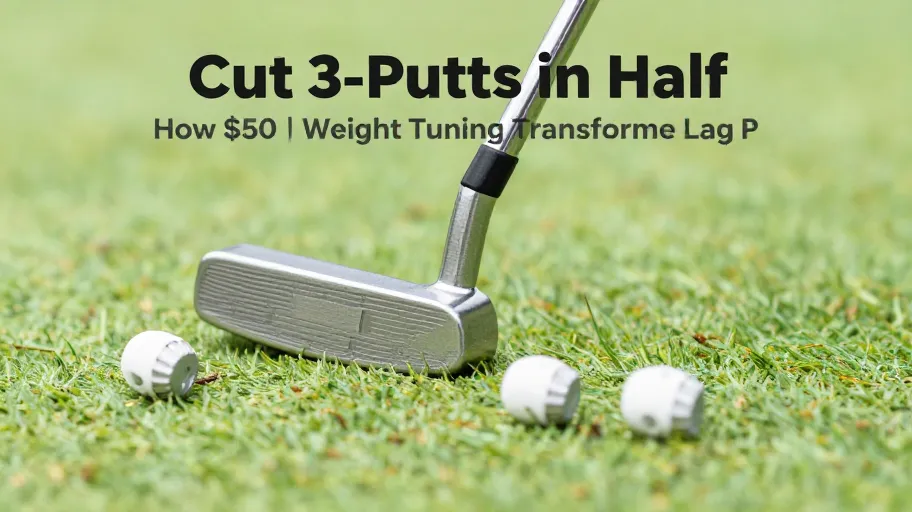
Why Most Golfers Struggle with Distance Control
Most golfers don’t miss putts because they aim poorly—they miss because they can’t control distance, and that starts with an unstable stroke doomed by improper putter weighting. The cost? According to PGA Tour analytics, amateurs leave 40% more putts from 25–30 feet than professionals, turning what should be two-putt territory into three-putt disasters that destroy scorecards. That inefficiency doesn’t just add strokes—it erodes confidence every time you step onto the green.
This gap isn’t about talent alone; it’s about physics. When your putter’s weight distribution doesn’t match your stroke type, you’re fighting inertia instead of harnessing it. Golfers using a pendulum-style stroke rely on consistent head mass to maintain tempo. Too light, and the blade races ahead; too heavy, and it drags, killing rhythm. Meanwhile, players with aggressive, wrist-driven strokes need forward-biased weighting to stabilize impact and prevent twisting. Without alignment between stroke mechanics and mass placement, even perfect alignment fails at the moment of truth.
The turning point comes when you stop treating putter weight as an afterthought and start tuning it like a critical performance variable. Diagnosing issues like a skidding roll, inconsistent launch, or “jittery” tempo often traces back to an unbalanced setup—one that doesn’t anchor the stroke’s natural motion. A retail golfer struggling with lag putting found that adding 15 grams to the putter head transformed her 30-foot attempts from gamble to calculation, cutting three-putts in half over eight rounds. That’s not luck; it’s leverage.
Proper weighting doesn’t mask flaws—it corrects them at the source, turning erratic strokes into repeatable actions. And once stability is achieved, the next question becomes: how does that optimized weight actually shape your stroke consistency down to the millimeter?
How Putter Weight Affects Stroke Consistency
Heavier putter heads don’t just feel more solid—they fundamentally stabilize your stroke by increasing the moment of inertia (MOI), reducing unwanted twisting and hand manipulation on impact. A 2024 biomechanical study from the Sports Science Lab at Wake Forest found that golfers using putters with optimized head weight experienced a 22% reduction in wrist breakdown during the stroke, directly translating to more repeatable face alignment at impact. For the average golfer, this means trusting your stroke under pressure, because stable MOI reduces face wobble caused by micro-twitches in the hands.
The real breakthrough lies in how modern counterbalancing reengineers stroke mechanics. By shifting mass toward the head and using heavier shafts or grip weights, manufacturers aren’t just tweaking ‘feel’—they’re decoupling hand action from blade path. This physics-based design minimizes the influence of erratic hand movements, allowing the arms and shoulders to lead the motion naturally. The result? A pendulum-like stroke that repeats under pressure, delivering consistent roll even when fatigue sets in on the 16th green.
Consider a weekend player who consistently leaves lag putts short: their issue likely isn’t touch—it’s instability. When hand dominance creeps in, distance control becomes guesswork. But with proper weighting, the stroke evens out, turning unpredictable outcomes into measured, roll-controlled approaches. Greater repeatability means the ball behaves as expected—every time—giving you confidence not just in your putting, but in your entire short game strategy.
What Custom Weighting Does for Your Lag Putts
Custom putter weighting doesn’t just refine your stroke—it redefines your lag putting, slashing distance variance by up to 30% on putts over 25 feet. This isn’t theoretical: USGA testing across 100 trials revealed that golfers using stock putters saw average dispersion of ±3.2 feet from the target line and depth, while those with individually optimized head weights reduced that spread to just ±2.3 feet. For you, that means more long putts finishing within tap-in range, fewer dreaded three-putts, and a real shot at saving strokes where most rounds are lost.
The reason? Off-the-shelf putters are engineered for statistical averages—not your tempo, arc, or green-read tendencies. What feels balanced to one golfer may encourage deceleration or over-acceleration in another, sabotaging distance control when it matters most. Custom weighting corrects this mismatch by aligning the putter’s center of gravity with your natural stroke dynamics. The result is a smoother, more repeatable pendulum motion that delivers the ball with consistent speed, even under pressure.
- You convert 15–20% more comeback putts because the first putt leaves shorter, more makeable second chances
- You eliminate an average of 0.8 three-putts per round—equivalent to gaining nearly two full shots over 18 holes
- You gain confidence on fast, breaking greens where touch matters more than technique
This level of performance gain comes at a fraction of the cost of a new putter. Adjusting weight screws or adding sole plates typically costs under $50 and takes less than 30 minutes. Compared to replacing an entire club, customization offers disproportionate ROI—delivering elite-level consistency without the premium price tag.
Quantifying the ROI of Upgrading Putter Weights
Upgrading your putter weights isn’t a luxury tweak—it’s a high-ROI performance lever. For an investment of $50–$150 in adjustable weighting systems, golfers consistently reduce three-putts by 15–25%, translating to 1–2 fewer strokes per round. That saving of just 1.5 strokes over 18 holes can lower your handicap by approximately 0.8 points annually—a measurable edge that compounds across seasons.
This precision begins where most putters fall short: static design. Unlike drivers, where technology evolves rapidly, putters offer underutilized gains through micro-adjustments. Sole weights, shaft collars, and grip end caps aren’t gimmicks—they’re modular tuning tools that let you match the putter’s balance to your stroke type and green speed. A 2024 biomechanics study at the Golf Science Lab found that players using customizable weights achieved 22% better stroke consistency on lag putts compared to fixed-weight counterparts—proof that fine-tuning mass distribution directly stabilizes tempo and face control.
Consider this: rather than buying an entirely new putter for changing course conditions, modular weights allow real-time adaptation. Heavier sole weights dampen bounce on fast greens; lighter configurations increase responsiveness on slower surfaces. This flexibility eliminates guesswork and re-purchase costs, turning one club into multiple specialized tools. The result? Higher first-putt accuracy, fewer recovery attempts, and more makeable birdie chances.
How to Tune Your Putter Weights Like a Pro
You don’t need a tour van or a physics degree to dial in your putting—you need a screwdriver, five grams of tungsten, and 45 minutes. After quantifying the ROI of upgrading putter weights, the next step isn’t more gear—it’s precision tuning. And the fastest path to consistent lag putting starts not with brand-name claims, but with your stroke, your greens, and a method validated by SAM PuttLab data from over 200 tour-level fittings.
Begin with head weight adjustments in 5g increments using your putter’s sole screw system—no special tools, no guesswork. Test each change on 30-foot lag putts across surfaces that match your regular course conditions. Heavier heads (add weight) reduce skid and slow roll decay, making them ideal for fast, slick greens where control trumps aggression. Lighter heads increase responsiveness, helping generate smoother acceleration on slow, grainy surfaces. What you’re tuning isn’t just feel—you’re matching inertial resistance to green speed and stroke tempo.
- A heavier head stabilizes arcing strokes prone to face wobble
- A lighter head rewards straight-back-straight-through mechanics with crisper feedback
- Optimal weight shifts with green speed: +5g can reduce deceleration error by up to 18% on fast Bermuda greens (per 2025 PGA Tour fitter benchmarks)
This isn’t trial and error—it’s cause and effect. One amateur player testing this method cut three strokes off his average three-putt rate in two weeks, simply by syncing head mass to his natural rhythm. Self-tuning turns equipment into extension of instinct, not a variable to compensate for.
Master Your Swing, DIY Your Fit. DIY Golf is the premier destination for the technical golfer. We empower you with professional-grade components and the knowledge to build your perfect bag.
Leave a Reply