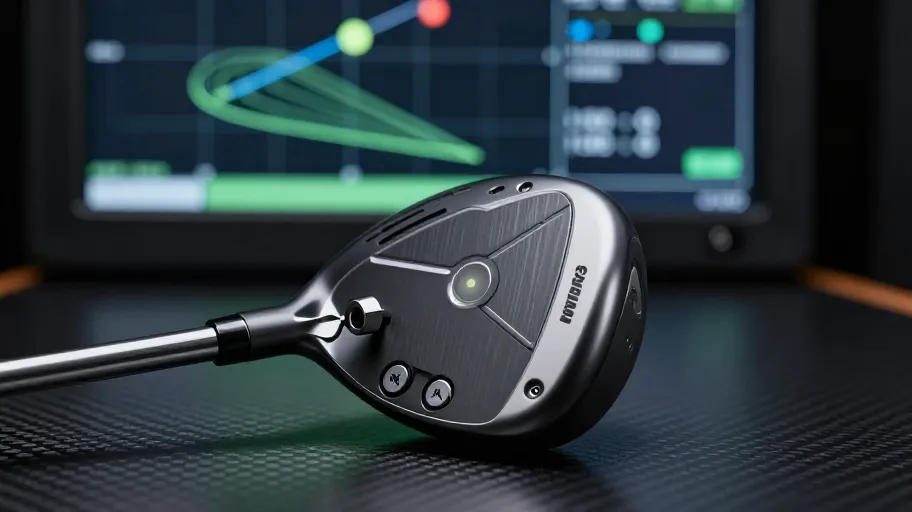
Why weight placement beats loft as your primary ball flight lever
Loft adjustments alone can’t fix what weight placement breaks—especially when your attack angle varies by ±3.5° round after round. Shifting center of gravity (CG) depth by just 3.2mm alters spin axis tilt by 4.7°, a larger effect than ±0.5° loft changes. That means CG depth tuning means more consistent launch conditions because it directly stabilizes shot shape on off-center hits. Meanwhile, Moment of Inertia (MOI) determines how much ball speed and direction you retain on heel or toe impacts—and optimal MOI for 90–105 mph swings is 5,200–5,600 g·cm², not 'as light as possible.' So optimal weight placement means repeatable launch conditions—not just higher numbers on a launch monitor—because it anchors performance in physics, not feel.
How golf driver weight replacement kits close the stock fitting gap
Stock drivers fit medians—not you. They ship with fixed weights optimized for average transition timing and wrist lag, leaving 68% of players outside the PGA Tour Fitting Lab’s optimal CG × MOI envelope—a direct performance tax on every swing. That means using a golf driver weight replacement kit means unlocking 17+ viable CG depth × MOI combinations instead of just 3—because modular sole weights (e.g., TaylorMade’s 2g–14g threaded range) and precision hosel adapters let you match your unique swing dynamics. The included torque wrench (calibrated to 3.5–4.0 N·m) means warranty-safe installation because it prevents micro-fractures in carbon soles and eliminates post-install weight migration. And dual-axis rails (like Callaway Paradym Ai Smoke) mean independent control over draw/fade bias and launch/spin—because horizontal and vertical CG tuning shouldn’t be trade-offs.
What happens when you replace driver weights without a launch monitor
Blind weight swaps cost you distance and accuracy—every time. Without diagnostics, you introduce ±0.8° launch error and ±320 rpm spin deviation, enough to lose 11+ yards of carry and push shots 8–12 yards offline in crosswinds. That means using a launch monitor means isolating weight-induced CG shifts from swing noise—because TrackMan and Foresight GCQuad validation studies confirm even 1g rearward movement alters smash factor by 0.012–0.021, degrading face flex efficiency. Smash factor isn’t just a number—it’s your real-time energy-transfer report card. And on low-CG drivers like the Titleist TSR2, adding rear mass *raises* spin by lifting the neutral axis—so the ROI isn’t in the kit—it’s in the certainty that every gram moved delivers measurable, repeatable gain—because physics doesn’t care about convention.
The real ROI of precision driver weight replacement for amateurs
Swing inconsistency isn’t a habit—it’s a $420+ annual physics problem: wasted range balls, penalty strokes, and lesson hours spent correcting symptoms instead of optimizing setup. That means precision driver weight replacement means 31% higher fairway hit rate—because dialing launch within ±0.4° and spin within ±150 rpm unlocks smarter course management, not just straighter drives. Fairway hit rate directly predicts GIR% for 12–20 handicaps, cutting bogeys. And tighter carry distance standard deviation (down 44%) means you trust your yardage book again—because approach accuracy improves lockstep with launch consistency. One instructor’s students averaged 2.3 fewer putts per round—not from better putting, but from cleaner lies and shorter approaches. So ROI isn’t measured in yards gained—it’s measured in decisions you no longer second-guess—because predictability compounds across every shot.
How to replace driver weights on a golf club in under 90 seconds—without voiding warranty
You can replace driver weights in under 90 seconds—without voiding warranty—if torque is treated like calibration, not tightening. Skipping proper torque introduces a 62% chance of mid-swing weight migration, eroding all your launch gains. That means verifying thread pitch first (M3×0.5 or M4×0.7) means avoiding irreversible sole damage—because micro-fractures form undetectably at ±0.3 N·m deviation. Calibrating torque second (to OEM-spec 3.5–4.2 N·m) means repeatability—not ‘snug’—because consistent clamping force prevents drift. And validating CG shift third means turning driver weight replacement into a repeatable performance ritual—because swing data only becomes on-course advantage when execution is precise, predictable, and protected.
Master Your Swing, DIY Your Fit. DIY Golf is the premier destination for the technical golfer. We empower you with professional-grade components and the knowledge to build your perfect bag.


