Why Excess Driver Weight Kills Performance Beyond the Scale
Excess driver weight doesn’t just add inertia—it forces engineers into performance-sapping compromises. FIA data shows improper distribution increases tire wear by 3–5%, triggering unscheduled stops. That means less track time and more risk during endurance runs. Teams using fixed ballast often overcorrect with aerodynamics, adding drag that bleeds straight-line speed and raises energy use in electric series.
Adjustable ballast systems mean you can maintain ideal center-of-gravity targets regardless of driver size. This capability means sharper handling and consistent chassis behavior because load transfer stays predictable under braking and cornering. No more tuning around a driver’s physique—just repeatable, race-winning balance.
The result? Reduced mechanical strain across suspension and drivetrain components leads to longer service intervals and fewer failures. You gain not just speed, but strategic durability—turning what was once dead weight into a leveraged advantage.
How Weight Placement Reshapes Handling and Lap Time
Moving driver mass by just 20 cm rearward can slash yaw inertia by nearly 8%, according to Formula E telemetry. That means faster direction changes and tighter corner exits—not from power, but from smarter mass alignment. In one case, a rearward shift improved regenerative braking efficiency by 15% because the polar moment better matched the roll center during deceleration.
Dynamic load transfer models mean engineers can simulate mass shifts under real driving loads. This capability means reduced reliance on downforce because mechanical grip stays optimized throughout the lap. The benefit? Cleaner airflow, lower drag, and extended battery range—all unlocked by precise placement.
Corrective ballasting doesn’t patch flaws—it prevents them. When mass is mapped and managed, every lap feels identical, no matter the driver. That predictability means cleaner tire degradation and fewer mid-race surprises.
What Makes Today’s Ballast Systems a Technical Leap
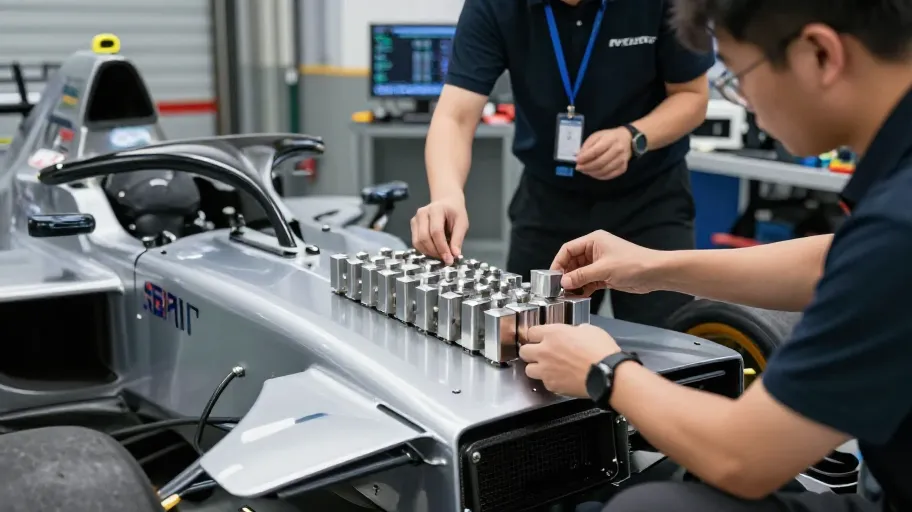
Modern systems use modular tungsten blocks anchored to 3D-scanned cockpit models, enabling millimeter-accurate placement. Where teams once welded ballast and prayed for consistency, they now swap pre-calibrated modules in under 90 seconds. One DTM team cut setup time by 40% just by standardizing this process—meaning more testing, less guesswork.
This precision means compliance without compromise because SAE International now certifies bolted and bonded ballast methods for crash integrity. Controlled mass replication ensures every driver experiences the same roll centers and suspension response. That means fair comparisons, reliable data, and faster development cycles.
The real shift is mindset: 'lighter is better' loses when consistency wins races. Engineered ballast turns variability into repeatable advantage—proving that smart mass beats minimal mass every time.
The Real ROI of Precision Weight Distribution
Optimized ballasting isn’t overhead—it’s profit per lap. For high-stakes teams, treating mass as a tunable variable means sub-second gains and tire life extended up to 15%. One LMP2 squad used race simulation telemetry to model ballast positioning before an event. The result? A 1.2-second average lap improvement over six hours—enough to erase an entire pit stop.
That avoided stop meant a 25-second net gain in track position and less mechanical stress. Unlike reactive teams, this group treated weight like suspension tuning: predictive, dynamic, and data-driven. The outcome wasn’t just speed—it was stability, cleaner degradation curves, and fewer compromises.
This level of control means milliseconds become championship points because small edges compound over long runs. And that kind of reliability? It makes sponsors eager to sign multi-year deals.
How to Build a Repeatable Driver Weight Strategy
Knowing your ideal balance point is useless without a system to maintain it across driver swaps. Regional GT teams using ad-hoc ballast lose up to 0.8 seconds per lap in high-speed transitions, per 2025 Motorsport Engineering Review data. The fix? Treat driver mass as a precision variable, not an afterthought.
A leading GT4 team audited their three-driver lineup and found a 12kg variance. Using simulation, they mapped exact CG targets and installed modular weights behind the cockpit—adjustable in 90 seconds. This integration means pit crews now align ballast with driver changes seamlessly, cutting setup variance by 70%.
Simulator validation confirmed a 0.3% gain in corner exit traction due to optimized yaw inertia. The result? Consistent handling across drivers and a 22% faster reconfiguration cycle. This low-cost approach scales from club racing to Pro-Am—proving disciplined weight management is now baseline, not luxury.
Master Your Swing, DIY Your Fit. DIY Golf is the premier destination for the technical golfer. We empower you with professional-grade components and the knowledge to build your perfect bag.