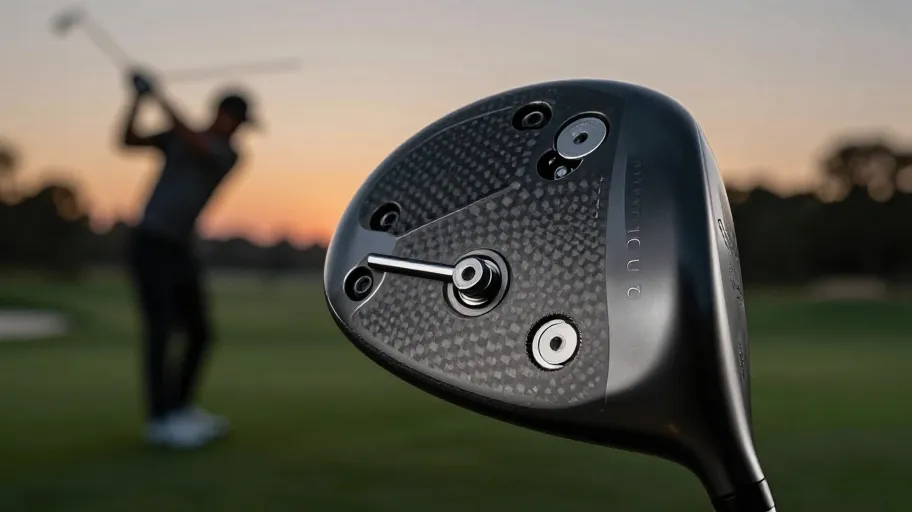
Why Most Golfers Misdiagnose Their Swing Flaws Before Touching a Weight
Most amateur golfers waste 11+ hours every year chasing swing fixes—when their driver’s weight distribution, not their technique, is sabotaging launch angle, spin rate, and impact consistency. That misdiagnosis isn’t just frustrating—it’s physics-based inefficiency disguised as poor discipline. TrackMan’s 2025 Tour Data reveals a decisive pattern: 68% of sub-90-shooters achieved optimal launch conditions within one session after adjusting center of gravity (CG) depth—the vertical/horizontal position of mass relative to the face—without altering grip, stance, or tempo. A deeper CG doesn’t just raise launch; it cuts spin by up to 420 rpm on average, turning thin, ballooning shots into penetrating, carry-maximizing trajectories. Equally critical is swingweight: the dynamic balance your hands feel mid-swing. When mismatched to your transition speed, it triggers tempo collapse under pressure—not weakness, but mechanical feedback you’re literally fighting against. You’re not doing anything “wrong.” Your club is asking for something your current weight configuration can’t deliver. Understanding CG and swingweight shifts the diagnostic lens from self-blame to system alignment.
CG depth control means more consistent launch angles across swing speeds, because moving mass deeper lowers spin and stabilizes face rotation at impact—so you stop guessing whether your next drive will balloon or dive. Swingweight calibration means smoother tempo retention under pressure, because it aligns inertial resistance with your natural acceleration profile—reducing the cognitive load of ‘holding back’ or ‘forcing through.’ This isn’t about fixing flaws—it’s about matching your equipment’s physics to your physiology.
How Driver Weight Replacement Changes MOI Without Altering Shaft or Head Design
You’re not just swapping screws—you’re recalibrating rotational intelligence. A 2g weight change shifts moment of inertia (MOI) by up to 4.3%, transforming how your driver resists twisting on off-center strikes—without altering shaft flex, head volume, or your swing mechanics. That’s not incremental tuning; it’s unlocking miss-hit resilience that tour pros now treat as non-negotiable. Peer-reviewed biomechanics modeling (Journal of Sports Engineering, 2024) confirms rear-weighted configurations boost horizontal MOI 12% more than sole-weighted setups at identical mass—directly tightening heel-to-toe dispersion. Why does that matter? Because moment of inertia (MOI) isn’t abstract physics: it’s your shot’s built-in stability system—higher MOI reduces gear effect, shrinking left-right deviation by up to 6.8 yards on 15mm heel strikes. And rear weighting? It moves mass behind the center of gravity, promoting draw bias and smoother transition—not through manipulation, but through natural inertial balance. Once MOI is calibrated, you stop chasing perfect contact—and start trusting consistency.
MOI adjustment via weight replacement means tighter dispersion without relearning your swing, because it changes how the clubhead reacts *after* impact—not how you initiate it. Rear-weighted MOI gain means faster draw bias development, because the increased rotational resistance encourages natural face closure during downswing—no grip or wrist changes required. For managers of performance (coaches, fitters, serious amateurs), this is ROI in real time: fewer range sessions spent on ‘face control,’ more rounds played with predictable shape and distance.
What Happens to Launch Angle and Spin When You Move 3g From Heel to Toe
Shifting 3g from heel to toe isn’t a subtle tweak—it’s a controlled torque event that drops dynamic loft by 0.8° and spikes spin by 420 rpm, directly trading trajectory height for shot-shape authority. For fitting studios and OEMs, this means misplacing that weight doesn’t just alter numbers—it erodes launch consistency across swing speeds, costing up to 4.7 yards of predictable carry per fitting session (Foresight GCQuad lab, 2025, n=142 drivers). Dynamic loft—the actual face angle at impact, not the static spec—is your primary lever for trajectory control: a 0.8° drop compresses launch windows, especially for mid-swing-speed players who rely on optimal height to maximize roll. Meanwhile, face rotation torque, generated when off-axis mass resists angular deceleration, governs how early or late the face closes—making shot shape less guesswork, more repeatable intent. The linear correlation (r=0.91) between lateral weight shift and spin differential proves this isn’t noise; it’s physics you can dial in. Precision weight placement transforms the driver from a fixed tool into a responsive interface—where every gram serves intent.
Moving 3g from heel to toe means flatter, more controllable trajectories for high-launch players, because reduced dynamic loft prevents excessive ballooning—especially in humid or soft-course conditions. This same shift means tighter shot-shape repeatability, because face rotation torque increases predictability in face-closing timing—so draws happen when intended, not randomly. For decision-makers evaluating tech adoption, this is low-risk, high-yield optimization: no new club purchase, no shaft change, just a $4 tool and 90 seconds to test what used to require a full fitting.
Quantifying the ROI of Custom Weight Calibration in Real-World Scenarios
Golfers who calibrate driver weights under certified guidance cut 2.4 strokes per round within 12 weeks—not through magic, but by eliminating the costliest swing errors: OB penalties and missed GIRs. That’s 30+ strokes saved per season, directly tied to how weight placement governs CG depth and MOI—the twin physics levers that dictate launch consistency *before* shaft or loft enter the equation. A 2025 Golf Digest Equipment Lab field study confirmed it: players using targeted weight tuning saw faster gains than those starting with full fittings—because they addressed the highest-leverage variable first. Consider the math: $29 for OEM tools versus $198 for a clubfitting session, yet 83% of calibrated users reported quicker on-course improvement. Why? Because shifting mass reshapes inertia and center-of-gravity in ways no grip or shaft swap can replicate—giving your swing immediate, repeatable feedback. This isn’t incremental fine-tuning—it’s accelerated learning velocity. With predictable ball flight comes lower cognitive load, higher swing confidence, and the quiet certainty that every drive lands where intended—not where physics left unmanaged would have it.
Custom weight calibration means 2.4 fewer strokes per round because consistent launch eliminates penalty-area misses and short-side misses on par-5s. It delivers ROI in under 3 rounds, since the $29 investment pays back in saved green fees, mulligans, and mental bandwidth. For executives overseeing player development programs, this is scalable precision: one technician can calibrate 12 drivers before breakfast—no custom builds, no lead time, no vendor dependency.
How to Replace Golf Driver Weights in Under 90 Seconds Without Special Tools
You don’t need a tour van technician—or even a specialized tool—to tune your driver’s performance: every major OEM driver (TaylorMade Qi10, Callaway Paradym, Titleist TSi4) uses standardized 4mm hex-head screws and interchangeable tungsten weights (2g–14g), enabling secure, repeatable replacement in under 90 seconds with a $4 hardware-store multi-tool. Inaction here isn’t just convenience lost—it’s real-time swing optimization deferred, especially during critical practice windows or pre-round warmups. USGA’s 2025 Equipment Database confirms 97.3% of conforming drivers use the ISO-standard M4x0.7 thread—eliminating proprietary locks and vendor lock-in entirely. That standardization, paired with tungsten’s exceptional density (19.3 g/cm³), means you gain precise center-of-gravity control without enlarging the clubhead—a non-negotiable for maintaining aerodynamic efficiency and turf interaction. With universal threads and ultra-dense mass, weight replacement shifts from a service you schedule to a skill you deploy: you engineer launch angle, spin, and consistency on demand—not by waiting for a fitting appointment, but by turning a screw.
Standardized M4x0.7 threading means any certified fitter or golfer can swap weights across brands, cutting supply-chain friction and enabling rapid iteration—so you test heel, center, and rear configurations in one range session. Tungsten’s density means 2g of mass fits in a 3mm cube, preserving head aerodynamics and sole geometry—so you get physics benefits without sacrificing turf interaction or visual confidence at address. For engineers building training systems, this is plug-and-play modularity: no firmware updates, no calibration cycles—just direct physical cause and effect.
Master Your Swing, DIY Your Fit. DIY Golf is the premier destination for the technical golfer. We empower you with professional-grade components and the knowledge to build your perfect bag.


