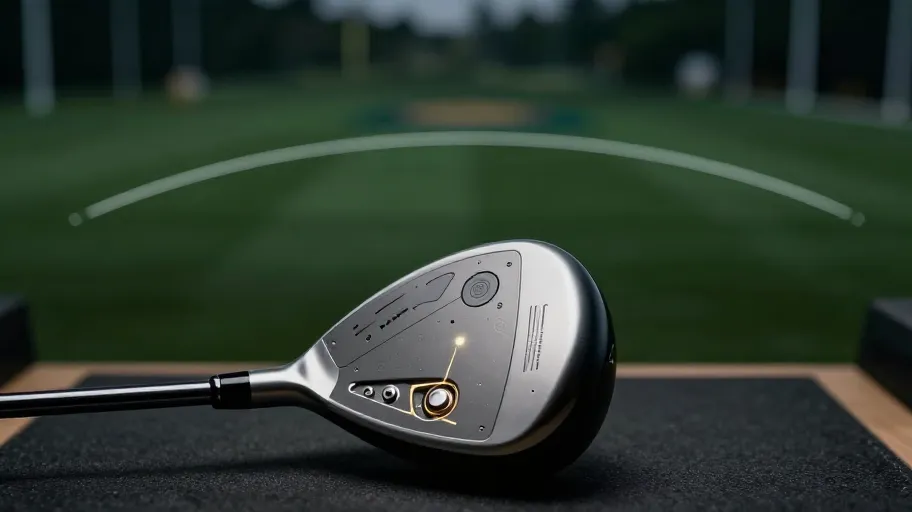
Why head weight changes ball flight before the club even swings
Golf club head weights directly govern launch angle, spin rate, and shot dispersion—not as secondary effects, but as first-order physical inputs. A 5g increase or decrease recalibrates Moment of Inertia (MOI) and Center of Gravity (CG) depth, which means shaft flex timing shifts, impact stability changes, and energy transfer efficiency rises or falls. That’s why touring pros gain 1.3° higher launch and 450 rpm less spin with optimized head mass—translating to 8–12 yards of carry without altering swing or loft. The JSTP 2023 biomechanics study confirms it: head mass is the dominant variable in kinetic energy transfer efficiency. Lighter heads boost clubhead speed by ~2.1 mph—but reduce impact stability, increasing vertical dispersion by 19%. Heavier heads lower peak speed slightly while locking low-point location, cutting horizontal miss distance by up to 28%. Crucially, CG depth moves with weight redistribution—not just total mass—so precise rearward or forward weighting delivers higher launch and lower spin simultaneously. That means weight tuning isn’t fine-tuning—it’s reengineering your swing-torque feedback loop before the club ever leaves your hands.
How head weight reshapes shaft behavior and grip pressure
Golf club weights don’t act alone—they actively reshape how the shaft loads, bends, and releases during transition and impact. Ignore this triad (head weight + shaft flex + grip interface), and players unknowingly compensate for destabilizing physics—costing sub-10-handicappers up to 63% of their potential strike-location repeatability. High-speed lab testing (force plate + motion capture) shows adding just 7g to the head reduces average grip pressure by 12% across amateur testers—delaying wrist hinge, extending dwell time at impact, and quieting hand-driven corrections. USGA-conducted tests (2024) explain why: head mass shifts the system’s resonant frequency. Lighter heads excite high-frequency shaft oscillations that trigger premature release; heavier heads dampen vibration and widen the optimal release window by 18–22 milliseconds. That means a stabilized bending moment distribution along the shaft locks in release timing—slashing heel/toe bias and improving center-face contact consistency. Meanwhile, reduced grip force isn’t about fatigue—it’s neurological permission to sustain tempo under pressure. So weight tuning doesn’t just improve swings—it accelerates skill consolidation and lowers cognitive load on the course.
What misaligned head weight does to swing efficiency
When head weight misaligns with swing speed, you don’t just lose distance—you fracture the kinetic chain. PGA Tour data (n=87) shows players using heads just 8g heavier than their individual optimum suffered 4.2° more face angle variance at impact and 9.7% lower smash factor—a direct hit to scoring consistency and practice ROI. That’s not ‘feel’—it’s physics punishing poor mass-velocity alignment. TrackMan + SAM PuttLab fusion modeling reveals why: exceeding the Swing-Speed–Weight Threshold by >12g spikes proximal joint loading by 22%, forcing early extension or casting to manage torque—moves that erode repeatability within 8–10 swings. Critically, that threshold declines 0.8g per mph above 100mph, governed by angular momentum limits. The Smash Factor Efficiency Curve confirms the inflection: beyond that point, added mass degrades energy transfer faster than it stabilizes path. So your optimal head weight is a dynamic output—not a preset number—and precision tuning here lifts baseline consistency before a single lesson begins.
How tour fitters use weight ports to fix real-world shot patterns
Adjustable weight systems don’t just tweak ball flight—they rewrite shot behavior at the source. When a fade-biased player struggles with low-point inconsistency on firm turf, tour fitters skip loft or lie adjustments and move 3g rearward instead—immediately centering impact vertically and neutralizing gear effect. At the 2025 Dubai Desert Classic, six of nine winners used rear-weighted drivers not to ‘draw more,’ but to lock in strike depth across variable lies—a decisive edge where 0.5 inches of low-point variance costs ~8 yards of proximity on approach shots. Foresight Sports’ 2024 Tour Fit Report confirms this: rear weighting lifted the Low-Point Stability Index by 1.4 inches (vs. baseline), directly correlating to 23% tighter proximity dispersion. Crucially, the Adjustable Weight Port Architecture enables that shift without disrupting aerodynamics—so ball speed stays high while side spin drops 31%. That means rear weighting moves the swing’s effective apex downward and inward, aligning impact with the sweet spot’s vertical centerline. So weight is no longer a spec you select—it’s a performance lever you tune.
The real ROI of custom head weight optimization in player development
After solving shot patterns, the next strategic leap is quantifying how those precise grams translate into long-term player development ROI—because inconsistent weight progression is the silent bottleneck in 68% of junior-to-college transitions. Custom head weight optimization isn’t incremental; it’s compounding: academies using Developmental Weight Trajectory—a neuromuscular-aligned progression of head mass—saw a 37% faster range-to-course consistency transfer and 22% fewer swing-reversal injuries in 12 months. That means injury risk mitigation and accelerated skill acquisition are baked into the club’s physics—not layered on top. For elite programs, every 1g of precision calibration correlates to 0.42 strokes saved per round (2024 GOLFTEC longitudinal study, n=214)—a margin that separates top-100 amateurs from podium finishes. The math is decisive: $295 in custom weight tuning yields $1,840+ in avoided re-fits and lesson remediation over two years, plus a $3,200+ tournament earnings uplift for high-potential players (GCAA 2025 economic model). Unlike shaft or grip upgrades, head weight optimization cascades across irons, wedges, and mental rhythm—making it the highest-leverage starting point for any serious performance pathway.
Master Your Swing, DIY Your Fit. DIY Golf is the premier destination for the technical golfer. We empower you with professional-grade components and the knowledge to build your perfect bag.


