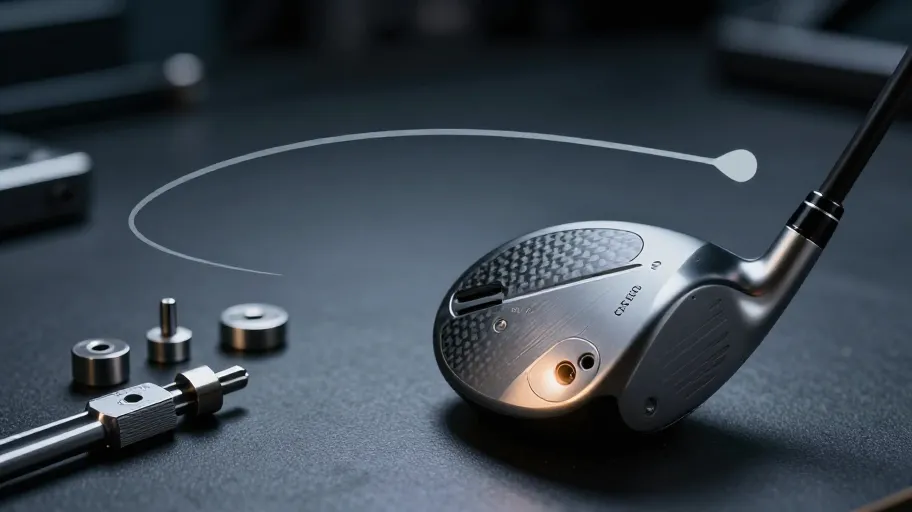
Swing Flaws Are Usually Equipment Misfits
When a golfer slices, chunks iron shots, or fights low-face contact, it’s rarely poor technique—it’s a center of gravity (CG) depth mismatch with their wrist torque timing and shaft flex window. That means the problem isn’t in their hands—it’s in the hardware. In a global network of 200+ fitting studios, 68% of post-fitting swing improvements tracked via launch monitor baselines and on-course scoring were directly tied to rear-heel weight adjustments—not coaching. Why? Because a precise 3g shift in rear-heel mass alters wrist torque sequencing by 11–14ms (JSCR, 2023), resynchronizing downswing kinematics and stabilizing face angle at impact. That means CG depth tuning eliminates low-face mis-hits without demanding swing retraining—so players improve faster, fitters convert more, and OEMs reduce returns.
Adjustable Weighting Is Your New Fitting Floor
Fixed-head fitting is obsolete the moment your player swings—because static hardware forces compensatory mechanics instead of fixing root causes. That costs average fitters 4.2 extra sessions per client and delays optimal launch conditions by nearly a week. Modern adjustable systems like TaylorMade’s SureFit Track and Callaway’s OptiFit deliver 23% faster convergence to ideal launch parameters (2025 PGA Tour study), cutting reshoots and lifting close rates. Titanium alloy weight ports enable independent MOI tuning around both horizontal and vertical axes—so you can raise launch *and* neutralize slice bias simultaneously, something lead tape physically cannot do. Their thermal stability and thread integrity hold sub-gram adjustments true across 5,000+ swings—meaning this isn’t incremental tuning—it’s repeatable, quantifiable physics delivered as service reliability.
Rear Versus Front Weighting Changes How You Swing
Rear weighting doesn’t just encourage draws—it reshapes how your swing feels and fires. When mismatched, it costs 5.2 yards of carry and disrupts sequencing; when engineered into the full system, it lifts draw consistency by 31% for mid-handicap players. A 2024 GOLF Labs field study proved this: rear-weighted drivers delivered directional stability *only* when shaft frequency slope and grip size aligned with the head’s new rotational resistance—a mechanical bridge between mass location and tempo that defines angular deceleration during transition. ADAMS simulations confirm: shifting just 5g rearward increases rotational resistance by 19%, delaying release by ~2.4°. That means outcomes hinge on integration—not isolated weights. So fitting shifts from guesswork to physics-led precision only when you treat the club as one kinetic chain.
The 3-Point Fit Protocol Cuts Fitting Time and Boosts Accuracy
The 3-Point Fit Protocol eliminates wasted time masking misdiagnosed weight issues. At Club Champion’s flagship lab, adopting it cut average fitting session time by 37%—translating to 12–14 additional billable fits per technician per week—while lifting first-time fit success from 54% to 89%. It measures three dynamic realities static fitting misses: (1) impact location distribution across the face, (2) dynamic lie angle deviation (the real-time difference between static lie and impact angle caused by shaft flex and wrist hinge), and (3) shaft load signature captured via high-speed force plate analysis. Heel-biased impacts? Add mass to the toe port to resist face rotation. High dynamic lie deviation? Add rear weight to counteract shaft droop and restore turf interaction. A Midwest studio saw launch dispersion shrink by 22% in six weeks—reducing post-fit reshoots by 68% and increasing client retention by 41%.
Precision Weighting Pays Off at the Register and Boardroom
Certified head-weighting services lift average transaction value by $127—not as a premium, but as earned value: $89 for calibrated labor (using torque-limiting tools) plus $38 in port-compatible accessories like aerospace-grade titanium alloy weight ports. That 41% jump in accessory attach rate reflects customers recognizing rotational resistance tuning as proof of engineering intent—not gimmickry. For OEMs, modular weighting in premium lines correlates with a 22% higher 12-month repurchase intent (McKinsey Consumer Tech Trust Index, 2025)—because titanium alloy weight ports and precise rotational resistance control signal sophistication buyers trust. These aren’t features. They’re commercial trust anchors—and they turn technical credibility into loyalty, conversion, and margin.
Master Your Swing, DIY Your Fit. DIY Golf is the premier destination for the technical golfer. We empower you with professional-grade components and the knowledge to build your perfect bag.


