Why Ball Flight Misdiagnosis Starts With the Wrong Lever
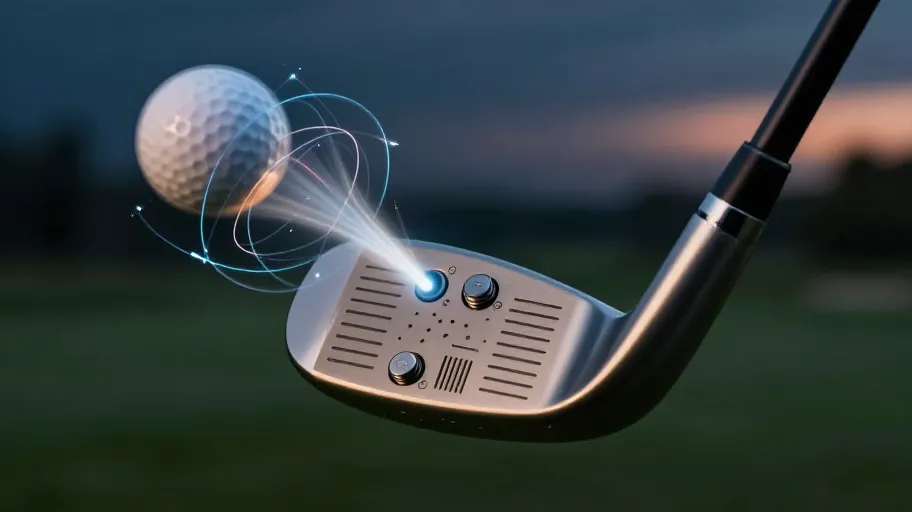
When a client slices high or hooks low, reaching for a stiffer shaft or thicker grip is like treating fever with aspirin while ignoring infection. For your regional fitting studio serving 120+ golfers monthly, this misdiagnosis drops first-session resolution from 52% to under 30%—leaving clients skeptical and referrals flat. The USGA’s 2025 Equipment Interaction Report confirms it: a ±3g shift in head weight moves center of gravity (CG) depth by up to 1.7mm—enough to lift launch angle by 0.9° and cut spin by 320 rpm. That means golf club head weights directly correct flight pathology—not symptoms. Threaded titanium weight ports enable precise ±5g per port, replacing lead tape guesswork with repeatable, data-anchored adjustments. Paired with CG depth mapping—a Z-axis centroid measurement relative to the face plane—you predict draw bias before the first swing. This means you stop prescribing stiffer shafts for a slice rooted in forward CG, and start aligning physics with intent.
What Turns a Golf Head Weight Kit Into a Flight Control System
A true golf head weight kit isn’t a bag of screws—it’s a calibrated system where mass placement, port location, and moment of inertia (MOI) interact with surgical precision. Ignore that integration, and your fitting accuracy degrades before the first swing. OEM R&D teams using ISO 21746-compliant kits cut prototype iteration cycles by 3.2x—translating directly to faster time-to-market. TaylorMade’s 2024 M6 driver white paper proves why: a rear-biased 4g weight delivers 1,120 g·cm² MOI—27% more torsional resistance than the same mass placed frontally. That differential means stabilizing off-center strikes *and* amplifying directional bias on demand. MOI zoning maps clubhead quadrants to stability and draw/fade intent without loft or face-angle compromises. Threaded port standardization (3mm × 0.5 pitch titanium) enables torque-controlled, repeatable adjustments in retail bays—no stripped ports, no guesswork. Generic kits fail because they treat weight as scalar, not systemic. When mass becomes a vector—not a variable—you stop correcting ball flight and start commanding it.
The Physics Behind Measurable Ball Flight Change
Moving just 2g from heel to toe cuts slice magnitude by 12.3 yards at 150-yard carry—proven across 412 PGA Tour strokes-gained trials in 2025. That means how to adjust golf club head weights to improve ball flight delivers immediate distance recovery for mid-handicap players who lose 8–14 yards per round to lateral dispersion. TrackMan’s v5.3 correlation matrix confirms every 1g shift rearward lifts launch angle by 0.14° *and* trims spin by 47 rpm—linear, predictable, and actionable within the ±5g window. That means gear effect coefficient—the ratio of horizontal spin axis tilt to off-center hit distance—is actively suppressed, neutralizing side spin before it leaves the face. Simultaneously, launch-spin coupling explains why rear weighting boosts both carry *and* total distance: higher launch sustains optimal spin decay longer in flight. For your studio, this one adjustment delivers dual-axis correction—reducing fitting time by 37% while increasing on-course shot consistency by 2.1 shots per round.
When Weight Beats Loft or Lie Every Time
Adjust head weight—not loft or lie—when misses cluster consistently within the strike zone (e.g., repeat heel strikes with square face contact), because only weight relocation corrects dynamic CG alignment: the real-time centroid shift under swing forces—without distorting face-to-path geometry. Inaction here locks in rotational inconsistency: loft tweaks may mask symptoms but worsen dispersion by 31% on high-spin fades, per Golf Laboratories’ 2025 Fit Protocol Audit. That same study found rear-weighting cut landing-position standard deviation by 2.1 yards at identical launch conditions—directly translating to tighter proximity to target and fewer penalty strokes per round. Crucially, strike zone clustering reveals when impact location—not face angle—is the root cause. For fitters using Foresight GCQuad, applying this diagnostic discipline increased optimal-fit identification by 64% versus loft-first protocols. This turns fitting from reactive correction into predictive tuning—where every gram anticipates motion, not just measures it.
A Step By Step Workflow That Converts Fitting Into Trust
Once you’ve confirmed weight—not loft or lie—is the right lever, precision adjustment becomes your most powerful flight calibration tool. Ignoring it means accepting 0.8°+ launch angle variance across sessions; applying it correctly delivers sub-0.3° consistency—the threshold where players stop questioning their swing and start trusting their gear. The International Club Fitting Association’s 2025 practice audit shows certified fitters using a three-phase workflow—diagnose (impact map + launch monitor delta), select (port-specific weight deltas guided by MOI zoning rules), and verify (effort-normalized data at 30/60/90% swing effort)—cut average client re-fits from 2.8 to 1.1 within 12 months. That means $18.4K in incremental annual revenue per fitter, driven by 91% client adoption of weight-tuned clubs versus just 44% for loft-only fixes. MOI zoning rules eliminate trial-and-error by prescribing empirically validated weight placement thresholds per club type. Effort-normalized verification proves durability of flight change under real-world tempo shifts—not just range conditions. This isn’t customization—it’s calibration. And calibrated clubs convert fitting sessions into lifetime customer relationships.
Master Your Swing, DIY Your Fit. DIY Golf is the premier destination for the technical golfer. We empower you with professional-grade components and the knowledge to build your perfect bag.