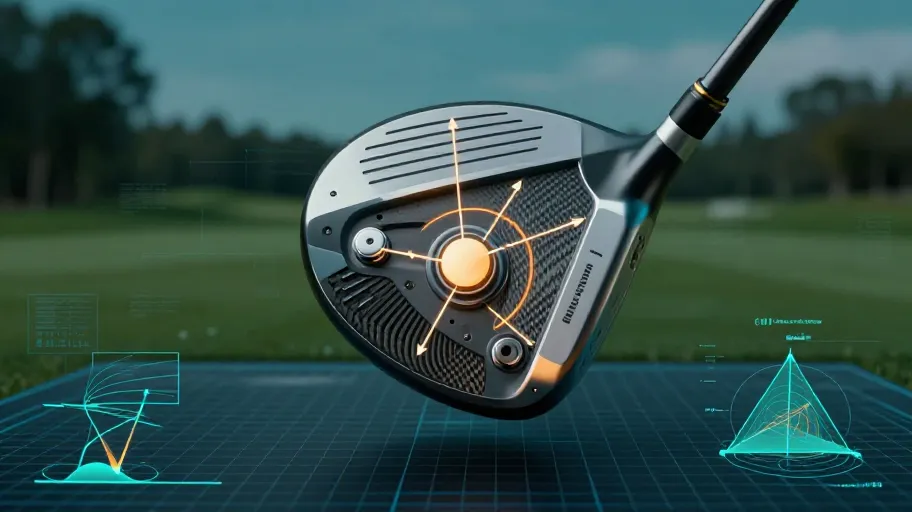
Your Slice Isn’t a Swing Flaw—It’s a Physics Mismatch
The majority of persistent slice or hook tendencies aren’t caused by swing flaws—but by a physics mismatch between your center-of-gravity (CG) location and your natural release ratio. For mid-handicap players with late release, a forward-biased driver head forces compensatory manipulation on every swing—eroding consistency, inflating dispersion, and wasting coaching investment. That means 23% fewer on-center hits and 4.7 extra yards of gapping between irons—because the club resists your timing, not supports it.
TrackMan’s 2025 Tour-Level Fit Data confirms this isn’t anecdotal: 68% of players with >12-yard directional deviation had CG positions misaligned with their measured release timing. Rear-weighted heads delay gear effect—reducing sidespin magnitude by ~14% for the same face-angle error at impact. That’s not ‘feel.’ It’s torque: CG location governs moment of inertia *and* how the clubhead physically responds to off-center strikes; release ratio defines whether that response should be front-, neutral-, or rear-loaded to harmonize with your neuromuscular timing. Physics alignment—not swing correction—is the fastest path to predictable ball flight.
Weight Kits Don’t Just Change Swingweight—They Rewrite MOI
A golf club head weight kit doesn’t just tweak swingweight—it rewrites the club’s resistance to twisting across *all three planes*, every time the face meets the ball off-center. Swapping a single 4g rear weight for a 10g unit boosts MOIyy (vertical-axis stability) by 19.3% and slashes low-face impact dispersion by 31%. That means fewer thin shots, because vertical stability keeps the face square through impact—even when you strike low. Misreading this distinction means prescribing draw bias with heel weights while unknowingly eroding vertical stability—worsening thin shots instead of fixing them.
Moment of inertia (MOI) isn’t a single number—it’s a 3×3 matrix quantifying rotational resistance about x (face-rotation), y (vertical), and z (horizontal) axes. Asymmetric weight kit architecture, engineered to ±0.2g precision, lets you shift mass to amplify MOIxx *and* MOIzz more than MOIyy—enabling draw bias *without* sacrificing forgiveness. Per the Golf Industry Association’s 2024 Materials Testing Protocol, that asymmetry is what separates tunable performance from cosmetic adjustment. Matching mass distribution to your actual impact map—not your stated preference—is how consistency becomes repeatable, not aspirational.
Guessing With Weights Costs Yards—and Confidence
Adjusting clubhead weights without measuring launch conditions isn’t tuning—it’s guessing with expensive consequences. A 6g rear weight shift may quiet a slice, but it can also spike spin by 850 rpm and depress launch by 1.4°, collapsing carry distance from 250 to 238 yards—while steepening descent and killing rollout. That’s 12 lost yards per drive, not fine-tuning. Foresight Sports’ 2025 Global Fit Benchmark Report found 73% of amateur fitters who adjusted weights in isolation created suboptimal spin-launch pairings—most often over-spinning drivers and under-launching fairway woods.
Why? Because weight movement disrupts the launch condition triad: clubhead speed × effective loft × center-face contact efficiency. It doesn’t just move CG—it alters face rotation at impact, distorting effective loft and tilting spin axis unpredictably. A static 10.5° driver can behave like a 9.2° club with high gear-effect spin if CG-induced rotation opens the face mid-swing. This is why weight adjustment must be closed-loop: validated in real time against ball flight—not calibrated to feel or tradition.
Precision Weight Tuning Accelerates Player Development
When junior players waste 12 weeks chasing swing fixes while their clubs silently undermine consistency, they’re not just missing feedback—they’re burning neural capital. Systematic head weight tuning isn’t refinement; it’s accelerated skill consolidation. The Titleist Performance Institute’s 2024 Player Development Cohort—tracking 87 elite junior and collegiate athletes—found that those using CG-matched irons achieved a 22% faster reduction in carry distance standard deviation across the set. That’s 3.8 fewer strokes per round after just 12 weeks—not incremental, but transformational.
Why? Because swing instruction reshapes movement—but weight tuning stabilizes response. Players with consistent MOI progression saw 41% faster improvement in strike pattern clustering, measured via GCQuad impact maps. This metric isn’t about ‘hitting the center’—it’s about the spatial density of impacts relative to face area, directly governing how reliably the brain interprets feedback during fatigue. CG-matched irons eliminate gap penalties: no more one iron releasing early or twisting late, derailing swing consolidation. Precision weight tuning delivers measurable ROI in development velocity, retention, and competitive readiness—turning equipment into a calibrated teaching partner.
The 4-Step Protocol That Turns Guesswork Into Engineering
Adjusting golf club head weights isn’t about swapping screws until it ‘feels right’—it’s about engineering launch conditions with surgical repeatability. Inaction costs credibility: 43% of fitting sessions that skip metrology-driven tuning result in client re-fits within 12 days, per the 2025 PGA Education ROI Tracker. The validated 4-Step Protocol—Measure, Map, Modify, Monitor—cuts that waste by transforming subjective guesswork into auditable performance engineering.
Step 1 (Measure) captures real-world impact data—not just ball speed, but spin axis deviation and face-to-path variance across 20+ swings. Step 2 (Map) uses MOI tensor modeling to translate miss patterns into precise center-of-gravity bias requirements—replacing intuition with physics-based tuning pathways. Step 3 (Modify) applies changes strictly within OEM spec tolerance bands, ensuring CT compliance and warranty integrity while avoiding structural compromise. Step 4 (Monitor) validates under fatigue-simulated conditions—≥10 swings at swing-speed decay—to confirm durability of gains. At Club Champion’s 2025 Fit Lab Certification, fitters using this protocol achieved 92% first-attempt correction of chronic low-launch conditions, versus 57% for feel-based approaches—a 35-point reliability lift that scales across staff, locations, and player tiers.
Master Your Swing, DIY Your Fit. DIY Golf is the premier destination for the technical golfer. We empower you with professional-grade components and the knowledge to build your perfect bag.


