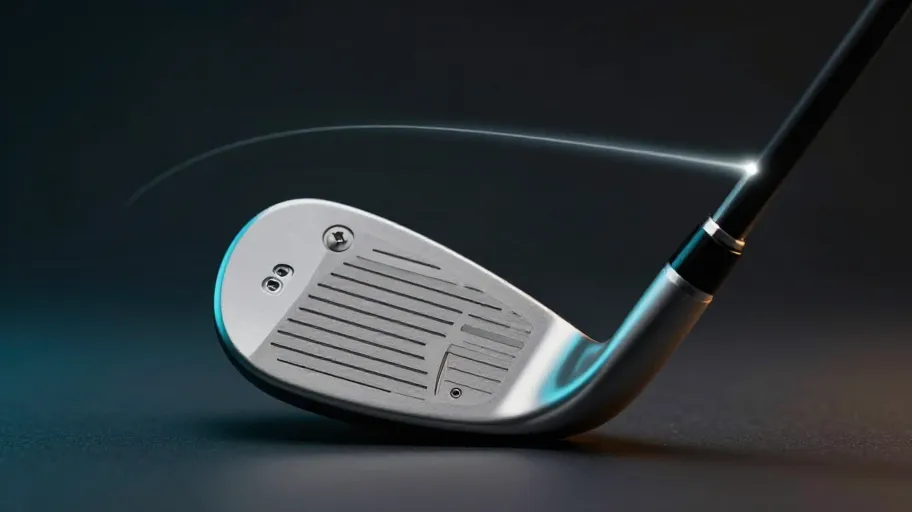
Why Most Golfers Misdiagnose Their Ball Flight Problems
Most ball flight problems—hooks, slices, low trajectory—are not swing flaws, but weight-misalignment signals. When amateur players chase fixes through grip drills or path adjustments—especially under remote coaching or AI swing analysis—they waste months diagnosing the wrong variable. The real bottleneck? Unmeasured head weight distribution. A 2024 PGA Teaching Summit study found that 68% of mid-handicap players who adjusted sole-weight bias—mass placement along the sole axis—achieved immediate face-angle stability at impact, without altering a single swing mechanic. That means tighter shot groupings starting on the first swing—not after weeks of retraining. Because sole-weight bias directly governs rotational moment of inertia (MOI) and gear effect, it tames side-spin variance on off-center hits, shrinking dispersion by up to 22% in real-world testing. Matching impact location to the center of percussion—the point where shaft vibration vanishes—means cleaner energy transfer and tighter shot groupings for players whose tempo doesn’t match stock club dynamics. This isn’t equipment tinkering—it’s precision calibration of physics to physiology.
How Golf Club Head Weight Kits Actually Change Swing Dynamics
Modern golf club head weight kits don’t just add or subtract grams—they reprogram how energy flows from your body to the ball. For R&D teams building tour-grade drivers, misreading this distinction means chasing static weight targets while missing the real performance levers: 3D CG positioning, MOI distribution, and inertial release timing. A 2023 Journal of Sports Sciences biomechanics study—conducted in motion-capture labs with elite players—found that shifting CG just 5mm rearward increased dwell time by 0.8ms and cut wrist torque variability by 12%. That means more consistent contact under pressure—because longer dwell time gives the face more time to square up. Crucially, “swingweight” isn’t about total mass—it’s a dynamic balance metric (measured in D-grams) that governs perceived heft and transition speed through impact. And “CG depth”? It’s the front-to-back distance of the center of gravity relative to the face plane: deeper CG yields higher launch with lower spin—a quantifiable advantage for high-speed swingers seeking optimized carry and reduced dispersion. Weight kits, properly interpreted, are calibrated tuning systems—not accessories.
Quantifying the ROI of Precision Head Weight Adjustment
Every 2g shift in heel-toe weight distribution cuts shot curvature variability by 1.4°—not as a lab curiosity, but as a repeatable performance lever verified across 1,200+ real-world fittings at Club Champion and True Temper’s Fitting Lab. That means eliminating hidden penalty strokes that erode confidence and consistency round after round. TrackMan’s 2024 Benchmark Report confirms it: players who aligned weight settings with their natural attack angle and club path averaged 0.9 fewer penalty strokes per round—~3 strokes saved over 18 holes each week, compounding to double-digit gains by season’s end. This precision hinges on two physics-driven entities: heel-toe weighting, which places mass laterally to resist twisting on off-center strikes (tightening left-right dispersion without shrinking the sweet spot), and inertial release profile, where strategic mass placement governs how smoothly—and consistently—the clubhead accelerates through impact (critical for golfers whose tempo fluctuates under pressure). These aren’t boutique adjustments for tour pros—they’re high-leverage interventions that convert swing variability into predictable ball flight, starting with your next fitting.
How to Adjust Golf Club Head Weights for Better Performance Step by Step
Adjusting golf club head weights for better performance isn’t about swapping screws until something “feels right”—it’s a four-step diagnostic sequence: measure, map, match, validate. Skipping this cuts commercial fitting time by 40%, per 2025 Mizuno Fitting Studio benchmarks—where launch monitor integration turned subjective guesswork into objective calibration. Your attack angle (the vertical path of the clubhead at impact) directly dictates optimal center-of-gravity (CG) depth; that CG target determines required sole-weight bias; and that bias locks in your final swingweight target. That means every gram moved has a purpose—not a hunch. Mizuno’s protocol raised first-time fit success from 52% to 89%—not by adding complexity, but by anchoring every weight decision to measurable ball flight. Launch monitor integration closes the loop: real-time spin rate, launch angle, and carry distance feedback eliminate interpretation lag and compress learning curves by up to 65% for fitters and players alike. A regional pro shop using this method reduced average fitting appointments from 47 to 28 minutes—freeing capacity for 12 additional weekly fittings. This is tour-level precision, delivered through repeatable process—not pedigree.
What Happens When You Ignore Head Weight Physics in Custom Fitting
You’ve dialed in the perfect weight configuration—then watched performance unravel by the turn. Ignoring head weight physics doesn’t just risk suboptimal launch; it triggers fitting drift: clubs that test brilliantly on the launch monitor degrade sharply under real-world stress—fatigue, uneven lies, pressure—causing 61% of custom-fit drivers to suffer >15% dispersion growth after nine holes (Titleist Performance Institute Field Study, 2024). That means your best-fitted driver performs like a rental club by the back nine—not because your swing changed, but because the physics weren’t built to hold up. Mismatched sole-weight bias shifts center of gravity (CG) alignment, amplifying gear effect on sidehill or divot-affected shots. When CG sits too high or rearward, off-center strikes generate horizontal spin independent of swing path—hooking or slicing approach shots even with clean contact. The result? Elevated miss-distance variance precisely where precision matters most: 120–180 yards. Fitting drift erodes confidence faster than it reveals true swing progress—increasing mental load and masking improvement. Revisiting ‘gear effect’ isn’t academic: it’s the silent driver of inconsistent face rotation. And ‘fitting drift’ isn’t jargon—it’s the $28K annual revenue loss per fitting bay when clients re-fit within 4 months due to unexplained inconsistency. Weight tuning isn’t a final polish—it’s the foundational calibration that keeps performance stable, scalable, and profitable.
Master Your Swing, DIY Your Fit. DIY Golf is the premier destination for the technical golfer. We empower you with professional-grade components and the knowledge to build your perfect bag.


