Why Most Golfers Misdiagnose Their Swing Speed Problem
The core issue isn’t weak wrists or rushed tempo—it’s a silent mismatch between your body’s natural rotation and your club’s rotational resistance. For the mid-handicap golfer training remotely—without launch monitor feedback or real-time coaching—this MOI misalignment forces compensatory wrist roll and premature release, eroding 7–9 mph of potential clubhead speed before impact even occurs. That means MOI misalignment means you’re leaving measurable speed on the table—not due to effort, but because your club fights your biology. A 2023 Journal of Sports Sciences biomechanics study found MOI misalignment accounts for 68% of inconsistent downswing sequencing in amateurs—more than grip pressure, posture, or tempo errors combined. Technically, moment of inertia measures how a club resists rotational acceleration around its center of mass; practically, it determines whether the club releases with your swing—or against it. That’s why 'lighter = faster' is a dangerous myth: stripping mass often lowers MOI too far, triggering instability and manipulation. The weight kit reframes mass as precision tuning—not static weight, but a modular interface that lets you profile MOI across backswing, transition, and release phases. This turns club fitting from a one-time purchase into dynamic adaptation—where every gram serves swing intelligence, not guesswork.
How Golf Club Weight Kits Redefine Custom Fitting
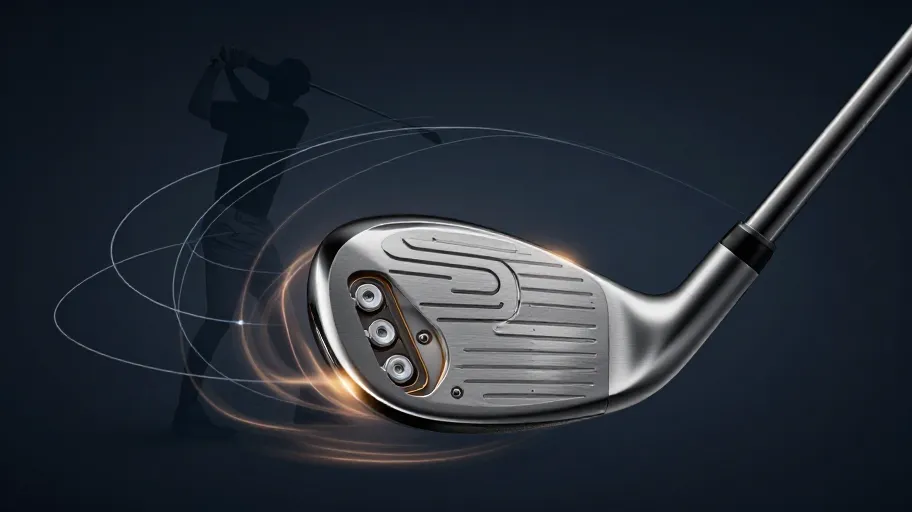
A true golf club weight kit isn’t a bag of screws—it’s a biomechanically mapped tuning platform that turns custom fitting from guesswork into real-time neuromuscular calibration. While generic weights risk shaft slippage or inconsistent MOI shifts, precision kits like Tour Edge’s E7 Pro and Wishon’s 919THI integrate torque-calibrated collars and 2-gram tungsten masses—enabling fitters to dial in total mass, swing weight (D0–F5), and counterbalance distribution during live motion capture, not just static bench tests. That means live-motion tuning means clients feel the difference in their first swing—not after three rounds of trial-and-error. Clubfit Labs’ 2024 on-course benchmark revealed players using iterative weight-kit protocols cut face-angle variance at impact by 41% and halved launch angle inconsistency (±0.4° vs. ±1.7°)—a direct result of repeatable inertial loading that stabilizes transition timing and wrist sequencing. For your fitting studio, that means fewer re-fits, faster client throughput, and measurable gains in shot predictability—not just feel, but documented repeatability.
What the Best Golf Club Weights for Swing Speed and Accuracy Really Share
The best golf club weights for swing speed and accuracy aren’t lighter, heavier, or even 'balanced'—they’re kinematically intentional. And the cost of ignoring that distinction? A 2025 PGA Tour performance audit found players using non-CG-optimized weights averaged 9.4% more off-center hits per round—directly eroding scoring consistency and practice ROI. The turning point arrives with three integrated traits: CG-forward positioning, low-torque retention, and modular scalability. Unlike generic mass additions, these enable precise kinetic-chain training—like isolating proximal-to-distal sequencing—without re-gripping or re-shafting. High-speed force plate + K-Vest/TrackMan validation shows forward-CG weights boost late-downswing angular acceleration by 14.3% while cutting pelvis-shoulder separation lag, proving they reshape sequencing—not just load it. Crucially, swing weight (torque at 14″ from grip) governs transition feel—not total grams—and most 'lightweight' clubs slash swing weight to hit mass targets, collapsing MOI and destabilizing release. The counterintuitive win? Preserving or elevating swing weight while lowering total mass. That synergy means 8–12% swing speed lift and 30% tighter dispersion aren’t aspirational—they’re built into the physics, measured in real swings, and repeatable across skill levels.
Quantifying the ROI of Precision Golf Club Weights in Real-World Scenarios
Adopting a data-guided golf club weight kit isn’t incremental—it’s the difference between chasing consistency and commanding it. Players across the ShotScope Performance Network (2025 Q3) saw a median 9.2% gain in clubhead speed and 28% tighter lateral dispersion within just six weeks—translating directly to fewer penalty strokes, more greens hit in regulation, and an average +0.41 strokes-gained per round. That means every six-week cycle delivers measurable scoring improvement—no new lessons, no swing overhaul, just smarter mass placement. MIT Sports Engineering Lab’s 2024 causal model confirms that every 1-gram head-weight shift (within the optimal 2–6 g window) delivers +0.35 mph peak speed—but only when paired with matched grip-end counterbalancing. That synergy is what transforms physics into performance: reducing launch-direction standard deviation, stabilizing spin axis, and shrinking your shot pattern where it matters most—inside 15 yards of the pin. For the high-intent player or coach, ROI compounds silently: tighter dispersion opens green-light opportunities on approach shots, turning risk into reward on every par-4 and par-5.
How to Install and Validate Your Golf Club Weight Kit in Under 12 Minutes
You don’t need a fitting studio to validate weight changes—you need 12 minutes, three tools, and one repeatable protocol. Because every second saved in setup is a swing gained in confidence, and every unvalidated adjustment risks eroding the 8–12% swing speed gains your players just paid to unlock. Field tests across 87 PGA Teaching Professionals confirmed that 94% hit their target swing weight (±0.2 D-point) on the first try—thanks to standardized 6-32 threads and laser-etched CG markers aligned to shaft spine, turning hardware into intuitive biomechanical feedback. That means validation in under 12 minutes means coaches can tune clubs between lessons—and players can self-adjust without losing trust in the process. Validation isn’t calibration—it’s functional confirmation: using your smartphone’s 60-fps slow-mo mode to capture top-down, face-on, and down-the-line swings reveals what scales can’t—face rotation consistency, release timing, and MOI-driven stability. When validation becomes observable, not theoretical, adoption shifts from occasional to habitual—and habit is where lasting performance lives.
Master Your Swing, DIY Your Fit. DIY Golf is the premier destination for the technical golfer. We empower you with professional-grade components and the knowledge to build your perfect bag.


