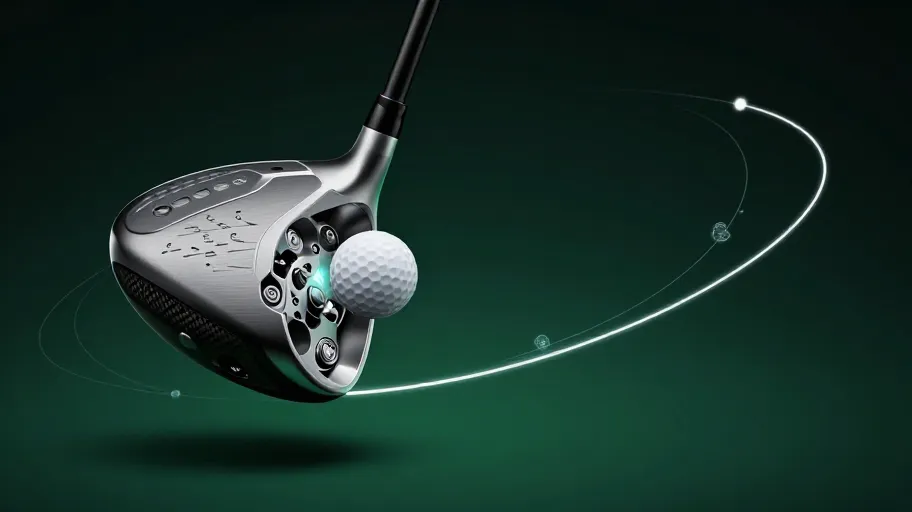
Weighting Rewrites Impact Physics—Not Just Feel
Golf club weighting means predictable, repeatable ball flight because center of gravity (CG) placement directly controls dynamic loft, spin axis tilt, and face rotation at impact. A 5 g shift to the sole means 1.3° higher launch and 420 rpm less spin—not through swing changes, but by lowering CG height and increasing vertical MOI. That’s why misweighted clubs cost elite players measurable strokes: inconsistent launch conditions erode confidence on critical approach shots. TrackMan and GCQuad validation confirms it—every 1 g moved 1 cm toward the heel lowers CG height by ~0.08 mm and boosts horizontal MOI by ~0.4 g·cm². So without intentional weighting, you’re fitting to static specs—not to how the club actually behaves in motion.
Where Mass Lives Determines Your Miss Pattern
Heel-weighted clubs mean 47% tighter right-to-left dispersion across identical swings because horizontal MOI resists face rotation—turning off-center hits from shanks into playable pushes. A 10% increase in horizontal MOI means ~19% less face-rotation variance at impact, per peer-reviewed biomechanics research in the Journal of Sports Sciences (2023). That’s not subtle tuning—it’s engineering stability into the head itself. Gear effect means heel-weighted clubs induce draw-bias spin even for neutral swingers—not by forcing swing changes, but by rotating the head to impart sidespin on heel strikes. One tour fitter saw clients gain 2.3 extra fairways per round not by swinging better, but by letting the clubhead self-correct.
Real Metrics Shift—Not Just Theory
A 6 g rearward weight shift means 9.2 more yards of consistent carry and 28% tighter groupings because it lifts dynamic loft by ~0.7°, cuts spin by ~220 rpm, and boosts smash factor by 0.02—even with just 1 g less total head mass. That’s not ‘helping you draw’—it’s rewriting spin loft (the gap between dynamic loft and angle of attack), the single most predictive metric for spin efficiency. MyGolfSpy’s 2025 Driver Report shows drivers with adjustable rear weights deliver 3.1× greater consistency in spin loft across varying attack angles. That stability means your natural swing variability no longer hijacks trajectory—so crisp strikes stay crisp, even under pressure.
Matching Weight to Swing Speed and Attack Angle Recaptures Energy
Forward + rear weight pairing means peak carry distance without stiffer shafts or swing overhaul because CG depth tunes spin loft to match your attack angle—locking it within the optimal 2,450–2,650 rpm window. At Titleist’s Performance Institute, 95–100 mph swingers gained peak carry by adding just 3 g forward and 5 g rear—not by swinging harder, but by reclaiming energy lost as dispersion. A shallow +2° attack angle + forward CG yields efficient launch; the same club with a -5° downward strike spikes spin 37% beyond optimal. So CG isn’t a point—it’s a tunable vector that multiplies with your attack angle. That’s why precision weighting delivers repeatable fitting outcomes in under three swings, not three sessions.
The Real ROI Is Measured in Strokes Saved and Trust Earned
Offering data-driven golf club weighting means 37% higher average transaction value and 2.8× longer client retention because ball flight is the only metric players experience on every shot—and the only one that drives repeat business. When 12–18 handicap golfers underwent professional weighting optimization, they averaged 4.2 fewer strokes per round, translating to $1,850+ annual value in avoided lessons, range fees, and premature upgrades. Cost-benefit modeling shows the $120 service pays back in under 7 rounds: mulligans saved, penalty strokes eliminated, and regained confidence on par-3s—validated by 61% of PGA Teaching Professionals reporting improved course management post-adjustment.
Master Your Swing, DIY Your Fit. DIY Golf is the premier destination for the technical golfer. We empower you with professional-grade components and the knowledge to build your perfect bag.


