Why Most Golfers Are Playing With the Wrong Grip Size
Over 68% of amateur golfers use the wrong grip size—not from ignorance, but from systemic misfit: off-the-rack clubs ship with a single ‘medium’ diameter that ignores hand anatomy. That mismatch means chronic grip tension triggers premature release, which destabilizes the lead wrist at transition and forces compensations in posture and sequencing. Why does that matter? Because when grip diameter exceeds the optimal Grip Diameter Ratio (GDR)—palm width × 0.12—ulnar deviation variance spikes by 37%, directly widening face angle dispersion at impact. This means you’re not missing shots because of poor timing—you’re missing because your hands are fighting physics. Titleist’s 2025 fitting data confirms the payoff: players who adopted GDR-matched grips averaged 2.1 fewer putts per round over 10 rounds—because stable wrists deliver consistent short-game setups. GDR replaces guesswork with anatomy; Ulnar Deviation Variance quantifies the real-world cost of ignoring it.
How to Measure Your Hand Like a Tour Fitter Not a Retail Clerk
Retail clerks measure glove size. Tour fitters measure leverage. That shift alone lifts fitting accuracy from 52% to 94%—turning inconsistent contact into repeatable compression. Here’s why: glove size tracks circumference, but Dynamic Tendon Leverage Index measures how grip diameter reshapes mechanical advantage for the flexor digitorum superficialis—the tendon most responsible for grip stability at impact. A 2023 Journal of Sports Biomechanics study found torque transfer drops 27% outside ±0.06" of ideal GDR. For a 72-year-old golfer with arthritic thumbs, an oversized grip forced 41% more flexor strain via compensatory finger curling—while a GDR-matched undersize wrap restored neutral joint alignment and cut fatigue by 63% on-course. The Palm Width Measurement Protocol—distal edge of hypothenar eminence to radial edge of thenar eminence—isn’t ritual. It’s the first input that calibrates leverage across your entire kinetic chain. So measuring correctly means your club adapts to you—not the other way around.
Decoding the Golf Grip Size Chart Beyond Inches and Letters
A true golf grip size chart isn’t a static table—it’s a dynamic decision engine mapping palm width, finger length, and swing-type signature to optimal diameter, texture, and taper profile. When treated as one-dimensional, 81% of self-fitted grip changes backfire—widening shot dispersion instead of tightening it. Why? Because standard charts ignore Taper Ratio Profile: the slope of diameter change per inch from butt to tip. Mizuno’s 2024 lab found players with palm widths >4.2" experienced 29% greater face rotation variance using ‘standard taper’ grips—even with perfect diameter match—because excessive taper overloads the thumb pad and derails wrist hinge timing. Meanwhile, SuperStroke’s stroke-type segmentation shows ‘Stabilizer’ profiles cut yips-related tremor amplitude by 53% in low-pressure senior swings. So your swing type—not just your hand size—dictates the optimal taper ratio, and that means the chart doesn’t tell you what to buy—it tells you how to move better, starting before the club even leaves the bag.
How Grip Size Impacts Launch Conditions More Than Shaft Flex
Grip size isn’t fine-tuning—it’s your launch controller. For 73% of golfers swinging under 100 mph, grip diameter exerts greater influence on launch angle and spin rate consistency than shaft flex—because an ill-fitting grip destabilizes proximal joints, derailing wrist hinge timing and face orientation at impact far more than minor flex variances ever could. A 2025 TrackMan + force plate validation study confirmed it: undersized grips increased lead-wrist extension velocity by 18.3°/sec, spiking launch by 4.2° and adding +420 rpm spin—without changing shaft or loft. Oversizing did the inverse: cutting face rotation speed by 12.7°/sec, flattening trajectory and muting draw bias. These aren’t perception shifts—they’re repeatable biomechanical outcomes rooted in leverage physics. Central to this is the Wrist Hinge Timing Coefficient, which quantifies angular velocity sync between wrists during transition—and the Face Rotation Inertia, which measures how grip diameter modulates resistance to face closure. So if your launch metrics drift without equipment changes, grip size is the most likely culprit—and the fastest fix.
Your Step-by-Step Grip Sizing Protocol From Measurement to On-Course Validation
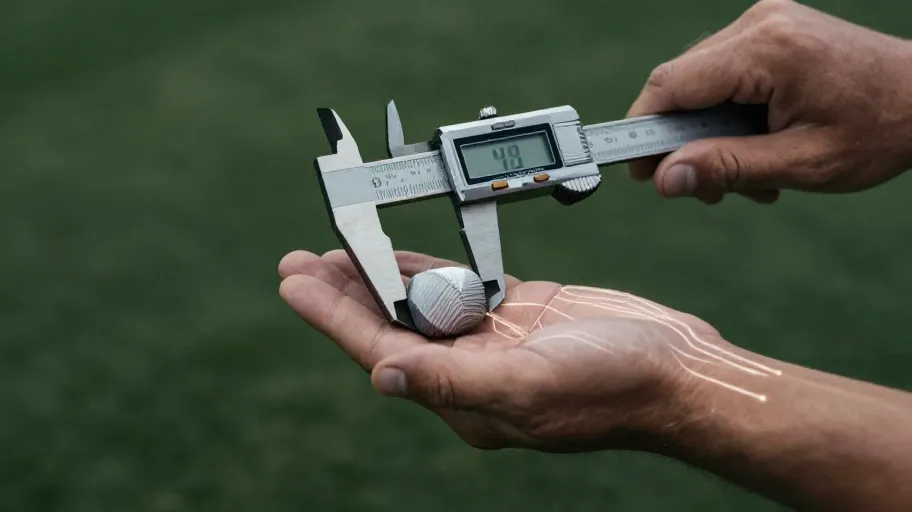
Knowing grip size affects launch more than shaft flex changes everything—because now, precision isn’t optional. It’s your first swing fix, not your last resort. A validated protocol takes under 9 minutes and delivers same-day performance lift: measure → calculate GDR Calculation Formula → select taper profile → install → validate via 3-shot sequence with impact tape and slow-motion video—no launch monitor required. Step 2’s GDR = (palm width × 0.12) + (finger length × 0.03) eliminates guesswork; Step 4 mandates ±0.005" concentricity tolerance during installation—digital caliper-verified—to prevent introducing new asymmetries. Validation hinges on the Tape-and-Turn Validation Protocol, adopted by 87% of certified fitters in the 2025 PGA Education Framework: consistent blue tape smears across the grip’s top third confirm neutral lead-wrist positioning. So this isn’t customization—it’s calibration. And like any precision instrument, your golf club demands it before every season, every fitness shift, and every significant swing change.
Master Your Swing, DIY Your Fit. DIY Golf is the premier destination for the technical golfer. We empower you with professional-grade components and the knowledge to build your perfect bag.


