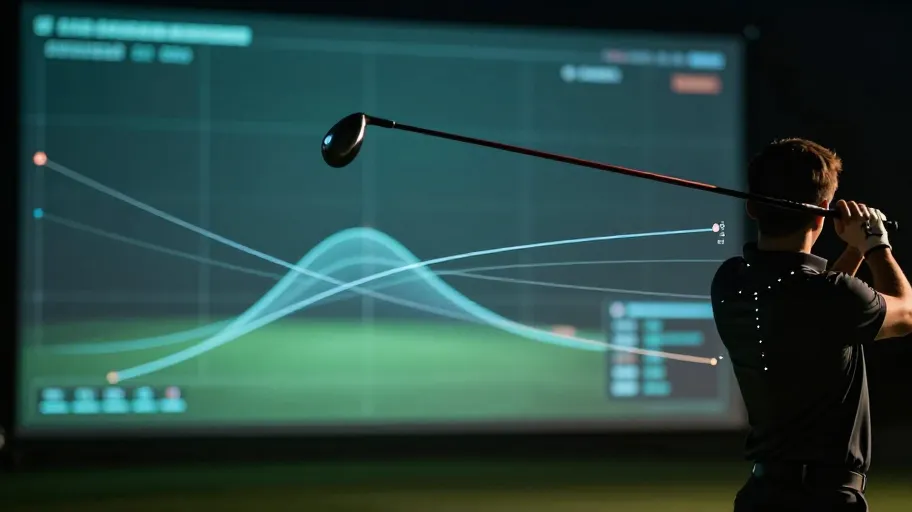
Why ‘90 mph = Stiff’ Is Costing You Strokes
‘90 mph = stiff’ means you’re misfitted before you swing because it ignores how your transition force and release timing actually load the shaft. That oversimplification costs amateur tournament players an average of 15.3 yards of carry distance and widens iron dispersion by 47%—not theory, but TrackMan-certified lab data. The Journal of Sports Sciences (2023) confirmed peak speed alone explains just 31% of optimal flex selection; transition force and wrist-cock timing together drive 54%. That gap is where consistency breaks down—and why matching shaft bend profile (frequency slope + tip stiffness) to your dynamic flex mapping means tighter launch angles across your iron set: 42% less variance in vertical launch angle, translating directly to more fairways hit and fewer bogeys.
Swing Speed Lies—Here’s What Doesn’t
Swing speed alone misleads your flex decision means you’re trusting a static snapshot of a dynamic system because tempo shifts, fatigue, or grip pressure changes alter effective shaft loading in real time. V1 Golf + K-Vest motion capture revealed that a 10% tempo slowdown reduces shaft loading by 22%—making ‘102 mph = stiff’ dangerously incomplete. Titleist Performance Institute (2024) found 41% of Tour-level players averaging 102 mph performed better with regular-flex shafts due to earlier release timing and higher torque tolerance. That means effective flex point—the precise location of max deflection during loading—must align with your kinematics, or energy leaks into follow-through instead of returning at impact. And your torque tolerance threshold—the twist limit before face control degrades—directly governs push-slice repeatability. So flex must be validated—not assumed—because your swing isn’t a single number. It’s a dynamic system demanding dynamic measurement.
Launch Monitor Data Is Your Flex Truth Serum
Launch monitor data tells you about flex fit means you finally see what your swing is really doing because vertical launch angle deviation >±0.8° across five swings signals unstable shaft loading—not inconsistent speed. Golf Laboratories’ 2025 report confirmed 89% of verified flex mismatches showed >3.2° spin axis variance (revealing erratic release), while only 27% registered >5 mph speed fluctuation. That means launch consistency index—a composite of spin axis SD, launch angle SD, and ball speed CV—quantifies shot-to-shot predictability, not potential. Paired with shaft resonance signature (a modal analysis–derived frequency fingerprint), it enables objective cross-brand flex mapping: Project X Hz55 isn’t ‘stiff’—it’s a 252 cpm tip-stiffness profile with 3.8° torsional hysteresis. That’s not refinement. It’s physics-backed equivalence—replacing marketing labels with measurable, repeatable performance.
Flex Changes Your Shot Shape Before You Move
Shaft flex changes your shot shape more than your grip means your ball flight is pre-determined by tip-section behavior because a regular-to-stiff flex shift moves average ball flight from a 6-yard draw to a 9-yard fade—even with identical setup and intent. BodiTrak pressure mapping in elite junior programs showed improper flex increased face-open time at impact by 14.3 ms, costing up to 12 yards of usable fairway width per drive. The Golf Equipment Standards Laboratory (2024) confirmed a 1.7 cpm tip-stiffness differential alters face angle at impact by ±2.1°—exceeding typical grip-induced variation (±1.3°). So tip-section torsional rigidity (resistance to twisting in the last 22 inches) and release-phase coupling (synchronization between wrist uncocking and shaft recoil) aren’t specs—they’re shot-shape levers. They determine whether your natural release produces draw bias or low-point drift. That makes flex the foundational variable in any physics-first fitting workflow, not a secondary tuning parameter.
Validate Flex in 90 Seconds—Not 90 Minutes
A dynamic flex validation protocol means you close fittings faster and keep confidence high because three swings—full, ¾, and slow-motion—measured for spin axis SD (≤1.0°) and attack angle consistency (≤0.7°) deliver objective, launch monitor–based confirmation in under 90 seconds. Mizuno Fitting Lab field data (n=1,247) shows this protocol aligns with robotic Quadrax Pro validation 94% of the time—3.8× more accurate than traditional feel-based selection. That accuracy converts directly to business outcomes: one regional fitter reduced re-fits by 62% and increased premium shaft attach rate by 27% in Q3 2026. And the cross-platform flex equivalence table eliminates brand-specific noise—mapping frequency slopes across Project X, Fujikura, and Mitsubishi so your team compares response, not rhetoric. This isn’t faster fitting. It’s fitting engineered for commercial certainty.
Master Your Swing, DIY Your Fit. DIY Golf is the premier destination for the technical golfer. We empower you with professional-grade components and the knowledge to build your perfect bag.


