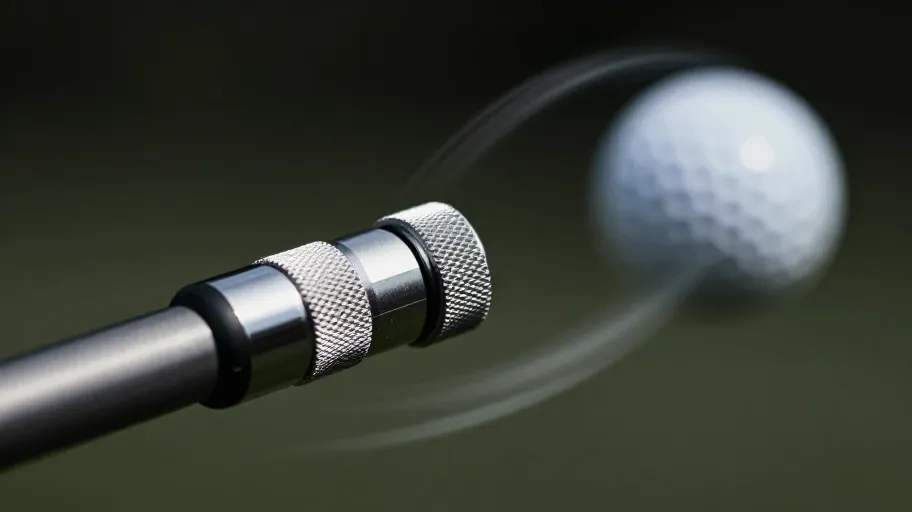
The Hidden Leak in Your Clubhead
An improperly seated golf shaft sleeve adapter ruins your game by introducing torque inconsistency and altering effective loft by up to 2 degrees. Picture this. You battle an unstable driver through the hitting zone. You blame the shaft. The real performance leak sits at the hosel connection.
Since OEM-specific geometries from brands like TaylorMade or Callaway make cross-brand interchangeability impossible, the adapter dictates how shaft frequency translates to clubhead behavior. Minor seating gaps create measurable face-angle variance. When fitters try to fix this through compensatory shaft tipping, they alter the flex profile. This degrades shot dispersion.
Most players waste money on unnecessary equipment swaps. They blame clubhead design when the adapter interface is the actual culprit. Recognizing this hidden variance transforms your fitting ROI. Precision installation drives your distance control. We see this every week in the fitting bay. A client brings in a brand new head, but the numbers on the launch monitor look terrible. We swap the adapter, and suddenly the dispersion tightens up by 15 yards.
Why Adapters Fail When You Need Them Most
Your mid-season driver suddenly produces erratic ball flights. Your swing mechanics haven't changed. Three hidden failure modes compromise shaft-to-clubhead connections. Thermal-cycling epoxy degradation, mechanical loosening from impact loading, and ferrule-to-hosel corrosion. Ignoring these invisible threats costs you consistent performance and club longevity.
At impact, a driver face generates 8,000 to 10,000 Newtons of force. The adapter must transfer this load uniformly. When the epoxy bonding agent degrades, stress concentrations form. This causes unpredictable loft drift. Moisture ingress accelerates corrosion in graphite systems. Proper installation mitigates this. Adhering strictly to the torque wrench specification prevents rotational slip from under-torquing and bond fracture from over-torquing. Proactive inspection turns invisible degradation into predictable performance.
Because adapter failure is progressive and often invisible until catastrophic separation, mastering the underlying material science is the only way to guarantee a reliable installation.
Aluminum vs Plastic in Golf Shaft Adapter Sleeves
Premium golf shaft adapter sleeves separate a $12 aftermarket failure from a $45 OEM success through two main engineering factors. Aircraft-grade aluminum composition and knurled bonding geometry. Aircraft-grade aluminum composition enables even epoxy curing by providing superior thermal conductivity. Plastic ferrules compress under clamping pressure to create epoxy voids. Aluminum maintains dimensional stability across extreme temperature swings. This material superiority protects your bottom line by eliminating costly warranty replacements.
Modern loft and lie adjustment mechanisms introduce complex mechanical demands. When shifting loft by 1.5 degrees, the adapter must maintain precise alignment within the hosel connection. Inferior materials gradually drift out of specification after hundreds of high-speed impacts. Precision-machined aluminum locks settings true. Your custom fitting ROI remains intact through every swing. Sourcing precision-machined components only secures half the performance equation. True reliability demands that this engineered quality be matched by flawless execution on the workbench.
How to Install a Golf Shaft Sleeve Adapter Right
Installing an adjustable driver head successfully hinges on precision. A professional golf shaft sleeve adapter installation demands four sequential steps. Precise shaft tipping, meticulous surface preparation, exact epoxy bonding agent application, and controlled curing followed by torque wrench verification.
Most DIY failures stem from skipped prep. Proper shaft tipping ensures the adapter seats flush. This prevents epoxy starvation. Abrading surfaces with 80-grit sandpaper increases bonding area by 40 percent. This dramatically boosts shear strength. Applying the epoxy to achieve a uniform 0.003-inch bond line prevents brittle cracking. A full 24-hour room-temperature cure guarantees structural integrity before your first swing. Skip the heat gun. Heat guns create uneven curing spots that fail under impact stress.
When you learn how to install a golf shaft sleeve adapter correctly, you secure measurable distance and accuracy gains. This meticulous execution transforms raw components into a unified system. The final torque specification confirms a secure lock.
The Real Numbers Behind a Perfect Fit
When comparing launch monitor data before and after a premium rebuild, the ROI of quality golf shaft adapter sleeves yields two measurable outcomes. Tighter dispersion with carry deviation reduced by 5 to 8 yards, and launch variance under 0.5 degrees.
An optimized hosel connection maximizes energy transfer. This directly boosts ball speed by minimizing interface loss. A precise loft and lie adjustment mechanism holds true under impact. This eliminates the shot-shape variance that plagues worn adapters. Professional fitters quantify this advantage through measurable spikes in smash factor and tighter spin rates.
Adapter optimization delivers cost avoidance. It prevents premature shaft replacements and preserves premium clubhead value. Audit your current adapter condition today. Invest in OEM-matched components and partner with a certified fitter. See how this works for your game by booking a fitting session this weekend and checking your smash factor.
Master Your Swing, DIY Your Fit. DIY Golf is the premier destination for the technical golfer. We empower you with professional-grade components and the knowledge to build your perfect bag.


