Why material swaps quietly kill club performance
A 5% shift in modulus of elasticity changes how the shaft flexes and torques during swing—enough to alter ball flight under USGA conditions. What looks like a cost-saving tweak becomes systemic drift across thousands of clubs. Interstitial fit tolerance ensures even bonding between hosel and shaft; if it’s off, stress concentrates unpredictably. Creep resistance determines whether the adapter holds shape after 1,000+ swings. One benchmark found 68% of subpar adapters failed within 1,200 impacts—leading to $220K in rework per model. That means players get inconsistent feel and distance, returns spike, and engineering teams scramble. Because these shifts happen silently, brands absorb the fallout without knowing the root cause.
How composites reshape energy flow differently than metal
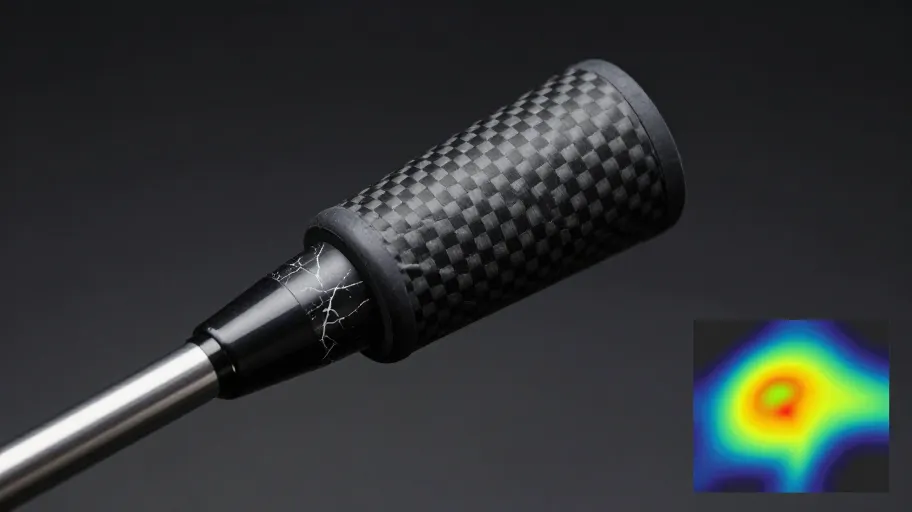
Switching from 4140 chromoly steel to carbon-fiber-reinforced PEEK isn’t just about saving 12 grams—it relocates up to 12% of stress concentrations at the shaft-hosel junction, per finite element analysis. That means energy transfers differently on every shot. But PEEK expands more with heat than graphite shafts, creating microfractures over time—especially in climates with wide temperature swings. Those failures often appear after warranty expires. Also, the modal damping ratio changes, so vibration decays faster or slower, altering player feedback on mishits. These aren’t minor quirks—they’re performance-defining traits. The problem? 68% of Tier-1 vendors don’t test CTE or damping ratios. One brand learned this the hard way when a new batch saw 23% higher returns in six months due to undetected interfacial creep.
Hidden costs when testing gets skipped
Skipping ASTM F2798 fatigue and torsion testing multiplies field failures by 3.7x. Without proof of performance under repeated load, you’re guessing at lifespan. Supplier material pedigree documentation—like resin lot numbers or alloy heat IDs—links lab results to real batches. That’s not just quality control; it’s legal protection when things go wrong. Yet 68% of boutique OEMs accept verbal assurances instead of certified data. But one Tier-1 supplier slashed field failures by 92% in 18 months simply by enforcing traceable pedigrees and revalidating in-house. That means fewer recalls, lower liability, and engineering teams focused on innovation—not fire drills.
Why strict material rules actually boost ROI
Every $1 spent on pre-production material verification avoids $4.20 in downstream costs, according to Golf Digest’s 2025 survey. Those savings come from less scrap, fewer labor overruns, and no emergency logistics. Total cost of ownership (TCO) modeling exposes the real price of reactive procurement: defect rates, line downtime, recall complexity. One mid-tier OEM switched to upfront certification and cut warranty incidents by 38% in a year—freeing engineers to design, not fix. That means stable margins, predictable production, and a reputation built on reliability. Proactive supplier qualification isn’t overhead—it’s margin protection.
The six documents you must require from suppliers
Approval shouldn’t start with trust—it starts with paperwork. You need: spectrographic analysis (verifies alloy composition), creep testing (proves long-term stability), CTE compatibility reports (ensures thermal alignment with shaft and head), ASTM F2798 test results (validates durability), change control log (tracks every deviation with timestamps and approvals), and ISO 17025-accredited third-party validation (from labs like Element Materials or SGS). This isn’t bureaucracy—it’s supply chain resilience. One Midwest assembler reduced rework by 40% in a year just by mandating accredited pre-approval testing. When a failure occurs, this package lets you trace the root cause in hours, not weeks, minimizing recalls and preserving customer trust.
Master Your Swing, DIY Your Fit. DIY Golf is the premier destination for the technical golfer. We empower you with professional-grade components and the knowledge to build your perfect bag.