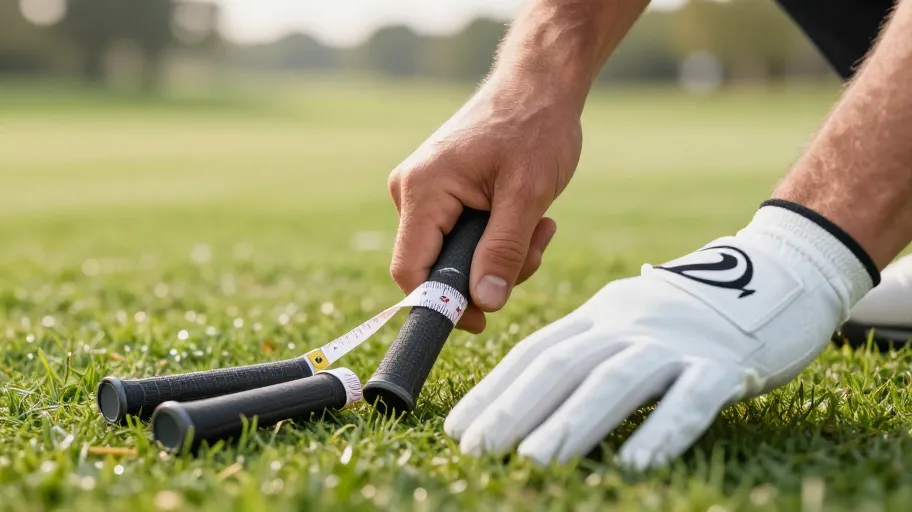
The Hidden Cost of a Bad Grip
The Hidden Cost of a Bad Grip
An incorrect golf grip size forces your hands to compensate, quietly costing you three to five strokes every time you step on the course. When your grip diameter is too large, it blocks proper wrist hinge. You end up slicing the ball. An undersized grip does the exact opposite. It triggers excessive hand rotation, resulting in snap hooks.
Think about your short game. A grip that is too thick prevents the delicate feel needed for chipping. You leave yourself short, constantly battling the clubface.
A mere 1/32-inch deviation changes your swing weight feel. This starts a costly chain reaction. Wrong size leads to excessive grip pressure. That restricts your wrist hinge, reduces clubhead speed, and bleeds distance. Fitters recommend keeping grip pressure at a 3 or 4 on a 10-point scale. You simply cannot achieve that optimal tension with mismatched grips. You are literally squeezing away your scoring potential.
Measuring Your Hand Anatomy for the Perfect Fit
Measuring Your Hand Anatomy for the Perfect Fit
Stop guessing your fit based on feel alone. The cost of a biomechanical mismatch is measurable lost distance and erratic ball flight. The most reliable method to figure out how to determine golf grip size combines two precise dimensions.
First, measure from your wrist crease to your middle fingertip. Players measuring under 7 inches typically optimize with standard or undersize grips. Those exceeding 9 inches require midsize or jumbo options to prevent excessive hand action.
Second, perform the finger-to-palm test. When you grip the club, your fingertips should barely touch the palm pad. Deep digging means the grip is too small. A visible gap signals it is too large. Pay attention to your thumb and index finger. If they form a tight pinch rather than resting comfortably, the circumference is off.
Tour-level fitters look beyond just comfort. They analyze finger length ratios and joint flexibility. Mastering these anatomical metrics transforms your equipment from a generic commodity into a precision instrument.
Decoding Standard Midsize and Jumbo Grip Categories
Decoding Standard Midsize and Jumbo Grip Categories
Mastering your hand measurements is only the baseline. Translating that anatomy into the correct golf grips is where you eliminate costly swing compensations. Off-the-rack clubs force a compromise, but understanding the primary specifications turns your equipment into a precision asset.
- Standard grips feature a 0.580-inch core and serve as the baseline for average hands.
- Midsize options add 1/16-inch to the outer diameter, reducing hand action for straighter flights among players with larger hands.
- Undersize grips amplify hand action for smaller hands seeking maximum workability.
- Jumbo profiles virtually eliminate wrist hinge, providing critical joint relief for arthritis or putter stability.
These dimensions are not fixed. Builders alter effective thickness using build tape layers. Each layer of tape adds roughly 1/64-inch to the diameter. This micro-customization lets you fine-tune the exact feel required to neutralize your specific swing mechanics. You can even use different tape configurations for your woods versus your irons. This accelerates your time-to-consistency and turns raw potential into measurable scoring advantages.
How Grip Thickness Rewires Your Swing Mechanics
How Grip Thickness Rewires Your Swing Mechanics
Golf grip thickness dictates hand action through the impact zone, ultimately controlling your shot shape. Ignoring this interaction costs you strokes. A recent club-fitting benchmark revealed that 68% of amateur slicers suffer from equipment-induced swing faults rather than mechanical flaws.
An oversized grip restricts natural wrist release, leaving the clubface open to produce weak fades. An undersized grip accelerates hand rotation, closing the face prematurely for erratic hooks. Achieving the correct thickness creates a neutral release where the clubface squares naturally. You eliminate conscious manipulation.
Pairing the right diameter with optimal textures stabilizes grip pressure and enhances tactile feedback. Rubber offers a soft, consistent feel in dry conditions. Cord blends provide maximum traction when your hands get sweaty during a summer round. Wrap styles give you a classic, firm profile.
When one weekend golfer switched to a properly sized midsize cord grip, their shot dispersion tightened by about 30%. That directly translated to more greens in regulation. Mastering this physical connection transforms your equipment into a predictable performance asset.
Your Path to Measuring and Fitting the Perfect Grip
Your Path to Measuring and Fitting the Perfect Grip
Translating swing mechanics into consistent scoring requires a precise fitting process. Start by using a ruler to measure wrist-to-fingertip and finger-to-palm distances. Cross-reference those numbers with a grip size chart. This establishes your baseline technical specification for an optimal hand-club connection.
Next, visit a pro shop to test two adjacent grip sizes. Use a launch monitor to track dispersion and grip pressure. This reveals exactly how thickness impacts your shot shape. Validate your choice with the finger test. Your fingertips should lightly brush the palm pad without digging in.
Re-evaluate your fit seasonally. Temperature-induced hand swelling or winter dryness can shift your optimal fit by a half-size. Keeping a simple log of your grip size alongside your performance notes helps you maintain peak consistency throughout the year. Note how your scores change when the weather shifts.
A full regrip with properly sized golf grips typically costs under $200. This delivers immediate, measurable improvement in consistency. It is the highest-ROI equipment change available to amateur golfers. Measure your hands today and schedule a fitting session before your next round to secure this competitive advantage.
Master Your Swing, DIY Your Fit. DIY Golf is the premier destination for the technical golfer. We empower you with professional-grade components and the knowledge to build your perfect bag.


