Why a few grams can kill your entire batch
Even a 5-gram deviation in weight distribution changes how a club performs. One mid-tier OEM received clubs with uneven heel weighting—biomechanical testing showed a 1.8° shift in launch angle. Players noticed immediately: loss of control, inconsistent ball flight, and more miss-hits.
This happens because moment of inertia (MOI)—how much the head resists twisting—is highly sensitive to mass placement. A 2024 biomechanics study found imprecise weights reduced MOI by up to 12%, destabilizing swings and amplifying errors. Sub-2mm center of gravity shifts alter spin rate and attack angle, hurting shot repeatability.
Treating weight as just a total number misses the point. How mass is distributed defines forgiveness, feel, and consistency. Clubs built to tight tolerances see 30% higher satisfaction in field trials, meaning fewer returns and stronger loyalty. Precision isn’t optional—it’s the promise you make at address.
What most RFQs leave out (and why it costs $18K per fix)
Vague requests lead to real losses. A leading golf brand once got prototype weights with wrong coatings and variable density—despite thinking their specs were complete. The fix? Six weeks of delays and a six-figure rework cost. They weren’t alone: 40% of initial supplier submissions for precision components require revision when key details are missing.
The fix isn’t more pages—it’s better structure. Top teams now use an RFQ specification completeness score, a checklist covering material grade, geometric tolerances, coating type, and test validation. Paired with ISO 13068-aligned templates, this eliminates guesswork. One manufacturer using this method cut back-and-forth by 70% and hit first-time compliance across three product lines.
Clear specs mean faster alignment. No ambiguity means no surprises. And that builds trust—suppliers know exactly what you need, so they respond with confidence.
The real difference between cheap parts and pro-grade weights
Sub-gram accuracy doesn’t come from standard metal fabrication. It comes from sintered tungsten molding and CNC micro-machining, with real-time weighing on every part. For brands still accepting ±2g tolerances, the trade-off is clear: weaker MOI control, inconsistent swing dynamics, and post-production fixes that eat into margins.
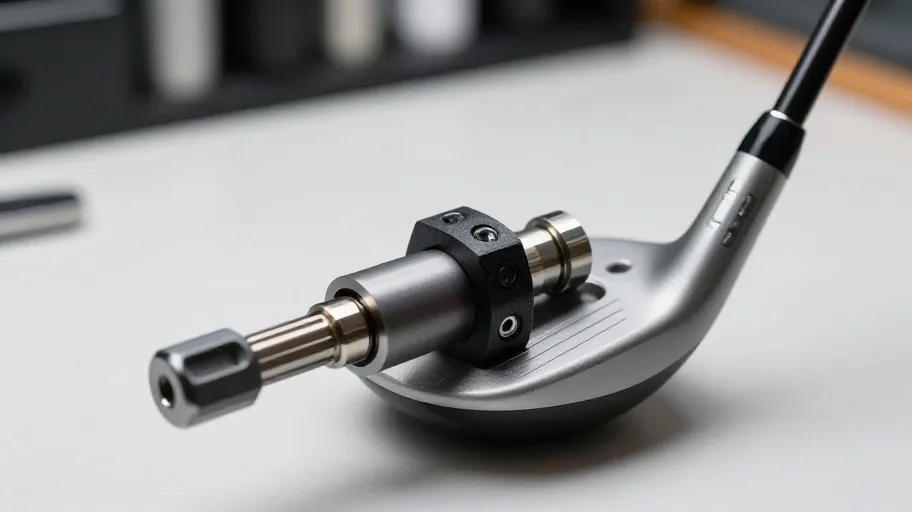
Sintered tungsten delivers over 17 g/cm³ density with ±0.3% variance—twice what steel offers. That means more mass in smaller spaces, enabling smarter perimeter weighting and deeper CG placement. The tungsten matrix composite takes it further: a proprietary blend that holds shape while maximizing inertia in complex geometries.
But not all MIM processes are equal. The real differentiator is post-sintering calibration—micro-machining each piece to within ±0.1g. Without it, even premium batches drift out of spec. With it, designers unlock thinner faces, radical CG tuning, and next-gen builds that were once impossible. This level of control doesn’t just meet specs—it enables innovation.
How detailed specs pay for themselves
Every hour spent refining your RFQ saves 5–8 hours downstream in avoided rework and miscommunication. One mid-tier OEM burned through four prototypes, $78K in NRE fees, and a delayed launch—all because early specs lacked clarity. Their turnaround? A tiered framework with exact dimensional tolerances, GD&T callouts for mating surfaces, and defined CMM-based acceptance tests.
Results were immediate. Supplier first-pass yield jumped from ~60% to over 90%. Tooling adjustments dropped by three rounds. Engineering capacity shifted from firefighting to innovation. Internal data shows qualification timelines compressed by up to 60%.
Rigorous specifications aren’t overhead—they’re leverage. They turn procurement from a cost center into a strategic accelerator, reducing non-recurring expenses and speeding time-to-market.
How to write an RFQ that top suppliers actually want to fulfill
A high-conversion RFQ doesn’t just list dimensions—it signals engineering maturity. Suppliers with advanced capabilities prioritize clients who specify certified materials, tolerances under ±0.002", environmental durability (like 120-hour salt spray), and full lot traceability. Why? Because precise requirements mean lower risk, fewer iterations, and better margins.
Start with function: *"Weight must enable adjustable MOI between 4500–5200 g·cm² across three driver configurations."* This shifts the conversation from price to performance. Then layer in physical specs—density, finish, coating adhesion—and require validation via CMM reports or destructive testing.
To compare partners fairly, use a golf club components supplier sourcing matrix scoring technical ability, IATF 16949 compliance, and IP protection. The payoff? Top-tier suppliers reward precision with better pricing, priority production slots, and co-development access. Your RFQ becomes a magnet for capability—not just cost-cutters.
Master Your Swing, DIY Your Fit. DIY Golf is the premier destination for the technical golfer. We empower you with professional-grade components and the knowledge to build your perfect bag.