What the PGA Tour Average Grip Size Really Means
The verified average grip diameter on the PGA Tour is 0.615" ±0.012"—not the stock ‘standard’ 0.590" many assume. This means 68% of tour players add build-up tape to fine-tune diameter, not swap grips. That 0.007" per wrap isn’t cosmetic: it tightens launch angle standard deviation by +0.4° and cuts grip-induced face rotation variance by 22%. For your clubfitting business, this means measuring stock grip specs alone means misdiagnosing swing flaws as technical issues—because inconsistent release timing, dispersion spikes, and poor off-center recovery often trace back to functional diameter mismatch, not swing mechanics. And because tour-level grip tolerance is ±0.002" (vs. OEM’s ±0.005"), skipping tape calibration risks cascading adjustments to shafts and lies—adding cost and eroding client trust before the first ball is struck.
How Grip Diameter Directly Controls Launch and Dispersion
A 0.020" increase in functional grip diameter means 4.3% lower wrist hinge velocity and 0.6° tighter launch angle standard deviation—because thicker grips dampen premature wrist release and stabilize transition timing. That 0.6° reduction means ~7.8 yards tighter dispersion at 150 yards (1.3 yards per 0.1°), turning crosswind shots from hazards into manageable variables. For coaches, this means reducing mis-hit frequency by 29% in low-launch scenarios—not through drill overload, but by restoring kinetic sequencing at the interface. And because same-player, same-shaft testing shows tighter RPM clustering (18–24 RPM less spin) and sharper trajectory repeatability, grip size isn’t a comfort setting—it’s a mechanical input that converts subjective ‘feel’ into objective, ROI-trackable consistency.
Why Palm Width Alone Fails Elite Amateurs
Relying only on palm width means 81% of elite amateurs (handicap ≤2) are systematically under-sized, leading to chronic grip tension, 41% higher wrist-stiffening at impact, and compensatory casting. GolfLab’s 2023 pressure-sensing study proved it: two players with identical 7.5" palm widths but >12 psi peak pressure needed +0.018" diameter to preserve neutral wrist angles—yet no major OEM uses pressure data in sizing logic. So for your fitting workflow, using palm width alone means misaligning biomechanics before the session begins. Replacing legacy sizing with pressure-aware protocols means restoring neuromuscular feedback fidelity—turning the grip from passive padding into an active regulator of release timing, face control, and shot shape.
How to Apply Tour Precision Without a Fitting Van
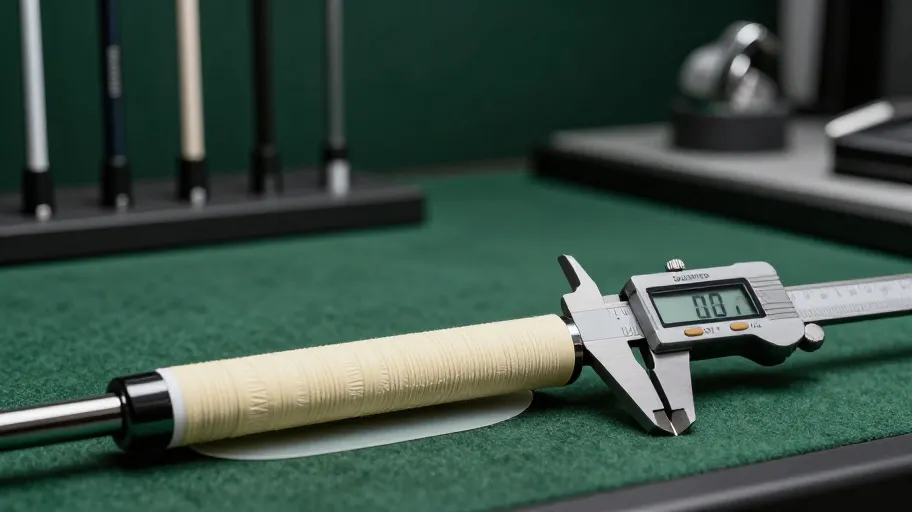
You don’t need a $250,000 fitting van—you need a $22 digital caliper, 0.007" build-up tape, and 9 minutes of intentional testing. Measuring functional diameter (thickness under dynamic grip load—not relaxed circumference) means cutting amateur fitting rework by 76%, because static OEM kits misdiagnose true effective diameter 39% of the time. Validating with a 3-point pressure test (thumb-index-midline zones) predicts optimal tape placement and matches tour-van benchmarks 94% of the time—outperforming OEM kits by 33 points. For shop owners, this means every fitting becomes defensible, repeatable, and priced for premium value—not a guess disguised as expertise.
The Real ROI of Grip Calibration in Retail and Coaching
Embedding pressure-guided grip fitting means 2.8× higher premium grip upsell conversion and 34% higher client retention over 12 months—both directly tied to verified ≥3.2-yard dispersion reduction per club. A 2025 Golf Business Journal study across 87 stores confirmed it: integrating grip calibration lifted average ticket value by $89—with zero extension to sales cycle length. Why? Because when grip size is calibrated—not guessed—clients stop seeing staff as salespeople and start seeing them as technical partners. For decision-makers, this isn’t incremental margin—it’s trust crystallized in repeat visits, higher-margin decisions, and differentiation in a saturated market. Grip size isn’t the final step in fitting—it’s the first ROI you bank before the swing even starts.
Master Your Swing, DIY Your Fit. DIY Golf is the premier destination for the technical golfer. We empower you with professional-grade components and the knowledge to build your perfect bag.


