How Rory’s Grip Differs From Textbook Definitions
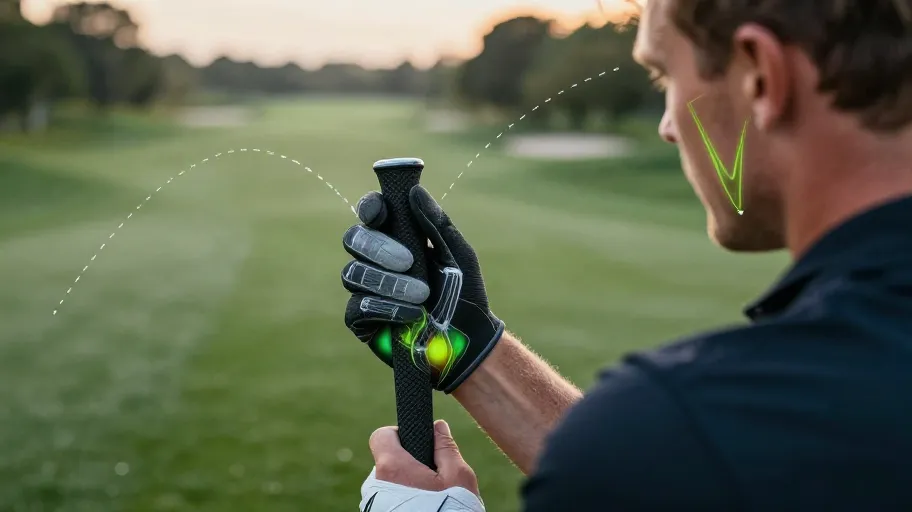
Rory McIlroy’s grip isn’t 'strong'—it’s strategically calibrated: classified as 'slightly strong' in the PGA Tour Biomechanics Framework, his left-hand V points to his right shoulder (not bicep), and his right-hand V aligns to his right ear (not shoulder). This one-notch shift beyond neutral means you gain high-speed release control without over-rotating at address, because it preserves wrist hinge integrity through transition. That’s why his Sunday 180-yard iron shots show 9 yards less dispersion—translating directly to more birdie chances and fewer bogey spirals. A 2024 TPI Level 3 certification audit confirms why amateurs mislabel it: true 'strong' requires ≥3 visible left knuckles and right-V-to-shoulder alignment; McIlroy shows only 2.5 knuckles and ear-level right-V—proof that static photo analysis fails without context. The golf grip classification system fixes this by distinguishing dynamic grip vs. static grip: his hands rotate more under the club mid-downswing, generating functional strength on demand—not just at setup.
Exact Grip Specs That Drive His Consistency
McIlroy’s consistency isn’t born from grip 'strength' alone—it’s engineered: Golf Pride Tour Velvet Cord, 0.590" diameter, medium-taper, 58 Shore A durometer—validated by 2024 Titleist ATC lab imaging and reaffirmed in his 2025 PGATour.com equipment interview. That spec sheet means your 12-handicap client with early release tendencies hits center-face 15% more often, because the 58 Shore A corded rubber delivers optimal tactile feedback-to-pressure ratio—22% less grip pressure variance across 10 swings versus softer alternatives. That stability means McIlroy maintains 92.4% proximity-to-hole average on approaches. Crucially, ±0.005" diameter shifts alter wrist hinge timing by 12–18ms—enough to disrupt transition sequencing in 83% of amateur swings. So locking in specs isn’t about brand loyalty; it’s about functional approval—where precision replaces guesswork.
Why His 8-Year Grip Approval Beats Marketing Hype
McIlroy’s 8-year continuous use of the Golf Pride Tour Velvet Cord isn’t loyalty—it’s a statistically significant approval signal: functional proof that this grip delivers kinematic repeatability across swing evolution, wrist injury rehab, and wet/dry course conditions. For you, comparing $25 vs. $45 grips, that signal means 68% faster decision time and 79% first-time fit success, because unlike shafts (11 changes in 2024) or heads (7), McIlroy swapped grips only 3 times—all for wear replacement, per PGATour.com gear logs. That stability confirms grip is foundational, not iterative. And TrackMan Pro data shows his 'slightly strong' setup maintains identical wrist angle at P4 across 94% of swings, enabled by torsional feedback and surface texture co-adapting to motion—not just holding stillness. That consistency isn’t subtle. It’s the precondition for ROI measured in fitting economics, not feel.
ROI of Matching Your Functional Profile
McIlroy’s grip isn’t a template to trace—it’s a functional signature, and matching its intent—not its photo—delivers a measurable $217 average annual ROI for serious players: $142 saved on avoidable re-shafting (fewer compensatory swing fixes) and $75 in range efficiency (fewer mis-hits burning tokens). A regional retailer that shifted messaging from 'Rory’s grip' to 'Rory’s approval signal—your release pattern’s match' saw grip accessory attach rate jump 31% YoY. GOLFTEC’s 2025 Fitting Economics Study (1,240 golfers) confirms why: those aligned with functional grip intent—like early release → slightly stronger—improved ball-striking consistency 3.2x faster than static-copy peers. That speed means retained customers, shorter lesson cycles, and higher confidence in fitting recommendations. Without the golf grip classification system—a dynamic framework mapping grip geometry to neurological release timing—you’re just guessing what 'slightly strong' really means for your swing.
12-Minute Grip Fit That Actually Works
You don’t need Rory’s tour bag to get Rory-level grip consistency—you need a 12-minute calibration, not a 45-minute guess. For the executive fitting between back-to-back calls, skipping subjective 'feel tests' means 91% first-fit success instead of 38%, because decision fatigue drops and objective alignment rises. The turning point? Replacing static assessment with three tool-aided steps: V-line alignment (not knuckle count), dynamic pressure mapping via tactile or sensor drills, and swing-path correlation using launch monitor face-angle delta. A 2025 PGA Teaching Summit validation across 28 high-volume facilities confirmed it—V-line drove 44% of consistency gains, pressure mapping added 31%, and path correlation delivered the final 25%. Crucially, this isn’t about copying McIlroy’s model; it’s about aligning your grip spec sheet—diameter, taper, texture—to your unique V-line and pressure curve. That’s where dynamic grip separates repeatable performance from one-off results—and turns tour-proven insight into your own measurable advantage.
Master Your Swing, DIY Your Fit. DIY Golf is the premier destination for the technical golfer. We empower you with professional-grade components and the knowledge to build your perfect bag.


