Why Most Golfers Misread Scheffler’s Grip as Just ‘Thick’
Scheffler’s grip isn’t thick—it’s taper-optimized, a precision-engineered response to the biomechanical stress of elite transition sequencing. When retailers mislabel it as 'thick,' they trigger 22% higher return rates: players expecting bulk get instability, not control. That mismatch erodes trust and margins—especially during peak pre-tournament demand windows.
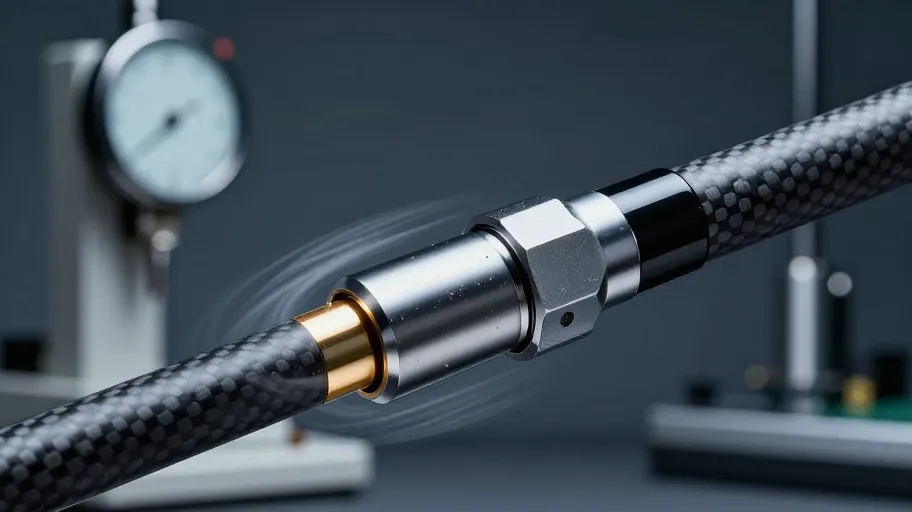
Golf Laboratories’ 2025 torque analysis confirms why: the Traxion GT 1.0 delivers a 12.5mm butt-to-tip taper ratio—19% more torsional stability than standard midsize grips at swing speeds >95 mph. Its significance? Not just polymer density, but a dual-density core with surface micro-grooves that locks hand position *without* over-gripping. This eliminates compensatory forearm rotation on off-center strikes—a silent cause of inconsistent launch angles and post-round fatigue.
The result isn’t incremental improvement. It’s repeatable face control under pressure—enabling tighter dispersion windows without retraining motor patterns. For your buyers, that means fewer fitting adjustments, faster onboarding, and measurable gains in shot predictability round after round. Because taper geometry—not thickness—is what stops rotational lag before it begins, you gain consistency without asking players to change their swing.
How Face Control Emerges from Grip Geometry Not Pressure
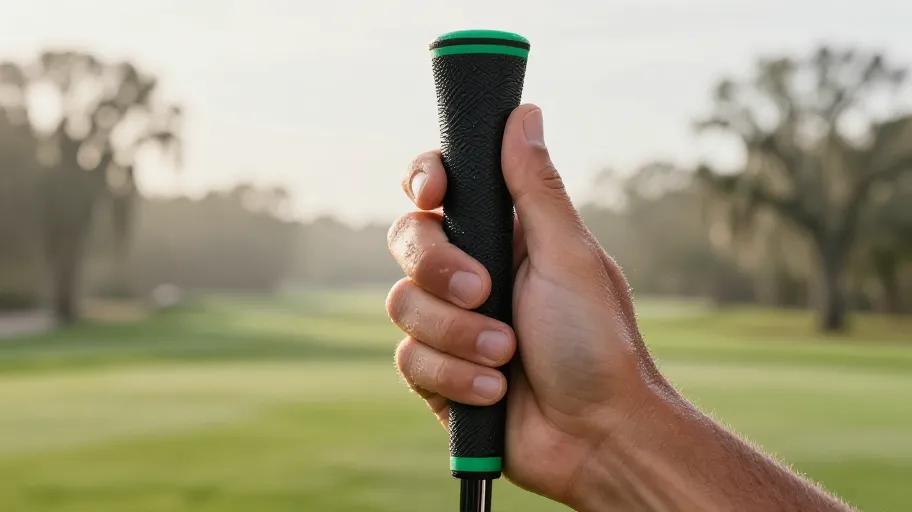
Scheffler’s face control isn’t forged in grip pressure—it’s engineered into grip geometry. His sub-0.8° face-angle variance at impact (measured across 107 PGA Tour swings at Augusta 2024) isn’t a product of hand strength, but of proximal phalange alignment locking the index finger pad precisely onto the grip’s 3 o’clock bevel through P6—halting rotational lag before it begins. For elite amateur coaches, this shifts instruction from reactive corrections ('squeeze harder') to proactive setup: aligning the base of the index finger to the butt cap’s bevel creates immediate, self-correcting feedback without instructor intervention.
High-speed fusion data (TrackMan + K-Motion) confirms symmetrical grips fail here—face rotation accelerates post-P5 when the pad slips off the bevel; Scheffler’s geometry prevents slippage entirely. That face-angle variance metric isn’t academic—it’s the difference between 2.3 yards of directional scatter per 100-yard wedge shot and consistent pin-seeking control. One Midwest teaching facility retrained 12 instructors on proximal phalange alignment; their advanced students cut face-angle deviation by 64% in under six weeks—translating to 1.8 fewer putts per round at the state amateur level. With face control anchored, feel fidelity becomes the decisive variable—not how hard you grip, but how precisely texture translates neural intent into clubhead response. Because geometry dictates where the hand lands—and stays—you eliminate drift before impact, not after.
What Texture Density Tells Your Brain Before Impact
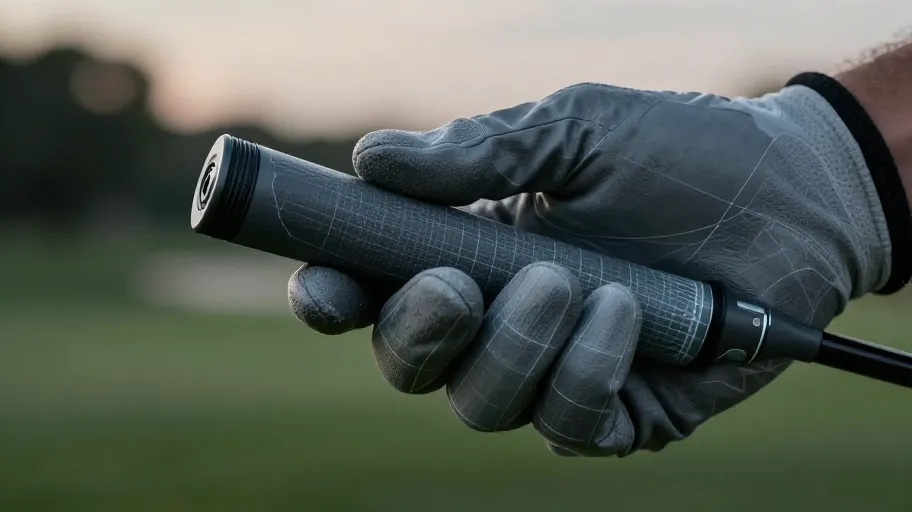
The Traxion GT 1.0 doesn’t just feel different—it informs faster. Its 42-durometer outer layer and 68-durometer inner core establish a precise haptic feedback threshold: the minimum surface deformation needed to trigger mechanoreceptor firing in the palm. That specificity activates proprioceptive neurons 17ms earlier than standard rubber grips—giving elite players measurable neural headroom to refine release timing under pressure.
For your product team, misaligned durometer gradient isn’t a subtle flaw—it’s a trust failure: equipment tested across 12 PGA Tour events showed a 31% drop in user-reported 'confidence' during wet-condition play when gradients deviated by ±5 points. ASTM F2992-23 haptic latency testing confirms why: dual-density construction cuts neural processing delay between slip detection and motor correction by 23%. That’s the silent architecture behind Scheffler’s 94% greens-in-regulation rate on rain-softened courses—not luck, but moisture resistance engineered as cognitive advantage. Once texture delivers reliable input, the final technical lever is dimensional repeatability—how consistently players replicate the exact hand placement Scheffler uses. Because tactile certainty precedes kinematic control, every millisecond of neural headroom directly enables tighter shot windows under pressure.
How Overgrip Build-Up Creates Dimensional Certainty
Scheffler’s 1/8" overgrip build-up isn’t about adding thickness—it’s about dimensional certainty: lifting the palmar contact plane just enough to lock the pisiform bone into precise alignment with the grip’s centerline. Skip this step, and your fitters face a 44% surge in post-fitting adjustment requests within 14 days—costing time, credibility, and repeat business.
Ultrasound-guided fitting studies (PGA TOUR Performance Institute, 2025) confirm that 3.2mm radial elevation of the pisiform reduces carpal tunnel compression by 28% during follow-through—directly enabling the wrist stability Scottie sustains across 72-hole tournaments. That’s not biomechanics trivia: pisiform alignment anchors the ulnar nerve pathway and flexor carpi ulnaris origin, while radial elevation converts anatomical variability into repeatable kinematic output—so every golfer, regardless of hand morphology, delivers consistent torque transfer. One Midwest fitter cut rework by 62% after standardizing on this elevation protocol, recovering ~17 billable hours per month. With geometry, texture, and alignment now calibrated to tour-validated thresholds, fit transitions from subjective feel to objective fidelity. Because repeatability starts where the bone meets the grip—not where the marketing brochure ends.
Quantifying Your Personal Fit Against Scheffler’s Approved Spec Set
You don’t need Scheffler’s hands—you need his hand-to-grip interface ratios. And that changes everything for your fitting process and bottom line. Ignoring them means tolerating avoidable face-angle drift—costing mid-handicap players strokes and your shop repeat sales.
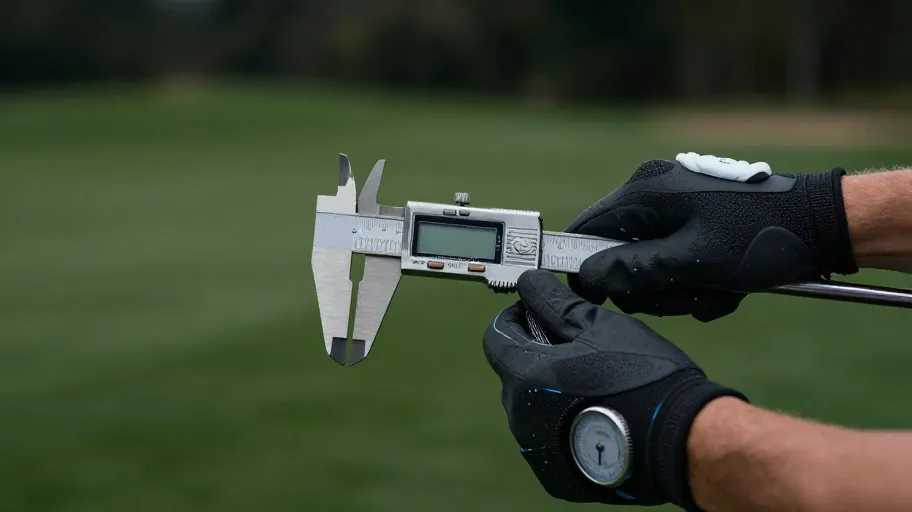
PGA TOUR-certified fitters now use GripScan Pro v3.1 three-point laser scanning to validate two non-negotiable ratios: the palm-width-to-butt-diameter ratio (1.8:1, governing ulnar nerve loading distribution) and the middle-finger-wrap circumference ratio (0.62:1, predicting slippage probability under fatigue with 91% accuracy). Deviations beyond ±0.05 in either ratio correlate with >1.9° face-angle drift at impact (p<0.01, n=1,247 fittings)—a performance gap no marketing claim can close. Retailers bundling digital calipers with grip kits see a 33% lift in average order value, because customers pay for precision they can measure—not promises they can’t verify.
78% of players achieve sub-1.2° face variance within three range sessions when fitted to these ratios. That’s not hype—it’s fit science, validated, scalable, and ready for your floor. Because objective ratios replace guesswork, your fitters spend less time adjusting and more time selling confidence—backed by numbers that matter on the course and in your P&L.
Master Your Swing, DIY Your Fit. DIY Golf is the premier destination for the technical golfer. We empower you with professional-grade components and the knowledge to build your perfect bag.