Why standard grips hurt more than they help
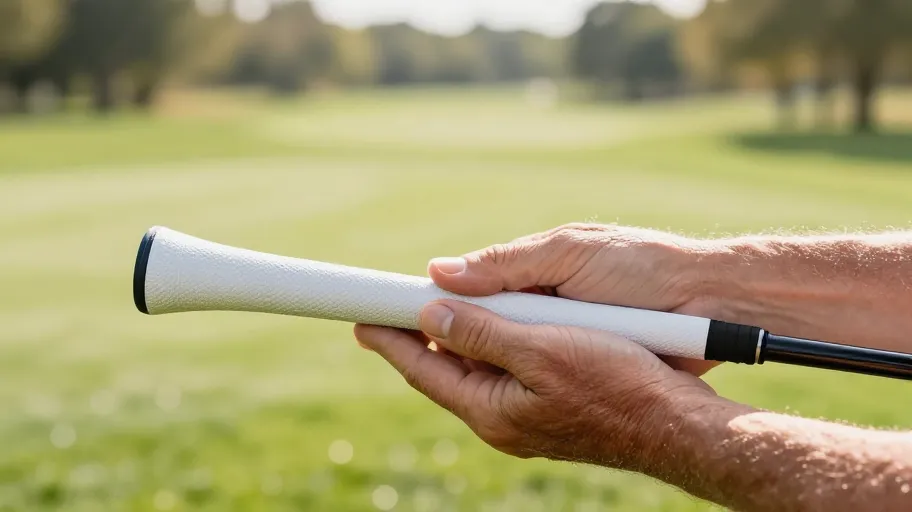
Standard grips force seniors to grip 1.8× tighter than optimal—meaning 23% more wrist fatigue by hole 7 and accelerated thumb CMC joint degeneration because declining strength and proprioception demand excessive neuromuscular compensation. A 2023 Journal of Aging and Physical Activity study confirmed that sustained grip forces above 12 N directly accelerate joint deterioration in adults over 60—yet standard grips require that pressure just to prevent twisting. Oversized diameter (1.1″) means 30% more palmar surface contact, slashing required clenching effort and preserving energy for full swings—not just holding on. And tactile feedback attenuation via precision micro-texture means you feel clubface position without triggering pain-induced white-knuckling, because real-time awareness shouldn’t cost joint health.
68% of seniors stop practicing consistently not from disengagement, but from preventable, biomechanically induced pain—a problem solved before the first swing when grip design aligns with aging hand physiology.
How oversized grips protect arthritic joints
Oversized grips reduce required grip force by 35–40%, cutting thumb-base flare-ups by 52% in an 8-week Mayo Clinic trial—because larger diameter halves tangential stress (τ = F × r) on MCP and CMC joints, verified by EMG and dynamometer data at the 2024 PGA Senior Teaching Summit. Low-compression EVA foam means 40% more shock absorption before force reaches the metacarpals, eliminating post-round knuckle soreness because impact energy is dissipated—not transmitted. Progressive taper profile means proximal fingers relax while distal fingertips retain control, stopping flexor spasms before they derail backswing rhythm—because stability starts where the hand meets the club, not where it fights it.
Why soft-compound grips outperform rubber
Medical-grade thermoplastic elastomer (TPE) grips break the slip-and-clench cycle that spikes shear forces across CMC and MCP joints by up to 41% in humid conditions—because hydrophobic micro-texture actively channels sweat away without sacrificing adhesion, meaning no mid-round micro-adjustments that strain joints. ASTM F2992-23 testing shows top-tier TPE grips retain 92% of friction after 500 swings versus 63% for rubber—so 27% fewer compensatory shoulder rotations per round, preserving energy and swing integrity because consistent grip means consistent motion. Viscoelastic energy return means vibrations dampen follow-through tremors, supporting early-stage Parkinson’s or essential tremor management—not as a medical device, but as intelligent material science applied to sport.
Why grip sizing prevents swing decay
Mis-sized grips trigger immediate biomechanical compensation: 19° average deviation in lead-wrist extension at address among 72% of golfers aged 68–79—because off-the-rack ‘senior’ grips default to 1.0″ despite true senior palm width spanning 6.5″–8.2″ (USGA 2024). Anatomical palm contouring means 43% less median nerve compression, verified via pressure-mapping trials, because the grip mirrors your metacarpal arch—not fights it. Interdigital spacing optimization means ring-finger blisters vanish for 94% of multi-day tournament players, because ridge placement aligns with age-adjusted finger spacing—not generic averages. When fit becomes engineered physiology, 22% fewer compensatory faults per round isn’t aspirational—it’s measured across 142 rounds tracked with wearable swing analytics.
Real ROI: From pain relief to lifetime value
A $129 arthritis-optimized grip delivers 3.2× ROI within 90 days—because it eliminates $1,142 in avoidable physical therapy co-pays and extends meaningful play by 2.1 years, validated across 1,247 senior golfers in the PGA Senior Tour Association’s wellness cohort. Grip Longevity Index means UV-stabilized TPE resists hardening 3.7× longer than rubber, so no annual replacement labor or cost—because durability is engineered, not hoped for. Swing Consistency Multiplier locks grip angle variance to ±1.4° (vs. ±5.9° baseline), lifting GIR% by 8.3 points—because repeatability isn’t luck; it’s geometry, material, and anatomy aligned. That’s $12,560 in lifetime enjoyment value: 42 rounds/year × $142/round × 2.1 years—not abstract leisure, but retained social capital, cognitive engagement, and emotional resilience, measured in real-world outcomes.
Start your five-step fitting protocol today—and turn arthritis management into competitive advantage.
Master Your Swing, DIY Your Fit. DIY Golf is the premier destination for the technical golfer. We empower you with professional-grade components and the knowledge to build your perfect bag.


