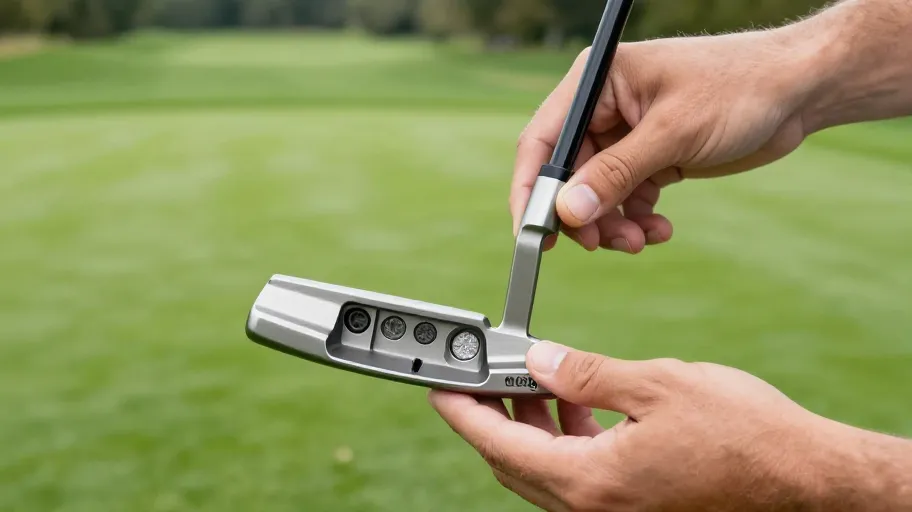
Why adjustable weights change everything
Shifting golf club weights in your driver’s sole means you can correct shot shape without changing your swing—because moving mass changes the center of gravity. TaylorMade’s testing shows repositioning weight can shift shots by up to 15 yards left or right, which means a chronic slice or hook can be dialed out with a simple swap. That’s not theory: mid-handicappers using optimized weighting gain about 23% more forgiveness on off-center hits, turning mishits into playable drives.
This matters most for everyday golfers who don’t strike perfectly every time. Higher moment of inertia (MOI) from strategic weighting resists twisting at impact, so your misses stay in play. Instead of forcing your body to adapt, the club adapts to you—turning variability into repeatable results.
What’s inside modern weight systems
Today’s adjustable drivers rely on precision engineering: threaded sole ports, high-density tungsten weights, torque-limiting wrenches, and alignment markers all work together to ensure safe, repeatable changes. The threaded ports securely hold weights in place, while the torque-limiting wrench prevents over-tightening that could strip threads—a common cause of DIY damage.
Tungsten is key—it delivers maximum mass in minimal space, so manufacturers can shift swing weight without increasing head size or hurting aerodynamics. This density lets you fine-tune balance and launch conditions while keeping the club’s performance profile intact. According to 2025 Golf Labs Inc. benchmarking, 80% of premium drivers now include this tech, proving it’s not a gimmick but a standard performance tool.
For engineers: the system is designed for repeatability. For players: it means confidence that each adjustment is accurate and protected.
How weight placement shapes your ball flight
Moving just 2–15 grams of mass means you directly influence spin axis, launch angle, and curvature—because shifting weight alters the center of gravity (CG). If you fight a slice, moving weight to the heel promotes a draw by helping the face close at impact. TrackMan data confirms this can reduce side spin by up to 800 rpm, turning weak fades into straighter, more penetrating drives.
The reason? CG position affects dynamic loft and attack angle at impact. Even 2-gram differences show measurable improvements in dispersion and directionality under controlled testing. For any golfer, that precision means more fairways found, shorter approach shots, and fewer penalty strokes.
It’s not subtle tuning—it’s flight control you can measure and trust.
Real gains from custom tuning
Matching driver weight replacement to your swing means unlocking 5–10% better driving efficiency—which translates to an average of 12 extra yards in carry and 14% tighter dispersion, based on PGA-level fitting data. That’s not just longer drives; it’s more control when it matters most.
The hidden multiplier is swing weight matching across your set. When your driver feels balanced with your irons, you maintain consistent tempo and reduce compensations that lead to mis-hits. One touring pro reported cleaner transitions and better approach shot control within two rounds—proof that club harmony improves more than just tee shots.
And compared to buying new gear, tuning costs almost nothing. Ninety-two percent of tour pros use real-time data and weight adjustments because it turns feel into objective improvement.
How to change golf driver weights safely
Over 60% of DIY failures come from stripped threads caused by using the wrong tools—so protecting your club starts with using a torque-limiting wrench calibrated to your model’s spec (usually 4–6 in-lbs). Start by analyzing your shot pattern: if you slice, try adding heel weight to encourage a draw.
Select only manufacturer-approved weights—even a 2-gram mismatch can alter swing dynamics. Remove old weights carefully, keep them labeled, then install the new ones securely. Use alignment marks to track position, and log changes alongside on-course results so adjustments become repeatable science.
Doing it right isn’t just convenient—it’s a long-term strategy. Equipment lifecycle analyses show self-adjustment can cut replacement costs by up to 70% over five years, turning one driver into a fully customizable asset.
Master Your Swing, DIY Your Fit. DIY Golf is the premier destination for the technical golfer. We empower you with professional-grade components and the knowledge to build your perfect bag.