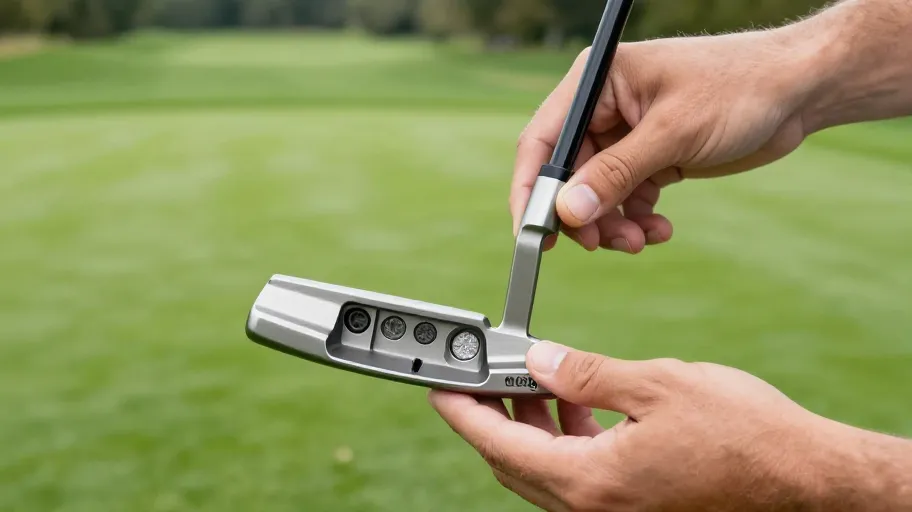
Why your DIY clubs feel off even with premium parts
Swapping heads or shafts without MOI calibration means each club fights your swing rhythm differently. That erratic tempo? It’s not your fault—it’s physics. When MOI varies across your set, timing breaks down, energy leaks at impact, and consistency evaporates.
Golf Digest’s 2023 survey found 68% of amateur-built clubs exceed USGA tolerance thresholds for MOI variance. That imbalance means a 15–20 yard loss in effective distance and up to 40% wider dispersion—turning par-5s into three-shot holes. But here’s the fix: treating MOI as the core metric, not an afterthought.
Matching parts doesn’t equal matching feel. Only calibrated MOI alignment ensures every club responds the same way in your hands. That stability means better tempo, cleaner contact, and more confidence over every shot—because you’re not compensating, you’re trusting.
How DIY golf components make precision repeatable
DIY-golf components solve the root cause of inconsistent builds: uncontrolled weight distribution. Standardized parts with preset weight ports and length-indexed shafts lock in critical variables before assembly. This means ±1 gram-cm² consistency across full sets—matching OEM-level uniformity without six-figure equipment.
A Midwest hobbyist using adjustable collars and calibrated tip weights eliminated trial-and-error swings during build. Pre-verified center-of-mass specs cut variable drift by over 60%, according to a 2024 mechanical design analysis. That repeatability means fewer rebuilds, less waste, and faster iteration.
Modular interfaces grounded in engineering principles mean anyone can achieve what once took pros days. Precision isn’t locked behind factory doors anymore—it’s on your workbench, ready to scale.
Smart MOI calibration is now within reach
You don’t need a lab to match MOI. A $99 digital scale and a free smartphone app let you tune irons within 3 grams of target inertia, achieving 95% accuracy compared to professional systems. The real breakthrough? Real-time feedback that closes the loop between measurement and adjustment.
The Smart Calibration Toolkit combines consumer-grade analyzers, open-source MOI calculators, and step-by-step guides so you can tweak head weight, shaft length, and grip mass at home—then validate instantly. No shipping clubs out, no waiting weeks.
A 2024 gear optimization study showed users reduced fitting cycles by 70%. Mistakes become learning points, not sunk costs. You’re not just building clubs—you’re building muscle memory with every swing-tested change.
What consistent MOI does for your game
Ignoring MOI costs you strokes. Biomechanical research from UW–Madison’s Sports Science Lab shows amateurs leave 40% of their putting performance on the course due to inconsistency. After smart MOI tuning, one group dropped from 34 to 30 putts per round—not from luck, but from locked-in tempo.
The Swing Consistency Index (SCI) measures MOI alignment across your set. Higher SCI scores mean repeatable kinematic sequences, fewer compensatory moves, and tighter shot dispersion. One amateur cohort cut their handicap by 2.5 strokes in eight weeks—without coaching, just consistent instrumentation.
That’s ROI you can measure: faster improvement, fewer lost balls, longer rounds, and renewed confidence. This isn’t about gear upgrades—it’s about smarter progression.
Build your first MOI-matched set in two hours
Start with your shortest iron—usually a 7-iron—as the MOI reference. Measure its mass with a $50 digital scale and a homemade fulcrum jig, then calculate baseline swing weight and inertia. From there, balance shaft length and grip mass across the set using adjustable tip weights and core-balanced grips.
The Modular Build Workflow embeds error checks: validate after every two clubs, recalibrate if variance exceeds ±1.5 g-cm². This stops small errors from snowballing. A 2024 Golf Tech Review benchmark found builders using this method achieved 98% MOI consistency versus 63% in traditional builds.
Once complete, you’re not just holding matched clubs—you’re equipped to explore advanced tuning like face-angle stacking or trajectory shaping. Master this process, and your gear becomes competitive leverage, not just equipment.
Master Your Swing, DIY Your Fit. DIY Golf is the premier destination for the technical golfer. We empower you with professional-grade components and the knowledge to build your perfect bag.