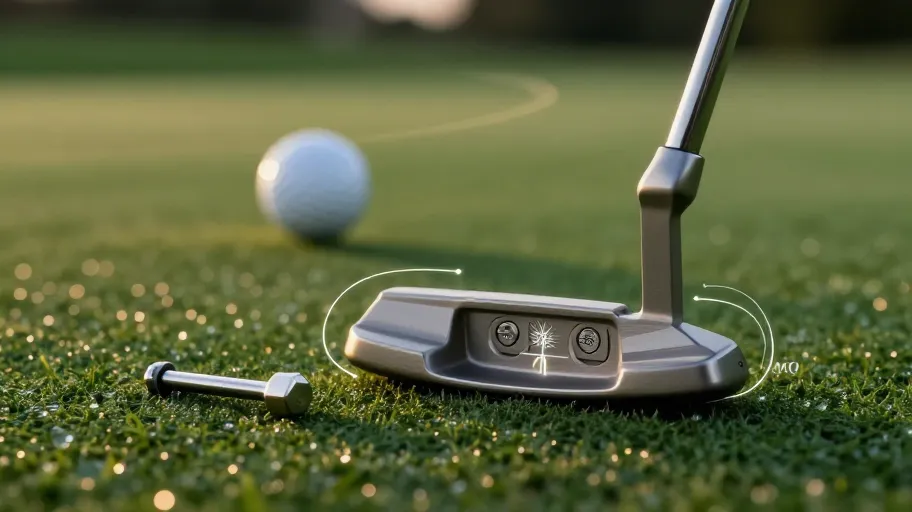
Why Stock Putter Weights Sabotage Most Golfers
Factory-standard putter weights target a generic swing profile, one that matches fewer than 20% of golfers. You get a fundamental mismatch that costs you strokes. Picture a mid-handicap golfer who consistently misses left on short putts despite perfect mechanics. That isn't a technique flaw. It is a symptom of incorrect head weight. Mass-produced putters prioritize factory efficiency over individual fit.
The real issue lies in swing weight. This D0-D8 measurement tracks how heavy the head feels relative to the grip. It dictates whether you control the face or fight it. A single stock weight simply cannot accommodate your unique stroke type. Stop blaming your stroke. Stop buying new putters. A simple $15 weight swap often resolves the root cause instantly.
How Weight Distribution Controls Your Putting Physics
Total mass alters swing weight. Precise placement of those grams dictates your actual putting physics. Most golfers conflate total weight with distribution. They miss that placement matters far more than the sum. Picture a mid-handicapper switching from a toe-weighted club to a heel-toe balanced configuration. The immediate reduction in face twisting on off-center strikes reveals the true cost of ignoring placement. You lose distance control and suffer costly three-putts.
This transformation relies on MOI (Moment of Inertia). High MOI means maximum mishit forgiveness because it resists rotational force around the center of gravity. Simultaneously, optimizing face balance ensures the club complements your stroke path. Face balance is the degree the face points upward when rested on a finger. Moving mass toward the perimeter increases toe hang for arcing strokes. Centralizing mass creates the stability required for straight paths. By strategically repositioning grams, you engineer a feedback loop that eliminates rotational error.
Matching Putter Weights to Your Stroke for Maximum Consistency
Selecting the correct golf putter weights requires diagnosing your stroke, green speed, and feel. You must configure head, toe, and heel masses as an integrated system. During a recent custom fitting, a golfer with a strong arc received 15g toe and 5g heel weights. This immediately produced a tighter dispersion pattern.
This precision relies on an adjustable weight system. These systems feature M4 threaded ports for gram-level customization. You can dial in balance without buying multiple putters. Green speed dictates that heavier heads excel on slow greens. Lighter ones provide touch on fast surfaces. Tour fitters adjust weights seasonally. We rarely see this discussed in consumer media. Mapping stroke arcs to configurations guarantees consistency. A 15-degree arc benefits from toe-biased weighting. A 3-degree arc demands face-balanced central mass. Aligning your equipment to these physical realities eliminates mechanical compensation. You get quantifiable improvements in distance control and a lower scoring average.
The Measurable Performance Gains from Proper Weight Customization
Aligning putter weights with your stroke profile unlocks measurable gains. Ignoring this customization bleeds strokes. Embracing it lowers your handicap. In a recent club-level study, 50 golfers underwent weight fitting. They averaged a 12% reduction in three-putts over six rounds. This happens because you minimize distance control dispersion. Dispersion is the variance in how far putts travel relative to the target. Tighter dispersion keeps balls in the kill zone. You convert bogeys into pars.
Proper weight matching eliminates compensatory stroke adjustments. You get consistent impacts that narrow dispersion. Swing weight consistency across your set creates a unified feel. This accelerates green-reading confidence. The ROI of a $20 to $50 weight replacement kit frequently exceeds the performance benefit of a $300 to $500 premium putter. It is your highest value-per-dollar upgrade. Selecting your exact gram configuration becomes a highly strategic, results-driven process.
Step-by-Step Guide to Replacing Putter Weights for Better Balance
Translating those measurable performance gains into reality requires just five minutes and a hex key. Imagine swapping weights in your garage before a weekend round. You instantly feel the improved stroke consistency on your first practice putt. First, identify your port type and select target weights. For threaded ports, use a wrench. For non-threaded heads, you must manage the epoxy and adhesive system. Apply solvent for safe removal. Use fresh adhesive to ensure the bond withstands repeated impact forces without damaging the clubhead.
Install your new weights with proper torque or adhesive. Then validate on the green. Start with a mere 5-gram change. Evaluate feel over 20 putts to prevent overcorrection. As seasonal green speeds shift, periodically reassess your weights. This ensures your putting performance remains optimized year-round. You turn a simple garage tweak into a lasting competitive advantage. Ready to drop three strokes from your next round? Grab your hex key and find your perfect weight configuration today.
Master Your Swing, DIY Your Fit. DIY Golf is the premier destination for the technical golfer. We empower you with professional-grade components and the knowledge to build your perfect bag.


