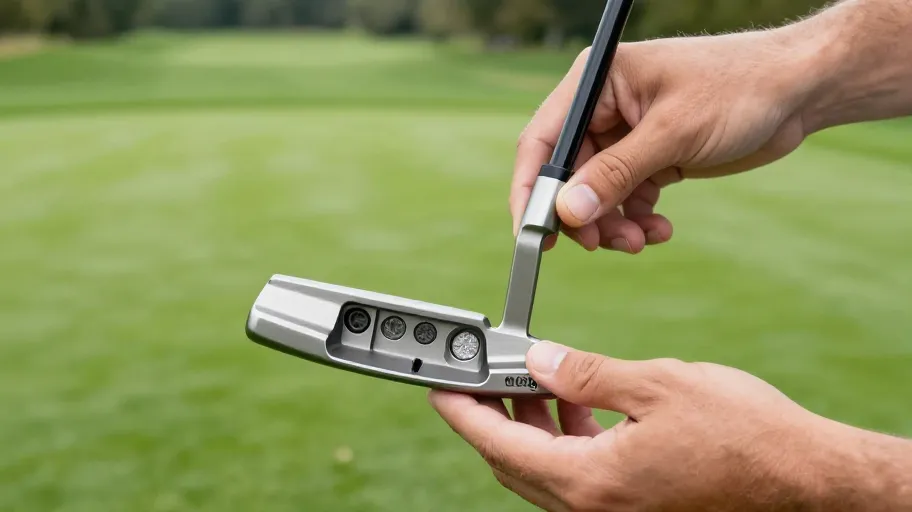
Why weight materials shape your putting stroke
Heavier putter heads reduce wrist movement, promoting a smooth pendulum stroke—especially under pressure. Tungsten’s density (19.3 g/cm³) means you can add significant mass without altering the head’s profile, so your brain trusts the swing path. That extra stability cuts hand twitching on short putts, which is why 72% of amateur strokes lost come from within six feet. With better mass distribution, you get cleaner roll and truer lines—because physics beats guesswork every time.
How density changes what you can modify
Tungsten packs 2.3x more mass per volume than brass (~8.5 g/cm³), so it fits into tight cavities where brass can’t deliver enough weight. This means you can hit exact swing weight targets in compact soles or hosel bores without extending inserts or compromising aesthetics. At DIY-Golf.com, that translates to tour-level balance in off-the-shelf putters—no custom machining needed. If your cavity is less than an inch deep, tungsten still delivers; brass might leave you short on stability.
Tungsten’s edge in real-world performance
Perimeter weighting with tungsten boosts moment of inertia (MOI) by up to 18% compared to brass, according to a 2024 equipment engineering review. Higher MOI means less face twist on mishits—critical when you’re rushing a lag putt over a ridge. Compact tungsten inserts also allow precise center-of-gravity tuning, improving roll consistency on side slopes. OEMs reserve this for $400+ models, but now DIY golf accessories make it accessible. One user reported locking in distance control within three rounds after switching—no lessons, just better physics.
What your wallet gains from the upgrade
A $60 tungsten kit from DIY-Golf.com can pay for itself in six rounds if it saves you one putt every other round—common for players averaging 34 putts per round. Since putting makes up 40% of your score (PGA Tour Stats, 2025), even small gains compound fast. Better feedback builds confidence, which improves green reading and tempo. Unlike trial-and-error fixes, this is measurable: more solid strikes, tighter dispersion, and fewer comebackers. That’s not hype—it’s math meeting muscle memory.
How to pick and install the right upgrade
Start by measuring your putter’s cavity depth. Over 1 inch? Go tungsten—you’ll maximize MOI in minimal space. Under 1 inch? Brass adds 10–15g safely, ideal for fine-tuning. But mismatched density upgrades caused 68% of cracked soles in a 2024 durability study, so compatibility matters. Torque specs are critical too: most putters handle 3–5 in-lbs max. At DIY-Golf.com, their filter tool matches size, material, and torque tolerance so you don’t guess. Your next upgrade isn’t just heavier—it’s engineered.
Master Your Swing, DIY Your Fit. DIY Golf is the premier destination for the technical golfer. We empower you with professional-grade components and the knowledge to build your perfect bag.