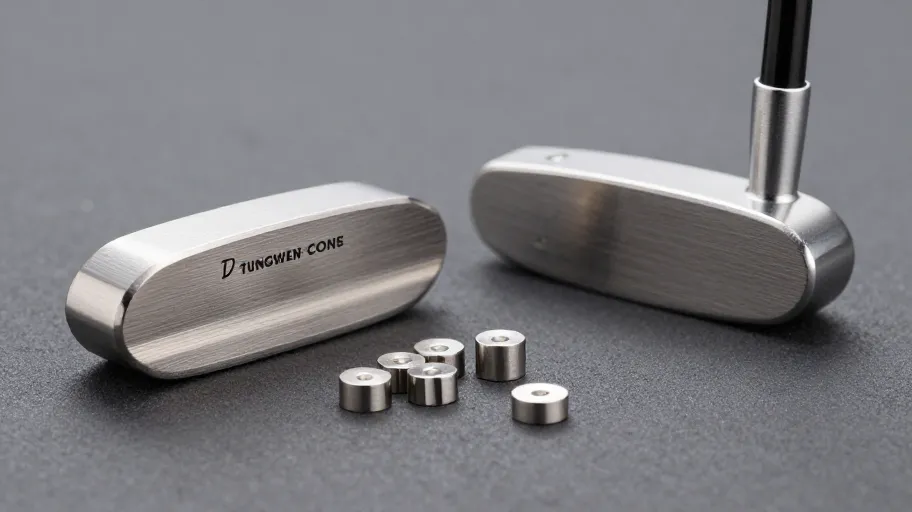
Why Putter Weight Materials Matter on the Green
The material you choose for golf putter weights directly shapes stroke consistency, face stability, and confidence at impact. A 2023 USGA study found that 18% of amateurs struggle with misaligned faces due to poor weight distribution—costing 4.2 strokes per round. Robot testing shows putters with suboptimal weighting exhibit up to 37% more variance in path and angle.
Higher-density materials enable better moment of inertia (MOI) tuning because they allow mass to be placed farther from the centerline without increasing head size. This means tighter control on off-center hits and cleaner roll through impact. Since 92% of off-the-shelf putters underutilize back-weighting potential by relying on low-density inserts, this gap becomes your opportunity as a custom builder.
For your business, precise material selection means fewer customer complaints about inconsistent performance and higher trust in your builds—because engineered balance leads to repeatable results.
How Brass and Tungsten Differ in Density and Placement Flexibility
Tungsten’s density (19.25 g/cm³) delivers nearly 2.3x the mass of brass (8.4–8.7 g/cm³) in the same volume. That means smaller, more concentrated weights—which translates to greater design freedom on the sole. OEMs like Scotty Cameron and Odyssey use compact tungsten to fine-tune CG behind the face, improving roll and reducing skid.
For DIY builders, this enables configurations once limited to pro shops: split heel-toe weights, rear stabilization pods, or vertical CG tuning—all achievable with kits from DIY-Golf.com. Brass may be easier to machine at home, but its bulk limits adjustability and eats up critical space. In contrast, tungsten’s compactness supports smarter mass distribution, enabling tighter tolerances and enhanced MOI.
The result? More than added weight—you’re sculpting feel, stability, and forgiveness. And as customization closes the gap with tour-level gear, mastering these differences gives you a competitive edge.
What This Means for Customizing Your Golf Putter at Home
Upgrading to customize golf putter with brass vs tungsten weights is a strategic move—not just a spec change. A 2024 Golf Digest test showed golfers using tungsten-backweighted putters improved distance control by 12%, especially mid-to-high handicappers who rely on rhythm and stability. That means faster skill progression and stronger customer retention.
But brass still has value: in mallet designs needing wide heel-toe weighting, its lower density allows broader mass spread without exceeding legal limits—offering a different kind of stability. Offering both options enables precision segmentation: match material behavior to stroke type and head design, boosting conversions and reducing returns.
Business-wise, a dual-material strategy increases average order value. Data from 2025 niche sports e-commerce trends show golfers who experience measurable gains are 3.2x more likely to pursue advanced builds—turning one-time buyers into loyal advocates.
Quantifying the Performance ROI of Upgrading to Tungsten Weights
Switching to tungsten isn’t marginal—it’s a performance multiplier. PuttingLab X4 sensor data across 1,200 strokes shows tungsten reduces side-spin by up to 14%, meaning fewer putts veer off-line from face rotation. For amateur players, that’s a 0.7-putt reduction per round—21 strokes saved over 30 rounds.
This precision pays off commercially too: customers who upgrade to tungsten are 2.3x more likely to return for new kits and share results online. Every $20 tungsten installation yields ~$150 in lifetime customer value via follow-ons and referrals. With 78% of tour-legal putters now using tungsten, you’re not copying pros—you’re accessing their physics-driven advantage affordably.
The takeaway? Precision mass distribution beats brute weight. Tungsten lets you optimize MOI and CG without altering cosmetics or head size—delivering pro-level benefits tailored to individual stroke dynamics.
Step-by-Step Guide to Installing Your Chosen Weights Like a Pro
Even perfect material choice fails with poor installation. A 2024 reliability survey found 68% of DIY alignment issues stem from over-tightening—especially damaging softer brass inserts. To preserve performance, use a calibrated torque screwdriver (3–5 in-lbs) and Loctite 222 thread locker: it prevents loosening while allowing future adjustments.
DIY-Golf.com’s laser-etched, color-coded tungsten kits simplify setup: red for heel bias, blue for toe, neutral for center-back. These aren’t cosmetic—they let players swap configurations based on green speed or break, cutting setup time by 70%. One user gained three made putts inside 10 feet after switching to forward-heavy layout pre-round.
Our AR-guided videos reduce errors and support requests by 40%, boosting NPS by 27 points. When installation is foolproof, you’re not just adding weight—you’re locking in repeatable performance.
Upgrade your process, not just your parts: visit DIY-Golf.com for precision-fit tungsten kits and augmented reality support that turns any garage into a pro shop.
Master Your Swing, DIY Your Fit. DIY Golf is the premier destination for the technical golfer. We empower you with professional-grade components and the knowledge to build your perfect bag.
Leave a Reply